
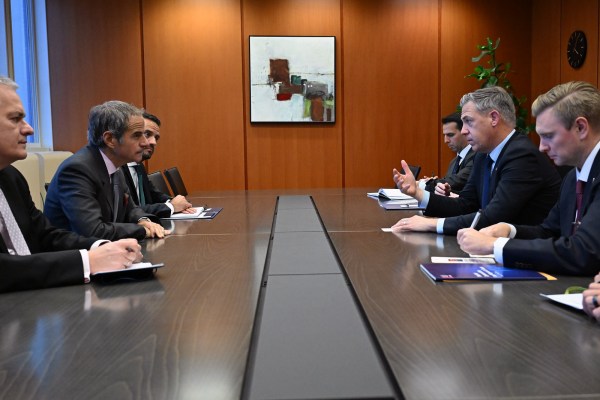
Weekly News Recap (12 – 18 October 2026) © Photo by IAEA Imagebank via Flickr International Justice Section China: Court Sentences Three People to Death for Involvement in Myanmar Scam...Read More
Weekly News Recap (2 - 8 December 2024)
© Photo by UNGA via Flickr
- New Zealand: Supreme Court Upholds Māori Indigenous Marine Rights
- ICJ: Public Advisory Hearings Commence Regarding State Obligations Regarding Climate Change
- Belgium: State Found Guilty of Crimes Against Humanity During Colonial Rule in Congo
- ECtHR: Russia Found Guilty of Anti-LGBT+ Discrimination and Violation of Article 8 Rights
- ICJ: Slovenia Files Declaration of Intervention in the Myanmar Genocide Proceedings
- Finland: Russian Combatant Accused of 2014 War Crimes in Ukraine Stands Trial
- South Africa: Youth Campaigners Win Landmark Climate Case Against New Coal-Fired Power Proposed by Government
- Romania: Constitutional Court Annuls Result of Presidential Election
International Peace & Security Section
Ukraine: US to Send US$725 Million in Additional Military Assistance
Syria: UN Reports Opposition Groups and Terrorist Groups Taking Over Part of the Country
UN: A Two-State Solution is the Only Path to Lasting Peace in the Middle East
UN: Young Women Will Lead The Way to International Peace and Security
Congo: Fighting Resumes Between the Congolese Army and M23 Rebel Group
Egypt: Call To Government To Lift Arbitrary Travel Ban Imposed on Three Human Rights Defenders
Poland: Signs US$4 Billion Loan Agreement with the US for Defence Improvements
Mozambique: At Least 5 People Dead and 3 Seriously Injured in Protests Alleging Election Fraud
- Georgia: Police Arrest 48 Protesters in Crackdown on Pro-EU Demonstrations
International Justice Section
New Zealand: Supreme Court Upholds Māori Indigenous Marine Rights
On 2 December 2024, the New Zealand Supreme Court unanimously upheld an appeal by the Attorney General, which cemented a change in interpretation regarding the legal test under the Marine and Coastal Area (Takutai Moana) Act 2011 (MACA). This ruling makes it easier for Māori people to claim customary rights to the foreshore and seabed. The court’s decision focused on how Section 58 of MACA should be interpreted. It found that the Court of Appeal had taken too narrow an approach in deciding what is needed to grant a customary marine title (CMT) in the common marine and coastal area. The Supreme Court clarified that MACA’s goal is to recognise and balance different interests in these areas and that the previous three-stage test did not fully address the Act’s reconciliation goals due to its narrowness. It emphasised a holistic view informed by Māori customs when determining what it means to “hold” a CMT. This judgment is the first of two related to claims of customary rights over specific coastal and marine areas. It arises from seven appeals recently heard together. The next ruling will tackle remaining issues from these appeals.
ICJ: Public Advisory Hearings Commence Regarding State Obligations Regarding Climate Change
On 2 December 2024, the International Court of Justice (ICJ) commenced two weeks of public hearings on State obligations related to climate change. The hearings follow a request for an advisory opinion made in March 2023 after the UN General Assembly adopted Resolution 77/276. This resolution seeks guidance on States’ duties to protect the climate for current and future generations and the legal implications of actions causing harm to the climate system. A specific focus is on the responsibilities of the international community towards small island developing states that face significant threats from climate change. The request for an advisory opinion was submitted by the government of Vanuatu. An unprecedented amount of global participation followed, with 91 written submissions and participation from 98 States as well as 12 international organisations in the oral proceedings.
Belgium: State Found Guilty of Crimes Against Humanity During Colonial Rule in Congo
On 3 December 2024, the Brussels Court of Appeal found the state guilty of crimes against humanity for the systematic kidnapping of five mixed-race women as children during Belgium’s colonial rule in Congo. These women, now in their 70s, were forcibly removed from their black mothers and white fathers and placed in Catholic orphanages, part of a state-led plan targeting mixed-race children. The court overturned a previous ruling that dismissed the case as time-barred and awarded each woman €50,000 for moral damages, along with over €1 million in legal costs. The court described the abductions as inhumane acts constituting crimes against humanity under international law. This landmark judgment marks the first time Belgium has been condemned for such colonial-era crimes. Lawyer Michèle Hirsch hailed it as a historic victory. In 2019, Belgium formally apologised for the abduction of thousands of “metis” children during its colonial administration of Congo, which lasted from 1908 to 1960. Belgium’s foreign affairs ministry has not commented on the ruling.
ECtHR: Russia Found Guilty of Anti-LGBT+ Discrimination and Violation of Article 8 Rights
On 3 December 2024, the European Court of Human Rights (ECtHR) delivered its judgment on the case of Yevstifeyev and Others v. Russia (Applications Nos. 226/18, 236/18, 2027/18 and 22327/22). The applicants are Russian LGBT+ rights activists and filed the complaint that the Russian government violated Articles 8, 13 and 14 of the European Convention of Human Rights (ECHR) for failures of the Russian authorities to afford redress to the applicants in respect of various homophobic statements. Under Articles 8 and 14 of the Convention, the Court found that the homophobic targeting faced by the activists were to a serious degree and affected the applicants’ psychological well-being and dignity. The Court observed that the Russian authorities’ lack of response to the applicants’ attempts to seek protection from domestic avenues meant that the government failed to uphold its positive obligations under Article 8. As such, Article 13 of the Convention, right to an effective remedy before national authorities, was also violated. The applicants jointly claimed 11,000 euros each for non-pecuniary damage and were awarded an additional 7,500 euros by the Court.
ICJ: Slovenia Files Declaration of Intervention in the Myanmar Genocide Proceedings
On 4 December 2024, it was announced that Slovenia has filed for intervention in the International Court of Justice (ICJ) case accusing Myanmar of genocide against the Rohingya population. This allows Slovenia, as a party to the Genocide Convention, to present its legal interpretation to the court. Although such interventions are not binding, they can influence the court’s deliberations. The ICJ will determine the admissibility of Slovenia’s intervention based on Article 84(1) of the Rules of Court. In its intervention, Slovenia stressed Myanmar’s jurisdiction over the territory where the alleged genocide occurred and urged the court to assess all actions collectively to determine the intent to destroy the Rohingya population under Article II of the Genocide Convention. Slovenia argued against a narrow interpretation of “intent,” which could obscure the true intentions behind actions. It also advocated for defining protected groups using both objective and subjective criteria and stated that immunities, including for heads of state, cannot shield individuals from genocide prosecutions. Myanmar and Gambia, the main parties in the case, will review Slovenia’s declaration and submit observations. The ICJ has previously accepted interventions from seven other countries on this matter. Myanmar faces widespread allegations of atrocities against the Rohingya, including mass displacement and crimes against humanity. In November, the International Criminal Court’s prosecutor sought an arrest warrant for Myanmar’s military chief on related charges.
https://www.icj-cij.org/sites/default/files/case-related/178/178-20241204-pre-01-00-en.pdf
Finland: Russian Combatant Accused of 2014 War Crimes in Ukraine Stands Trial
On 5 December 2024, Yan Petrovsky, a Russian ultranationalist and alleged neo-Nazi paramilitary leader, went on trial in Finland for alleged war crimes committed during Russia’s initial invasion of Ukraine in 2014. Finnish prosecutors are seeking a life sentence, accusing Petrovsky, also known as Voislav Toden, of participating in atrocities as deputy commander of the Rusich group, a paramilitary unit linked to the Wagner Group and sanctioned by the EU and US. Prosecutors allege that Petrovsky and his unit killed 22 Ukrainian soldiers, seriously injured four others, and violated the laws of war, including mistreatment of wounded and deceased enemies. Petrovsky, who denies all charges, was arrested in Finland in July 2023 after entering the country using a new identity, despite being under an EU-wide entry ban. Although Ukraine sought Petrovsky’s extradition for terrorism-related charges, Finland’s Supreme Court blocked it, citing concerns over potential inhumane prison conditions in Ukraine. Finnish authorities have taken up the case, citing an obligation to prosecute. The trial is expected to continue until January 2025.
South Africa: Youth Campaigners Win Landmark Climate Case Against New Coal-Fired Power Proposed by Government
On 6 December 2024, it was reported that South Africa’s High Court declared the government’s plan to add 1,500MW of new coal-fired power unlawful and invalid, citing failure to consider the impact on children’s rights and the environment. The ruling came in the “Cancel Coal” case brought by three youth-focused civil society groups: African Climate Alliance (ACA), Vukani Environmental Justice Movement in Action (VEM), and Groundwork Trust, represented by the Centre for Environmental Rights (CER). The court found that government decisions by the Minister of Mineral Resources and Energy and the National Energy Regulator of South Africa (NERSA) violated constitutional obligations, particularly the right to a healthy environment. Both officials were ordered to cover the legal costs of the case. The decision is seen as a landmark victory for climate advocacy, setting a precedent for future legal challenges against environmentally harmful projects. Campaigners argue that South Africa, the seventh-largest coal producer globally, must move away from coal due to its environmental, health, and economic toll. The judgment underscores the constitutional obligation to prioritise the health and future of citizens, particularly children, in energy policies.
Romania: Constitutional Court Annuls Result of Presidential Election
On 6 December 2024, Romania’s Constitutional Court annulled the first round of its presidential election, citing evidence of foreign interference, and ordered the entire electoral process to restart. The decision delays the second-round vote, initially scheduled for Sunday, and tasks the government with setting a new election date. The annulment followed revelations from declassified intelligence documents that alleged Calin Georgescu, the far-right, NATO-skeptic surprise frontrunner, benefited from a foreign influence campaign, suspected to be Russian. Georgescu had won 23% of the vote, ahead of opposition candidate Elena Lasconi (19%) and the governing party’s Marcel Ciolacu. Allegations also arose that TikTok had given Georgescu preferential treatment, which the platform denied. Outgoing Prime Minister Marcel Ciolacu supported the court’s ruling, calling it necessary to address blatant election interference. However, Lasconi, the runner-up, condemned the decision as undemocratic and disrespectful to the nine million Romanians who voted. Georgescu dismissed the allegations as politically motivated and pledged to run again. Meanwhile, President Klaus Iohannis remains in office until a new president is elected, emphasizing Romania’s stability and commitment to its pro-European, NATO-aligned stance. This unprecedented annulment leaves Romania in uncharted political territory, with no clear timeline for resolving the situation.
International Peace & Security Section
Ukraine: US to Send US$725 Million in Additional Military Assistance
On 2 December 2024, it was reported the US plans to send Ukraine an additional US$725 million in military support. This will include counter-drone systems and munitions for its High Mobility Artillery Rocket System (HIMARS). The package will also include more anti-personnel land mines, which Ukraine is utilising to slow Russian and North Korean forces in Russia’s Kursk region. US President Joe Biden has vowed to spend all of the military funds for Ukraine Congress approved this year before he leaves office on 20 January. There is uncertainty about what the new Trump administration will mean for Ukraine, as he has promised to bring the conflict to an end. Ukrainian President, Volodymyr Zelenskyy, indicated recently that a NATO membership offer for Ukraine-controlled territory could end the “hot stage” of war.
Syria: UN Reports Opposition Groups and Terrorist Groups Taking Over Part of the Country
On 3 December, 2024, Syria’s UN special Envoy, Geir Pedersen, told the UNSC that Syria’s status quo has been radically altered in just a few days, with a significant increase in fighting, resulting in a fluid and dangerous situation and a risk of further division which was not in Syria’s interest. A bigger territory has come under the control of non-state actors, including the terrorist group Hay’at Tahrir al-Sham and armed opposition groups, including the Syrian National Army. These groups now control a territory containing what is estimated to home around 7 million people – including Aleppo. Both sides have escalated attacks, including government airstrikes and civilian infrastructure including hospitals. Resulting in civilian suffering and casualties on both sides.
UN: A Two-State Solution is the Only Path to Lasting Peace in the Middle East
On 3 December 2024, the President of the UN General Assembly (UNGA), Philémon Yang, emphasised that peace and security in the Middle East cannot be achieved through force or occupation but only through dialogue, mutual recognition and a commitment to a just, comprehensive and lasting solution based on international law. Yang added that the two-state solution is the only path to lasting peace and that the initial two-state solution, resolution 181, envisioned 77 years ago is out of reach today. Yang explained how the ongoing denial of Palestine as a state produces violence and despair. Meanwhile, the permanent observer of the State of Palestine, Riyad Mansour, said that Israel’s obvious plan was to destroy and displace the people to annex the land. He urged that the illegal occupation must end, and supremacist ideologies must be defeated because failure to stop a genocide is not an option. Similarly, political coordinator at the permanent mission of Israel to the UN, Reut Shapir Ben Naftaly, explained that Hamas’ murder, rape, and torture of 1,200 people, and the kidnapping of 240 has been insufficiently addressed by the UN. The General Assembly fixates on resolutions which are sponsored by Cuba, the Democratic People’s Republic of Korea, Venezuela and the Syrian regime. She explains that “if these actors were truly interested in bringing solutions to the war-torn region, they would abandon their obsessive efforts to delegitimise Israel and focus on how to bring upon the immediate release of all hostages, how to dismantle Hamas, how to stop looting of aid by Hamas terrorists, and how to stop hatred in the Palestinian education system”. Lastly, the resolution (A/79/L.23) passed with 157 votes in favour and 8 against.
UN: Young Women Will Lead The Way to International Peace and Security
On 3 December, 2024, Under Secretary-General for Political and Peacebuilding Affairs, Rosemary DiCarlo, told the UNSC that, even though peace is in peril worldwide and diplomatic dialogues are shrinking, young women peacebuilders are demonstrating that a better world is possible, and she urges ambassadors to open doors for the next generation. DiCarlo stresses that investments in women, peace and security are not options but necessities for preventing conflict and achieving sustainable and inclusive peace. She further lists Malala Yousafzai, Greta Thunberg and Ilwad Elman as examples of young women who are envisioning and demanding a world of justice and peace, but requires “bucking of the status quo”. It requires reimagining the global power structures, she adds, and placing women and girls at the centre of our efforts to address the root causes of conflict and insecurity. “If we do not break free from patriarchal norms, true peace and inclusive security will remain out of reach”, she warns.
Congo: Fighting Resumes Between the Congolese Army and M23 Rebel Group
On 3 December 2024, it was reported fighting between the Congolese army and the M23 rebel group had resumed in eastern Congo. This marks another violation of a ceasefire which came into effect in August this year. The Congolese army said fighting on Monday had resulted in several members of the M23 group dead and wounded in the North Kivu province. The M23 group is one of many armed groups battling for power in mineral-rich eastern Congo on the Rwandan border. The conflict has created one of the world’s largest humanitarian crises, with more than 7 million people displaced. Congo and the UN have accused Rwanda of backing M23, a claim Rwanda denies, but they admitted to having troops and missile systems in eastern Congo for its security. It is estimated there are about 4,000 Rwandan forces in Congo according to the UN. Last week, Congo and Rwanda’s foreign ministers agreed terms for the disengagement of Rwandan forces in eastern Congo. Mediation talks are set to begin this month. Congo’s President Felix Tshisekedi and Rwanda’s President Paul Kagame are set to meet on 15 December, according to reports by Angola who have acted as mediator in the conflict.
https://apnews.com/article/congo-m23-rwanda-ceasefire-violation-2e5e96e768187b9a65db519ffc546b1c
Egypt: Call To Government To Lift Arbitrary Travel Ban Imposed on Three Human Rights Defenders
On 4 December 2024, a coalition of 34 rights organisations urged the Egyptian government to lift travel bans and asset freezes on three directors of the Egyptian Initiative for Personal Rights (EIPR). These sanctions, imposed on Gasser Abdel Razek, Mohamed Bashir, and Karim Ennarah in December 2020, followed their release from detention on terrorism-related charges linked to their human rights work. Rights groups argue the charges are baseless, and no evidence has been provided by authorities. The sanctions violate Egyptian laws, which require regular judicial reviews of asset freezes and limit travel bans to three years. EIPR claims these provisions have been ignored, highlighting a broader pattern of judicial harassment and suppression of dissent in Egypt. This appeal comes amidst a wider crackdown on activism in Egypt, where protests are met with severe penalties, including arrests under vaguely defined security laws. Amnesty International recently documented the arrests of 119 individuals during anti-government protests over economic hardships. With Egypt’s Universal Periodic Review (UPR) at the UN Human Rights Council scheduled for January 2025, rights groups are calling on member states to pressure Egypt to end these punitive measures against human rights defenders.
https://eipr.org/en/press/2024/12/egypt-lift-punitive-measures-against-eipr-staff
South Korea: President Yoon Facing Impeachment After Attempt to Impose Martial Law Overturned by Parliament
On 5 December 2024, it was reported South Korean President, Yoon Suk Yeol, is facing increased pressure to resign after his shock move to impose martial law in South Korea failed. The move triggered public outrage with some parliament members now looking to impeach President Yoon. Protesters in Seoul have called for Yoon’s resignation, while the police have said he is being investigated for “insurrection.” South Korea was plunged into political chaos on Tuesday when Yoon announced the emergency martial law declaration. He claimed this move was to “safeguard a liberal South Korea from the threats posed by North Korea’s communist forces and to eliminate anti-state elements.” Some Members of Parliament jumped the barricades to get past security forces to enter the National Assembly where they declared the move invalid. Of the 190 members present, 190 voted to lift the martial law. South Korea’s constitution states martial law must be lifted by a majority in parliament. Yoon then announced he would comply with the demand and lift martial law. The Defence Minister, Kim Yong-hyun, resigned on Thursday, taking full responsibility for the martial law declaration. Before this shock move, Yoon faced a low approval rating as well as corruption allegations. The main opposition Democratic Party has a majority in parliament and is able to impede President Yoon’s budget plans. Yoon accused the opposition of cutting “all key budgets essential to the nation’s core functions” and went on to describe the opposition as “anti-state forces intent on overthrowing the regime,” which meant his decision to impose martial law was “inevitable.” Opposition leader Lee Jae-myung, said the enactment of martial law was “illegal and unconstitutional.” A motion to impeach Yoon was brought to parliament on Wednesday.
https://www.bbc.com/news/articles/c74x8xpz3j2o
https://www.dw.com/en/south-korea-ends-martial-law-after-parliamentary-rejection/a-70947817
Poland: Signs US$4 Billion Loan Agreement with the US for Defence Improvements
On 5 December 2024, the Polish Defence Minister, Wladyslaw Kosiniak-Kamysz, said Poland had signed a US$4 billion loan under the US Foreign Military Financing programme that will be used to transform its military force. Kosiniak-Kamysz added it was “proof of enormous trust and strong alliance between Poland and the United States of America.” Altogether, the US has given over US$11 billion to Poland to fund arms programmes. Following the Russian invasion of Ukraine, Poland became NATO’s top spender for defence in relation to its gross domestic product (GDP). Poland said it will spend 4.1% of GDP on defence in 2024 and plans to increase this to 4.7% in 2025.
Mozambique: At Least 5 People Dead and 3 Seriously Injured in Protests Alleging Election Fraud
On 6 December 2024, it was reported that protests across Mozambique, sparked by allegations of election fraud, have left at least five people dead and three seriously injured. The unrest, reportedly incited by defeated presidential candidate Venancio Mondlane, occurred in cities such as Maputo, Nampula, and Zambezia. Mondlane, who claims the 9 October 2024 election results were fraudulent, called for a week-long nationwide protest from 4 – 11 December 2024, urging disruptions to roads, railways, ports, and airports. Clashes erupted between police and protesters, some of whom were armed with stones, knives, and machetes. In Matola, tensions escalated after a plainclothes police officer fatally shot a 13-year-old boy, prompting residents to block access to a key industrial park, temporarily disrupting operations at Mozal, a major aluminum exporter. Outgoing President Filipe Nyusi cautioned that the unrest could impact public sector salaries, particularly for teachers and nurses, due to Mozambique’s lack of external financial support. The protests reflect heightened tensions over alleged electoral irregularities and growing dissatisfaction with the government.
https://www.africanews.com/2024/12/06/mozambique-protests-five-dead-unrest-disrupts-key-operations/
Georgia: Police Arrest 48 Protesters in Crackdown on Pro-EU Demonstrations
On 7 December 2024, it was reported that Georgian police arrested 48 protesters during a crackdown on pro-EU demonstrations in Tbilisi, marking the ninth consecutive day of unrest. The protests were sparked by the Georgian Dream government’s decision to suspend talks on joining the European Union. Security forces used tear gas and water cannons to disperse thousands of demonstrators, leading to clashes that included the arrest of opposition leaders and accusations of police misconduct. The government’s heavy-handed response has drawn widespread criticism domestically and internationally, with accusations of authoritarianism and a shift toward Russia. Rights groups and the ombudsman have condemned police actions, citing instances of “torture” and visible injuries among detainees. Protesters demand new elections and a return to the EU path, as joining the bloc is supported by around 80% of Georgians. However, the government has refused to back down, with Prime Minister Irakli Kobakhidze defending the crackdown and denouncing protesters in rhetoric reminiscent of Russian political discourse. The crisis has also seen resignations from diplomats and officials in protest against the government’s stance. Demonstrations have spread to other cities, with protesters vowing to continue their efforts despite the government’s resistance. Critics argue that Georgian Dream’s policies undermine democratic values and EU aspirations.
Weekly News Recap (5 – 11 October 2026) © Photo by IRIN Photos via Flickr International Justice Section ICC: Pre-Trial Chamber Unseals Arrest Warrants for Four Taliban Members Over Gender-Based...Read More
Weekly News Recap (28 September – 4 October 2026) © Photo by Julien Harneis via Flickr International Justice Section Türkiye: Court Convicts Comedian of Insulting President Erdogan Italy: Court Sentences...Read More

Weekly News Recap (21 – 27 September 2026) © Photo by United Nations Photo via Flickr International Justice Section ICJ: Colombia Withdraws Intervention in South Africa v. Israel Genocide Case...Read More