Since the 2010s, Indonesia’s digital public sphere has shifted from a space of democratic expression to one increasingly influenced by government-sponsored buzzers to suppress criticism.
During the 2025 free school lunch programme backlash, buzzers reframed legitimate criticism as public ingratitude, targeting critics with reframing narratives and harassment.
In the #SaveRajaAmpat protests, buzzers redirected environmental concerns by accusing conservationists of foreign interference, reframing the discourse around nationalism and economic progress while undermining civic accountability.
Contextual Background
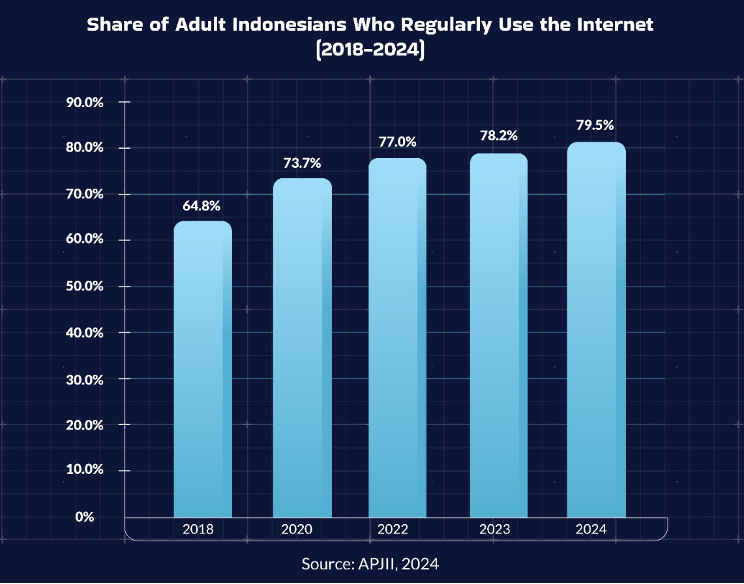
Since Indonesia’s democratic transition in 1998, the digital space has become a vital arena for political expression and public discourse. Under the previous New Order regime (1966–1998), the state tightly controlled information and suppressed alternative viewpoints.[1] This changed with the fall of the regime and the adoption of Law No. 9 of 1998[2], which guaranteed freedom of speech. Concurrently, Indonesia’s post-authoritarian period saw the rise of independent media, more open political discussions, and increased civic participation.[3] The early 2010s marked a shift in civic participation, with Indonesians increasingly turning to social media platforms like Facebook and Twitter (now X) to express public opinions towards government policies.[4] This shift coincided with a surge in the nation’s internet access. Between 2018 and 2024, there was an increase of nearly 25% of Indonesians who regularly use the internet[5], with most using it for news and social media.[6] As a digital space, social media has become an important form of public sphere in Indonesia.
Percentage of Indonesians using the internet (APJII, 2024)
Public sphere is a concept coined by German philosopher and social theorist Jürgen Habermas, which can be defined as: “a domain of social life where individuals come together to discuss matters of public interest through rational-critical debate.”[7]In a functioning democracy, the public sphere is a space where diverse voices can engage openly, and where policy can be influenced by informed public opinion. However, Habermas also warns of the risks posed by propaganda and manipulation. It happens when public discourse is hijacked by actors who prioritise influence over quality of information. In this particular Indonesian context, the emergence of government-sponsored online actors known as “buzzers” represents such a phenomenon. By altering the narratives of digital public spaces, buzzers challenge the integrity of the public sphere using disinformation. Moreover, the usage of buzzers in Indonesia has occasionally led to violent episodes. Hence, this article aims to examine how buzzers impact the quality of Indonesia’s online public sphere.
Buzzers, who are paid or coordinated individuals used to influence online opinion, have evolved into central actors in shaping Indonesian political narratives. The word itself derives from the English word “buzz”, to describe how actors buzz rumours to gain attention.[8] The term gained popularity during the 2012 Jakarta gubernatorial election and later evolved into a more formalised apparatus under Joko Widodo’s presidency (2014–2024). No longer just grassroots actors, buzzers now operate with state or elite backing to defend or promote government narratives.[9] As to Abdul Rohim Ghazali of the Muhammadiyah Public Policy Institute, “many buzzers now offer professional services to political elites” (Tempo, 2021).[10]
Buzzers have become key players in Indonesia’s increasingly violent digital political landscape. Ranging from everyday users managing multiple accounts to celebrities, they employ tactics like hashtag spamming, mass retweeting, and deflecting topics to manipulate online conversations. According to Ismail Fahmi of Drone Emprit, these buzzers use computational propaganda to influence trending topics, especially during elections or debates about government policies.[11] Those who see buzzers as beneficial argue that they function to maintain political stability by minimising anti-government disruptions.[12] However, their tactics often undermine rational public discourse. Rather than encouraging policy debates, buzzer-driven conversations frequently evolve in personal attacks, disinformation, and identity-based provocations. Research by Putri (2024) shows that buzzers can escalate both vertical and horizontal tensions, leading to doxxing, harassment, and even real-life threats. What was once a space for democratic dialogue is now increasingly shaped by coordinated disinformation, distorting Indonesia’s digital public sphere. Using examples of two case studies in 2025, this article explains how buzzers use such strategies to distort digital public space, eventually increasing violence in the digital media.
Free School Lunch Programme
In 2025, the Indonesian government launched a nationwide free school lunch programme which drew criticism from parts of society. Critiques focused on the programme’s lack of planning from the start to the implementation phase. Poor budget planning led to the programme’s Rp71 trillion (US$4.35 billion) cost, causing unpopular cuts to health and education[13], while its implementation was marred by food poisoning and poor-quality meals.[14] In fact, Tempo (2025) reported 1,205 food poisoning cases as of 23 May 2025.[15] The Centre for Indonesia’s Strategic Development Initiatives also criticised the over-reliance on ultra-processed foods.[16]
Public frustration quickly spread onto social media, with students, parents, teachers, even headmasters posting complaints directed at the school lunch programme’s quality. TikTok users uploaded videos of spoiled or inedible food allegedly distributed at schools.[17] On X (formerly Twitter), users shared testimonies of food poisoning, while tagging government officials in calls for policy improvements.[18] These platforms became key arenas for bottom-up accountability, reflecting dissatisfaction and amplifying grassroot concerns about food safety and budget priorities.
Healthy School Lunch Competition in Yogyakarta Province, Indonesia (Flickr, 2009)
Buzzers countered the criticism by framing concerned citizens as ungrateful middle-class individuals unaccustomed to receiving government aid. Their disinformation efforts sidetracked valid feedback instead of addressing it.[19] As an example, the narratives surrounding food poisoning cases were deflected by using stories of students from remote areas being thankful for the free meals. In some cases, this pushback also included digital violence such as the doxxing of students and their families who had publicly criticised the programme for being ungrateful.[20] Online intimidation became one of the tactics to counter the critiques. Furthermore, some internet users who criticised the programme even closed their accounts and were forced to publicly apologise in real-life.[21]
Pro-government buzzer hashtags supporting the free school lunch programme as of 29 June 2025 (X, 2025)
Such targeted attacks effectively shifted the online discourse on the free school lunch programme. The conversation became mired in personal attacks and accusations of ingratitude, instead of focusing on improving food safety and ensuring the programme’s accountability. Based on the definitions of a public sphere, the digital space could have served to improve the free school lunch programme from the bottom up through rational critical debate. However, the distortion of discourse through coordinated digital backlash has undermined meaningful democratic dialogue.
Mining Concessions in Raja Ampat Archipelago
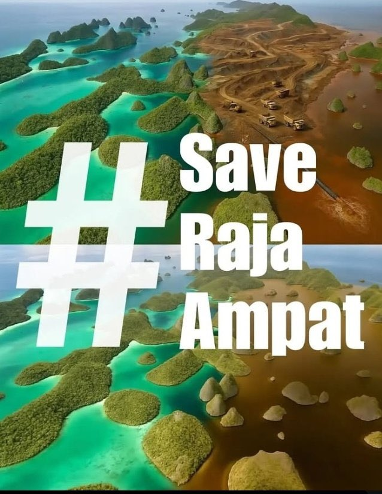
A recent public outrage surrounded the Raja Ampat archipelago being used to mine nickel. Raja Ampat is a Marine Protected Area, with a high biodiversity index reflecting 75% of the world’s known reef species.[22] Public outrage erupted when the Ministry of Mining granted four nickel mining concessions within this nationally protected zone, ignoring its protected status.[23] The move triggered widespread online protests using the hashtag #SaveRajaAmpat, calling for ecosystem protection and government accountability.[24] Others protested and raised concerns about how the government reportedly quietly granted mining concessions, without conducting the necessary parliamentary hearings or studies, despite the area being a nationally designated protected zone.
A popular AI-generated image for the #SaveRajaAmpat campaign (X, 2025)
However, buzzers swayed the narratives from people asking for government accountability to irrelevant matters. From 6 to 9 June 2025, a shift in online discourse was observed with the rise of the hashtag #TegasTanganiRajaAmpat (Effectively Handling Raja Ampat). The narrative framed the government as effectively addressing the issue, although it was the government itself that had approved the controversial mining concessions in the first place. Analysis by PARES (2025) indicated that nearly 46.9% of posts carried a neutral or positive tone, suggesting a partial shift away from critique.[25] In more aggressive online narratives, pro-government buzzers portrayed conservation activism as a form of foreign meddling in national affairs. The buzzers framed opposition to the mining policy as an effort to destabilise Indonesia’s economic agenda.[26] The term ‘Antek Asing’ (foreign adversaries) was frequently employed to discredit environmental defenders as those trying to fail Indonesia’s economic achievements.[27] Google Trends showed a spike in searches for ‘Antek Asing’ during the Raja Ampat mining controversy, which declined after the government revoked the concession on 11 June 2025.
Search popularity for ‘Antek Asing’ in June 2025 (Google Trend, 2025)
This framing shifted the civil online discourse into intimidation. Non-Governmental Organisations (NGOs) supporting environmental protection faced increased online hostility, including a reported case of hacking.[28] Social media, ideally a public sphere for rational discussions and debate for better government accountability, has instead been used to discredit conservation efforts. Despite these digital efforts to delegitimise opposition, mounting pressure eventually led the government to publicly disclose the locations of the mining concessions.[29] Still, this partial victory came only after intense contestation both online and offline.
Conclusion
Since the 2010s, the internet has become a key public sphere in Indonesia. While Habermas views the public sphere as a space for open, informed debate, digital spaces are increasingly influenced by online actors such as buzzers. This was evident in the backlash over the free school lunch programme, where concerns about planning and food safety were reframed as ingratitude, with some critics even doxxed. A similar pattern emerged with #SaveRajaAmpat, where calls for accountability were dismissed as foreign interference. Rather than fostering civic engagement, social media is increasingly weaponised by buzzers to suppress dissent and discredit advocacy.
Policy Recommendations
The Government of Indonesia and independent stakeholders should establish multi-sectoral forums to monitor online harassment and uphold ethical standards in digital engagement. The Ministry of Communication and Digital Affairs launched Sistem SAMAN (National Digital Content Complaint and Moderation System) in January 2025 to moderate digital content.[30] However, Sistem SAMAN remains poorly integrated with grassroots initiatives and has yet to address buzzer-driven online harassment effectively. These forums should include civil society, academia, and tech platforms, and ensure that state-backed digital campaigns do not involve intimidation or digital violence.
The Indonesian Government should strengthen and standardise safe, anonymous channels for citizens to report concerns and provide feedback on public programmes. As of this article, the Indonesian Government has an existing system called LAPOR! (Public Online Complaints and Aspirations Service). While the LAPOR! system enables anonymous complaints and is integrated with 34 ministries and all local governments, its effectiveness remains uneven across regions.[31] These channels must be made more transparent, responsive to public feedback, and capable of providing effective solutions, in order to reduce the risk of public frustration escalating into uncontrolled discourse on social media.
References
[1] In this era, the military dictatorship controlled and monitored television, radio, and newspapers. Political dissent was often suppressed through the military and the police.
[2] This law is still in place at the time this blogpost is written in June 2025.
[3] Public spheres, as discussions, were significantly restricted during the New Order Era. Hence, several researchers would argue that there were no functioning public spheres during this period.
[4] Ribut Priadi and Muhammad Thariq, ‘Reconstruction of Communicative Rationality: A Study on the Digital Mass Media Society in Indonesia’ (2023) 11(4) Journal of Law and Sustainable Development https://ojs.journalsdg.org/jlss/article/view/579 accessed 27 June 2025.
[5] In 2024, APJII reported that 80% of Indonesians used the internet on a regular basis.
[11] While defending the government policies are not tied to a schedule event like elections, the buzzers similarly employ coordinated response just like any other regular political events.
[12] Boy Anugerah, ‘Urgensi Pengelolaan Pendengung (Buzzer) Melalui Kebijakan Publik Guna Mendukung Stabilitas Politik di Indonesia’ (2022) 8(3) Jurnal Lemhannas RI 155 https://doi.org/10.55960/jlri.v8i3.340
[18] BBC, ‘Guru dan Murid SDN 4 Wonorejo Jateng “Keracunan” Sajian Makan Bergizi Gratis – Tambahan Kasus Baru di Tengah Isu Transparansi MBG dan Masalah-Masalah Lainnya’ (2025) https://www.bbc.com/indonesia/articles/cvgp082krldo accessed 24 June 2025 at 10:14
In his speech to the UN General Assembly in September, Uzbek President Shavkat Mirziyoyev announced that the process of forming a ‘New Central Asia’ has begun. Certainly in 2026, Central Asia is expected to become an increasingly cohesive and strategic geopolitical community.
From 7-9 July 2025, a Special Session of the Assembly of State Parties to the Rome Statute convened to undertake a mandated review of the Kampala amendments on the crime of aggression. This ASP presented a rare opportunity to finally harmonize the ICC’s jurisdiction over all four core crimes.