
Background
Lebanon has been experiencing one of the most severe global crises since 1850, according to the World Bank.[1] The economic crisis, which began in 2019, was driven by corruption, a sect-based political system, and financial mismanagement, resulting in many skilled young professionals leaving the country in search of better opportunities abroad.[2] Regional developments such as Israel’s expansionist policies in southern Lebanon and the Gaza conflict have further strained the country’s stability. Despite a ceasefire signed in November 2024, Israel has continued almost daily air and drone strikes on Lebanon, causing civilian casualties, widespread destruction of infrastructure, housing, and farmland, as well as rendering schools, health centers, and religious sites inaccessible.[3] While Israel claims it is targeting Hezbollah infrastructure, Lebanese officials report that many of the attacks have instead struck civilian facilities.[4]
As of 2025, the World Bank estimates Lebanon’s reconstruction cost at $11 billion, reflecting losses and needs between October 8, 2023, and December 20, 2024.[5] Due to the lack of funds, the country relies heavily on external donors, with the International Monetary Fund (IMF) expected to play a key role in providing financial support. However, access to these funds is conditional and depends on meeting specific criteria.[6] Fixing the currency, reducing public debt, and reforming the central bank are just a few examples of the required preconditions to receive financial assistance from the IMF.[7] However, because the Lebanese governments have failed to implement these reforms so far, negotiations with the IMF have stalled.[8] This has, in turn, delayed financial assistance and prolonged the country’s economic stagnation. With the new government led by Prime Minister Nawaf Salam under President Joseph Aoun, there are hopes for progress, but it remains uncertain whether meaningful reforms will be successfully implemented or if past failures will persist.
The Economic Crisis
Since its independence in 1943, Lebanon has followed an economic model that privileged banking, commerce, construction, and other service sectors over agriculture and industry, and sustained its economy through tourism revenues, foreign aid, and financial support from Gulf Arab countries.[9] The government depends mainly on foreign remittances coming from Lebanese living abroad to finance public spending and sustain economic growth.[10] This has created a rentier system, where the country’s income relies more on external inflows than on productive domestic industries.[11] This system discourages economic diversification and has made Lebanon vulnerable to external shocks. When remittances started slowing in 2011, coupled with the shifting geopolitical alliances, such as the decline of Gulf Arab financial support in reaction to Hezbollah’s rise, it pushed the already fragile system closer to crisis.[12]
Lebanon’s economic situation worsened over the next several years due to overspending, poor tax collection, corruption in public works, and a lack of transparency in the banking sector.[13] As these problems piled up, a severe financial collapse became inevitable. By 2019, banks became insolvent, and the liquidity crisis led banks to freeze depositors’ dollar accounts, wiping out personal savings and destroying public trust.[14] The crisis sparked widespread protests triggered by the government’s announcement of austerity measures, including a tax on WhatsApp calls, reflecting public frustration with the deteriorating economic situation.[15] By early 2020, Lebanon had defaulted on its foreign debt for the first time in history.[16]
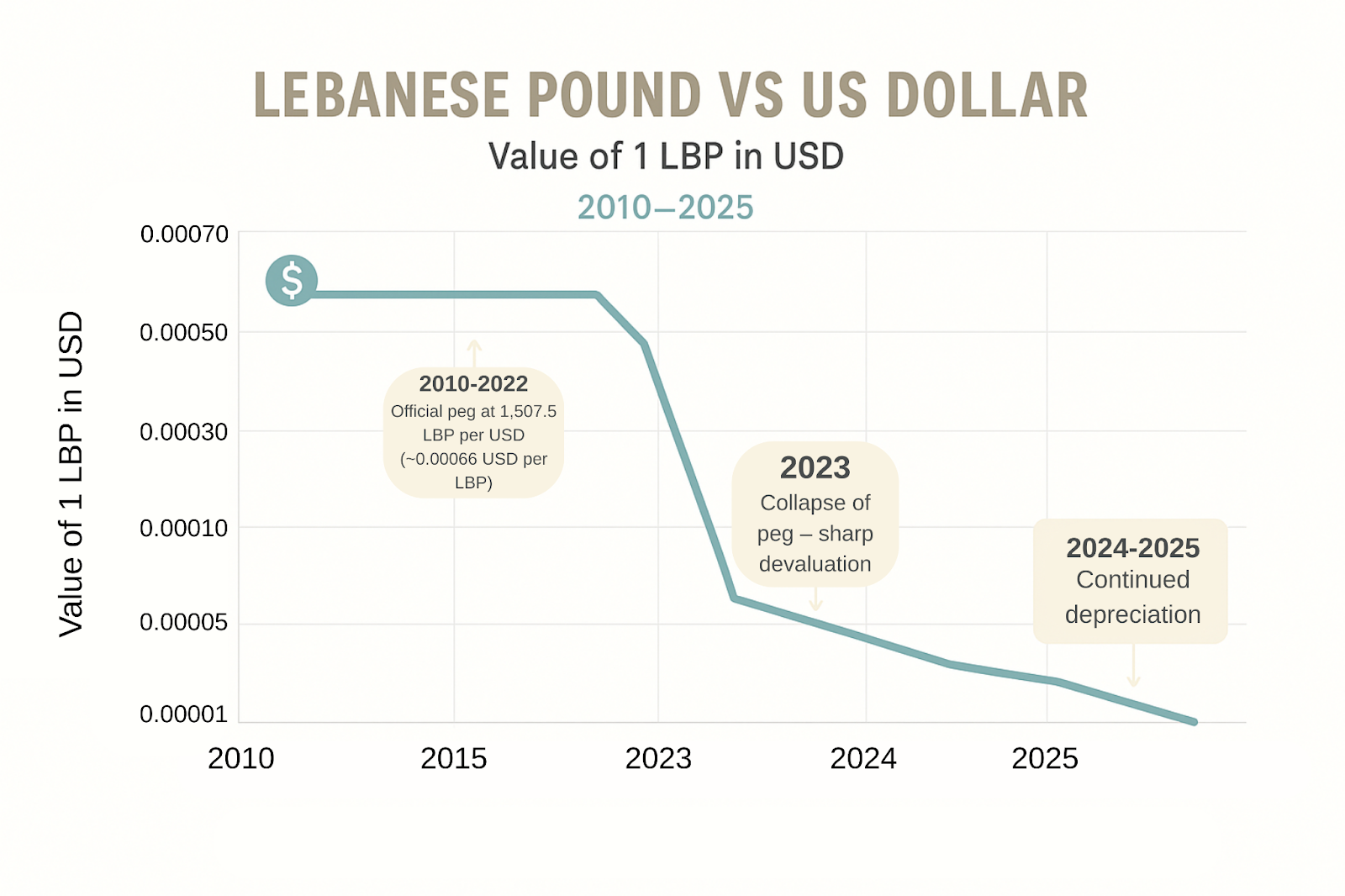
In 2023, Lebanon faced one of the world’s highest inflation rates at triple digits, with the Lebanese pound losing about 98% of its value since the crisis began, and the majority of the population now lives in poverty, surviving on about USD 3 per day.[17] Food prices surged by 1,000% between late 2019 and early 2022.[18] The already fragile electricity sector further deteriorated, severely impacting daily life and businesses. Electricité du Liban (EDL) could provide only 1–3 hours of power per day, together with constant power cuts, and therefore people rely on expensive and highly polluting private generators to provide their energy needs.[19] The Lebanese Central Bank (BDL) has introduced multiple exchange rates for different transactions to manage the currency crisis, but doing so has only undermined confidence in the market.[20] To counter this, BDL printed more Lebanese pounds, which fuelled hyperinflation and further devalued the currency. As a result, black market currency exchanges have become the only practical way for most Lebanese to convert their devaluing pounds into scarce US dollars.[21] The ongoing crisis has intensified calls for economic reforms.
IMF and Financial Assistance
Since the 1970s, the IMF has played a key role in supporting countries facing economic crises by providing financial assistance aimed at stabilizing economies and restoring growth.[23] It offers help through policy guidance, funding, and capacity development.[24] However, this support often comes with conditions, requiring countries to implement economic reforms such as fiscal austerity, monetary tightening, and structural adjustments.[25] Conditions are enforced through tools like prior actions, quantitative performance criteria, indicative targets, and structural benchmarks, all of which are monitored through regular IMF reviews.[26]
IMF programs come with both advantages and disadvantages. On the positive side, the key benefit lies in the credibility it lends to government actions and reforms, boosting confidence among investors and the international community. On the negative side, such programs may result in austerity, dependency, and potential investor uncertainty.[27] During the Eurozone crisis, for instance, Greece received IMF bailouts, and in return, the Greek government implemented austerity measures, including cuts in pensions, salaries, and social benefits, together with tax increases.[28] Those measures improved fiscal discipline in Greece, but challenges such as high unemployment, low productivity, and low wages persist.[29]
In the case of Lebanon, then-Prime Minister Hassan Diab formally requested IMF assistance in 2021, following the default on its foreign debt.[30] Following the negotiations, Lebanon and the IMF reached a preliminary deal in 2022, requiring the cabinet to approve fiscal and banking strategies, parliament to pass key financial laws, and the central bank to unify exchange rates and undergo audits.[31] A key obstacle to fulfilling these conditions has been Lebanon’s opaque financial infrastructure. Lebanon also has one of the strictest bank secrecy laws in the world, and the Central Bank’s records are widely regarded as lacking transparency.[32] To address the issue, the Lebanese government introduced several measures, including a new banking secrecy law, but the IMF has emphasized that these measures are insufficient to address the ongoing economic, financial, and social challenges.[33] The persistence of these issues highlights a system dominated by corruption and elite interests.
Corruption and Elite Interests
Lebanon’s IMF talks, which officially began in 2022, have stalled with little progress made so far by the government, largely because Lebanese elites have shown strong resistance to economic reform, often spreading anti-IMF narratives and misinformation in public discourse.[34] Opponents of reform have pushed false claims to create confusion and fear, like the idea that the government’s recovery plan would wipe out ordinary people’s savings.[35] The banks, closely tied to powerful politicians and key media outlets, are likely to suffer from IMF-backed reforms, such as lifting banking secrecy, which risks exposing widespread corruption. That is why, instead of pursuing genuine reform, Lebanese governments have followed what some call a “shadow plan,” where laws are passed but not enforced.[36] The Competition Law and the Public Procurement Law stand as two important examples of this situation, which were enacted in 2021, yet still face barriers in their implementation due to the lack of political will among elites.[37]
Riad Salameh, who was Governor of the BDL from 1993 to 2023, is a clear example of how elite interests fuel corruption in Lebanon’s case. During his tenure, he reportedly removed 14 pages from a 2017 IMF report under the pretext of protecting financial stability, potentially concealing warnings that could have mitigated the country’s crisis.[38] He has been widely accused of contributing to Lebanon’s economic collapse.[39] He also faces criminal charges for money laundering and embezzlement in European courts, with French and German authorities issuing arrest warrants.[40] He was arrested in September 2024 over alleged financial crimes linked to a Lebanese brokerage firm.[41] Investigations claim he hired that company to manipulate financial statements and conceal massive losses from the public eye.[42]
However, in early 2025, Lebanon elected Joseph Aoun as president and Nawaf Salam as prime minister, ending a nearly three-year political deadlock.[43] Aoun, seen as independent from Hezbollah and respected for his leadership of the army, marked a shift away from Iranian influence.[44] Salam, a former president of the International Court of Justice, formed a technocratic cabinet and pledged to pursue judicial and economic reforms.[45] While their appointments offered hope for change, expectations dimmed with the nomination of Karim Soueid as the central bank governor in March 2025.[46] Backed by the banking elite, Soueid is viewed as a defender of the status quo, with plans that prioritize saving private banks over real reform.[47] Moreover, these developments are affected by Hezbollah’s influence and broader regional dynamics, which continue to shape Lebanon’s fragile political and economic landscape.

Hezbollah and Regional Developments
By early 2025, Hezbollah’s power in Lebanon had been weakened significantly. Israeli strikes destroyed much of its leadership and weapons, while the fall of the Assad regime in Syria cut its main supply route from Iran.[49] With its control over key smuggling routes and infrastructure fading, Hezbollah is no longer the dominant force it once was. This shift made way for the election of Joseph Aoun as president, who declared that only the Lebanese army should bear arms, emphasizing state control over war decisions as a direct message to Hezbollah.[50] Though still influential, Hezbollah faces a stronger state and changing regional dynamics.
President Joseph Aoun made a visit to Saudi Arabia in March, signalling a renewed effort to rebuild ties with Gulf states.[51] Historically, Lebanon and GCC countries shared strong economic and social links, with Lebanese professionals contributing to Gulf development and sending back remittances.[52] However, relations deteriorated due to Hezbollah’s growing influence and its criticism of Gulf policies, leading many GCC states to cut support.[53] Now, with new leadership in Beirut, a weakened Hezbollah, and shifting regional dynamics, the Gulf states are cautiously re-engaging, though they expect genuine reforms and Hezbollah’s disarmament before offering major financial aid.[54]
On the other hand, Israel had escalated its military campaign in southern Lebanon, citing the need to prevent Hezbollah from regrouping.[55] Israeli airstrikes have killed hundreds of fighters and civilians alike since the beginning of the war in October 2023.[56] Despite a ceasefire brokered in November 2024, Israel has admitted to over 500 strikes on Lebanese territory, while also conducting ground incursions to destroy Hezbollah infrastructure.[57] The Lebanese army has largely remained on the sidelines, and Hezbollah, though weakened, vows not to disarm as long as Israeli attacks continue.[58] The situation remains volatile, with Lebanon caught between renewed conflict and reconstruction.
Reconstruction
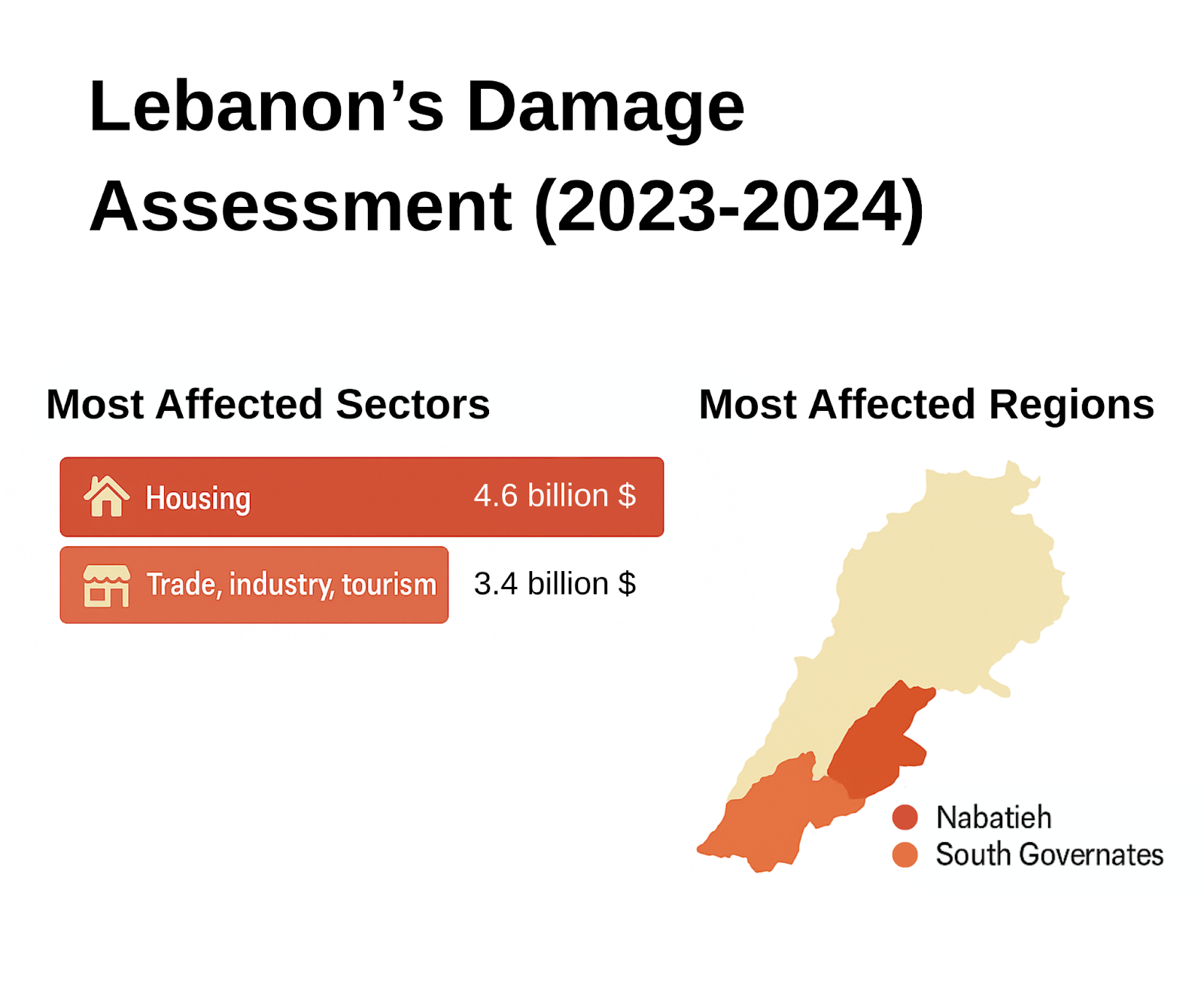
After more than five years of economic crisis and months of war with Israel, Lebanon faces its biggest infrastructure challenge, needing an estimated $11 billion to rebuild.[59] The conflict has caused an estimated US$14 billion in damage to Lebanon, including around US$6.8 billion in damage to physical infrastructure and approximately US$7.2 billion in losses stemming from reduced productivity, missed revenues, and higher operating expenses.[60] Around 10 percent of Lebanon’s homes (about 163,000 units) were damaged or destroyed by the Israeli strikes between October 2023 and December 2024, making it the hardest-hit sector, suffering $4.6 billion in damages.[61] The commerce, industry, and tourism sectors were also heavily affected, with losses estimated at $3.4 billion across the country.[62] Essential services like water, energy, transport, health, education, and municipal systems are expected to receive urgent support for quick repair and recovery.[63]
However, aid has been slow to arrive. Donor attention is now split between Lebanon, Syria, and Gaza, and key countries like the U.S. are making Hezbollah’s disarmament a condition for support.[65] Adding to the delays is the widespread mistrust in Lebanon’s political elite, who are known for funneling reconstruction funds to politically connected firms.[66] Donor states are urging Lebanon to implement reforms tackling the root causes, such as corruption before they provide aid.[67] From Israel’s perspective, reconstruction is a national security concern, as there is significant fear that without proper oversight, Hezbollah could use reconstruction funds to rebuild military infrastructure.[68] All these reasons combined, the reconstruction in southern Lebanon remains stalled to date, leaving communities dependent on urgent assistance in a prolonged state of uncertainty.
Conclusion
Israel’s incursions in the south, combined with Lebanon’s ongoing economic crisis, have created an urgent need for reconstruction. The country requires external funding, with the IMF being one possible source, but negotiations have so far stalled. However, with or without IMF assistance, Lebanon’s government must take decisive steps to prevent corruption. While an IMF agreement could trigger additional support from financial institutions and the EU, this alone will not address Lebanon’s fundamental need for deep economic, social, and constitutional reform, nor ensure the emergence of a viable economy and long-term stability. Structural changes remain essential for recovery, requiring strict reallocation of resources and a shift away from an import-based economic model. Success will ultimately depend on how committed political elites and the banking sector are to taking responsibility for the financial crisis. Only through genuine reforms, accountability, and good governance can Lebanon achieve sustainable reconstruction and long-term stability.