Israel’s global defence partnerships have created strategic dependencies that limit the accountability of Tel Aviv for mass human rights violations.
The growing influence of arms diplomacy underscores the urgent need for stronger international mechanisms to separate defence interests from human rights obligations.
Public mobilisation and civic protest have emerged as essential forces in pressuring states, such as Germany, towards taking more principled positions on the Gaza conflict.
Background
The war in Gaza has intensified the international scrutiny of Israel’s military conduct, prompting calls for sanctions, arms embargoes, and legal accountability. Yet, despite mounting pressure from human rights organisations, United Nations bodies, and segments of the public, Israel has not faced the same comprehensive sanctions imposed on other states such as Russia or Iran.[1] A central reason lies in Israel’s thriving defence industry and the geopolitical interdependencies it has created. Israel is not only a battlefield innovator, but also one of the world’s leading arms exporters, selling cutting-edge systems ranging from missile defence to drones, radars, and cyber capabilities.[2] These exports generate billions in revenue annually—reaching a record US $15 billion in 2024 —and, more importantly, bind Israel to key partners in ways that complicate punitive action.[3]
The argument that “weapons commerce insulates Israel from sanctions” is not merely theoretical. Defence ties often spill over into the diplomatic arena, shaping how governments vote, speak, or act on issues relating to Gaza. Countries that rely on Israeli systems for national security hesitate to jeopardise those relationships, whilst Israel leverages these links to secure strategic goodwill. This phenomenon, sometimes described as “arms diplomacy”, raises urgent questions about the role of commerce in shaping global responses to war and humanitarian crises including the one currently taking place in Gaza.[4]
This article looks at three case studies: the European Union (with Germany in focus), the United States, and India. Each one shows a clear example in which Israeli arms trading shapes international responses to the Gaza war—through economic ties, strategic alliances, or emerging-market partnerships.
EU and Israel Weapons Trade
Such dynamics are particularly true for the European Union (EU). Indeed, according to Israeli ministry officials, Europe has emerged as Israel’s largest arms market in recent years, accounting for more than half of all Israeli defence exports in 2024.[5] First, NATO members have agreed to US President Donald Trump’s call to raise annual defence spending from the long-standing two percent to five percent of GDP by 2035. Second, this commitment has been reinforced by the perception of Russia as a mounting threat to European security following Moscow’s ongoing war in Ukraine.[6] Alongside these drivers, the EU itself has channelled significant research and innovation funding into Israeli start-ups, many of which are active in the defence and security sector, further strengthening the ecosystem behind these exports.[7] Against this backdrop, several EU countries have turned to Israeli technologies:
Hungary purchased Rafael’s SPIKE LR2 long-range anti-tank guided missiles to equip its new Lynx KF41 infantry fighting vehicles.
Estonia ordered SPIKE SR missiles to bolster its capacity against armoured targets.
Germany, acquired the TROPHY Active Protection System for its Leopard 2 tanks in 2021, selecting what is widely seen as the most advanced combat-tested protection system available.[8]
In particular, Germany’s role extends far beyond being an importer of Israeli weapons. In recent years, Berlin has also become one of Israel’s key arms suppliers, approving over 550 millions of dollars in weapons systems exports since October 2023.[9] Despite mounting evidence of civilian harm in Gaza and growing pressure from activists and some member states, the European Union’s response to Israel through summer 2025 remained cautious and muted.[10] One key reason is that Israel’s arms exports to Europe have become a form of diplomatic insurance: by supplying weapons that European states consider essential to their own defence, Israel gains strategic leverage and weakens calls for sanctions.[11] This was further confirmed by the words of an Israeli diplomat, who stated that:
“These deals tie countries into a long-term relationship with Israel which helps curb moves towards sanctions against Israel. These countries are invested in Israel for their national security”.[12]Hundreds of activists take part in a protest against delivering weapons to Israel near Armin Papperger, the chief of Rheinmetall, and demand to stop weapon delivery in Duesseldorf, Germany, on August 28, 2025. (Photo by Ying Tang/NurPhoto)NO USE FRANCE
Such political ties of EU buyers of Israeli military technology, including Germany and Hungary, were reflected in Berlin and Budapest’ support of Israel’s right to defend itself.[13]
Nevertheless, Germany’s long-standing support for Israel has recently changed. In August, Chancellor Friedrich Merz’s government announced the suspension of all new arms deliveries to Israel, citing both the International Court of Justice proceedings and mounting evidence of war crimes in Gaza.[14] Despite the fact that EU partners’ proposal to review the EU–Israel Association Agreement has been long overdue and largely symbolic, it nonetheless signalled a turning point.[15]
US and Israel Weapons Trade
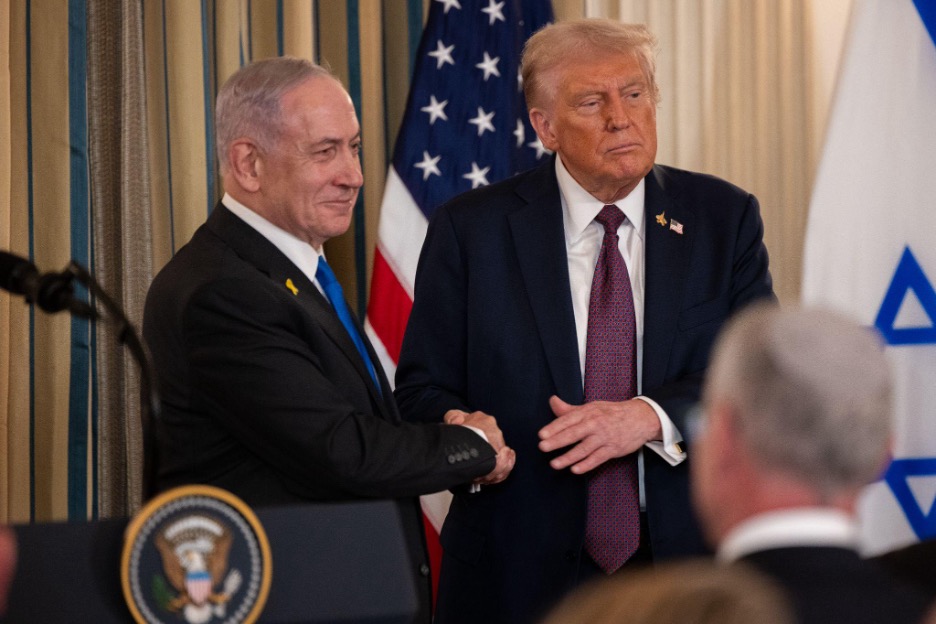
The United States (US) remains Israel’s single most important security partner, and that partnership has become a cornerstone of the immunity Israel enjoys from sustained diplomatic pressure over Gaza. Specifically, the US has benefited from several innovative military technologies from Israel like the Trophy Active Protection System (APS), which ensures a multi-layered protection from anti-tank guided missiles by detecting, tracking and intercepting threats before reaching the vehicle.[16] In 2020, APS had been enforced in Europe and represented a valid defence system against the possibility of the Russian anti-tank RPG-30 system which is currently being used in Ukraine.[17] Similarly, Washington provides Israel with a complex mix of annual foreign military financing, direct weapons sales, and expedited approvals for munitions and sensitive systems. The 2016 Memorandum of Understanding guarantees roughly $3.8–$3.9 billion a year in assistance (totalled as $38 billion across 2018–28), funding everything from missile-defence programmes to munitions purchases; beyond the MOU, ad-hoc emergency releases and sale approvals have flowed during wartime, most visibly in 2024–25.[18] Despite rising public and intra-party unease about civilian casualties in Gaza, Congress and successive administrations have repeatedly approved large packages and licences for Israel. This was the case of the resolution offered by Bernie Sanders to block a $8.8 million weapons sale to Israel, as well as the decision of Trump administration to approve military sales to Israel for $7.4 billion.[19]WASHINGTON, DC – SEPTEMBER 29: President Donald Trump shakes hands with Israeli Prime Minister Benjamin Netanyahu in the State Dining Room of the White House following a press conference in Washington, DC on September 29, 2025. Stringer / Anadolu
Such continued supplies make it harder for multilateral bodies and EU partners to mount coercive measures, because Washington’s backing provides Israel with political cover and portends secondary diplomatic costs. Arms-control analysts have urged Congress to pause or condition transfers where there is credible evidence of misuse. Yet such recommendations have largely failed to convert into sustained policy changes.[20]
In short, US weapons transfers are not merely material: they are instruments of diplomacy. By keeping the flow of equipment and approvals open, Washington reduces the political appetite — domestically and among many allied capitals — for measures that would isolate Israel.
India and Israel Weapons Trade
India has in recent years been Israel’s largest single customer for defence hardware outside the US, buying a wide range of systems that span surveillance, strike, avionics and electronic warfare. Over the last decade Israeli firms sold India radars, surveillance and combat drones (including variants of the IAI Heron), electronic systems, and missile-related technology — purchases worth billions of dollars and frequently described as a core element of New Delhi’s effort to diversify suppliers beyond Russia. Those trade ties have been remarkably resilient: reporting from 2024 showed that Israeli exports to India continued even as the Gaza war intensified.[21]
The strategic connection between the two countries in the security domain, especially over the last decade, reflects India’s broader understanding of the importance of its relationship with Israel. It is not merely a matter of successful cooperation between defence industries, but part of a wider network of interests encompassing technology transfer, intelligence sharing, and regional initiatives such as the I2U2 partnership linking India, Israel, the United Arab Emirates, and the United States.[22] While India has traditionally aligned itself with the Palestinian cause, advocating the creation of a sovereign and independent Palestinian state, recent years have revealed a notable policy shift towards Israel, underscored by the expanding scope of bilateral military and security ties.[23] This appeared evident immediately after the Hamas attacks on 7 October 2023. Indeed, Prime Minister Narendra Modi was among the first world leaders to express open support for Israel, tweeting: “We stand in solidarity with Israel in this difficult hour”.[24] The language of unequivocal solidarity—without any immediate reference to Palestinian rights or restraint—marked a notable departure from India’s traditionally cautious diplomacy.
This repositioning was made even clearer during the United Nations General Assembly vote when India abstained on a resolution calling for an immediate ceasefire in Gaza.[25] The vote clearly represents a broader recalibration of India’s foreign policy—one shaped increasingly by security interests and geopolitical pragmatism.
Israel’s weapons trade plays a pivotal role in shaping how governments respond—or fail to respond—to the ongoing crisis in Gaza. To move beyond rhetoric and towards accountability, clear policy changes are needed:
Policy Recommendations
Establish human rights conditionality in arms export policies:
Governments and international bodies should reinforce binding criteria that link arms sales and military cooperation to human rights compliance.
Strengthen independent oversight mechanisms at international level:
Institutions such as the UN and EU should enhance independent monitoring of arms-related diplomacy and create mechanisms to investigate violations where strategic partnerships may hinder accountability.
Support and protect civic space globally:
Civil society organisations and protest movements play a vital role in challenging impunity. Governments and donors should increase funding, legal protections, and platforms for these actors to operate freely and safely.
[7] Antebi, Liran. “Artificial Intelligence in Israel.” Artificial Intelligence and National Security in Israel, Institute for National Security Studies, 2021, pp. 83–90. JSTOR, http://www.jstor.org/stable/resrep30590.15.
[23] Ho Benjamin & Roy-Chaudhury Shantanu, “Through Domestic Eyes: Chinese and Indian Responses to the Israel-Hamas Conflict”, S. Rajaratnam School of International Studies, 2023, https://www.jstor.org/stable/resrep55439