
Introduction
For nearly two decades, Georgia was a beacon of democratic transition. Its reforms, pro-Western stance, and vibrant civil society made it a crucial partner for the EU and NATO in the strategically vital Black Sea region. However, this narrative has dramatically changed. Georgia is not merely experiencing democratic regression, it is undergoing an acute and rapidly consolidating authoritarian crisis, particularly evident from November 2024 onwards. Mass protests, widespread election fraud allegations, legislative attacks on civil society and independent media, the jailing of opposition leaders, and the effective sabotage of its EU candidacy demand an urgent and unequivocal framing of this dire situation. The Georgian Dream (GD) has chosen a path of illiberal reinforcement by systematically dismantling democratic institutions and repressing all dissent.
This crisis extends far beyond Georgia’s borders, resonating across the geopolitically contested Black Sea region. Russia’s invasion of Ukraine, its continued occupation of Georgian territories, and hybrid activities underscore the importance of internal democratic resilience for collective security. The GD’s deliberate undermining of Georgia’s democratic foundations directly compromises this resilience.
This article examines how Georgia’s internal authoritarian crisis, driven by a repressive ruling elite, undermines regional security and weakens cooperative frameworks in the Black Sea. It argues that democratic erosion in Georgia risks emboldening external authoritarian powers, corroding trust among allies, and diminishing the role of the country as a credible European and Euro-Atlantic partner. By linking domestic democratic trends to regional security dynamics, this study demonstrates that Georgia’s democratic resilience is a regional security imperative, now critically dependent on decisive international action.
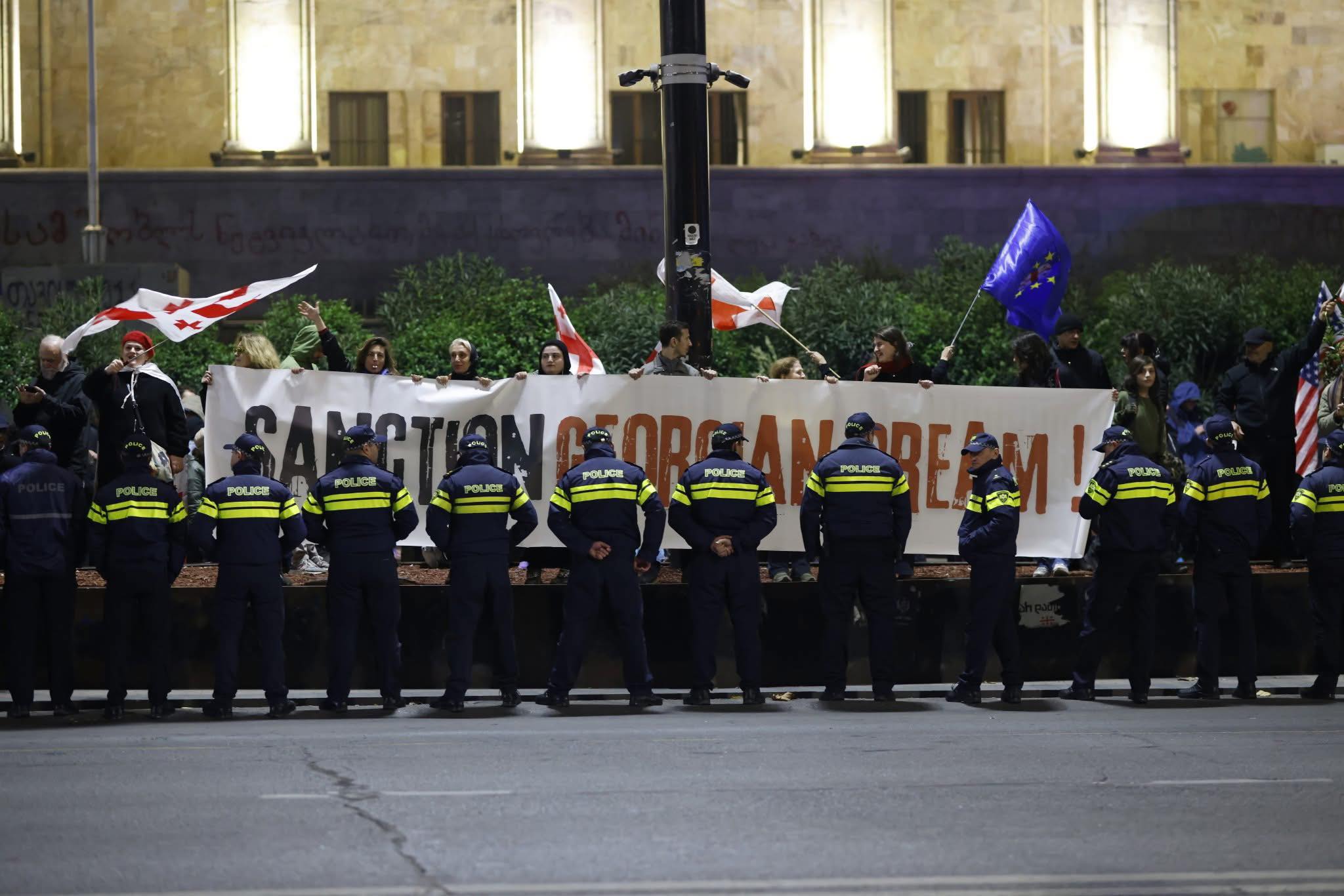
in Tbilisi. 8 November 2025. Source: Levan Zazadze.
Evolution of the Georgian Dream Party: From Pragmatism to Authoritarianism
The Georgian Dream (GD) party, which assumed power in 2012 on a platform of democratic reform and European integration, has undergone a remarkable and troubling transformation. Initially characterised by a broad coalition and ostensibly reformist agenda, GD increasingly centralised power around its founder, billionaire Bidzina Ivanishvili. Ivanishvili’s informal yet pervasive influence illustrates oligarchic governance: formal institutions are subordinated to his personal discretion, undermining constitutional mechanisms and weakening democratic accountability. State institutions, rather than functioning as independent arbiters, operate as instruments of the consolidation strategy of the ruling party.
This evolution from pragmatic governance to authoritarian reinforcement has been facilitated by the persistent use of historical and geopolitical narratives. The 2008 Russo-Georgian War has been instrumentalised to justify a cautious, Russia-leaning foreign policy and suppress domestic dissent[1]. By framing opposition to GD as destabilising and potentially provocative toward Russia[2], the party blends national interest with partisan preservation, thereby consolidating authority under the guise of protecting stability. Economic dependencies[3], including trade, remittances, and tourism, further reinforce pro-Russian policy tendencies, ensuring that pragmatic concerns of economic continuity are consistently prioritised over democratic norms.
Authoritarian tendencies are also deeply intertwined with elite self-preservation. Over a decade in power has allowed GD to establish strong networks of patronage and corruption. The judiciary has been systematically captured through politically motivated appointments and institutional manipulation, ensuring that legal scrutiny remains selective and under the thumb of party interests[4]. Courts, prosecutors, and law enforcement act as shields against accountability rather than impartial guardians of justice. In this sense, democratic erosion is not merely an incidental feature of GD, it is a deliberate strategy to protect the ruling elite from investigation, prosecution, and political challenge.
Geopolitically, Georgia’s traditional hedging strategy between European and Euro-Atlantic integration and Russian pressures has shifted towards a much greater accommodation of Russian interests. Russia leverages Georgia’s occupied regions of Abkhazia and South Ossetia, energy dependence, and economic influence to shape Georgian policy. GD’s foreign policy, initially presented as balanced pragmatism, has thus increasingly facilitated Russian strategic aims while undermining Western integration, illustrating how authoritarian consolidation can be reinforced by external geopolitical pressures.
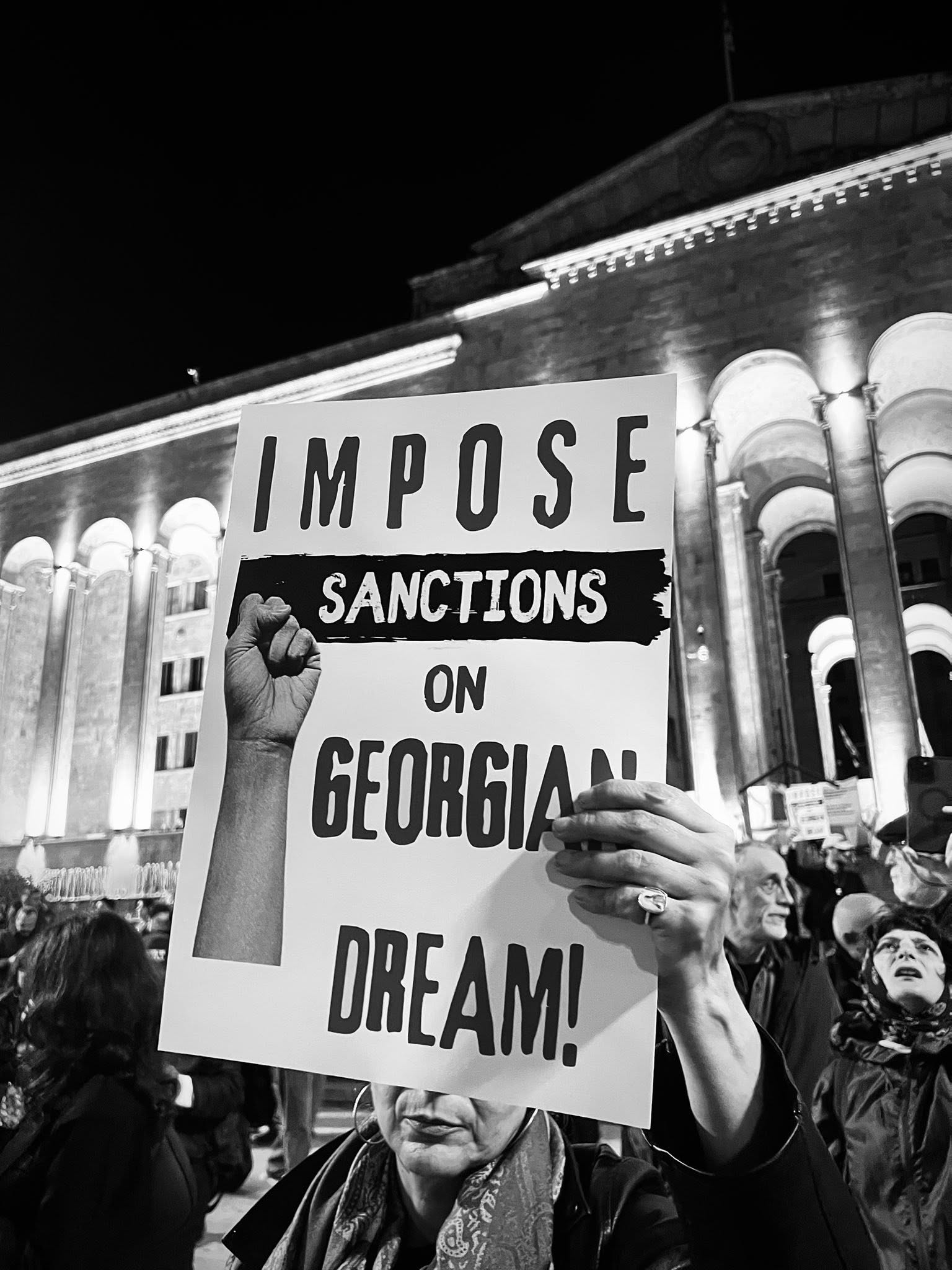
Source: Megi Benia.
Post-2022 Dynamics: War in Ukraine as a Catalyst for Open Pro-Russian Alignment
The Russian invasion of Ukraine in February 2022 marked a pivotal moment in Georgia’s democratic trajectory. GD’s initially cautious pro-Russian tendencies escalated into open alignment, reflecting both domestic elite calculus and external pressures. This shift was crystallised in high-profile public interventions by Bidzina Ivanishvili. His April 29, 2024, speech[5] exemplified an overt replication of Russian narratives, portraying Russia as a rational actor defending its interests while framing Western support for Ukraine as destabilising. By embracing these narratives, GD positioned itself publicly in line with Russian strategic messaging, abandoning the subtle pragmatism that previously characterised its foreign policy.
The consequences of this rhetorical alignment were compounded by concrete policy decisions. The November 28, 2024, announcement to postpone Georgia’s EU accession process[6], initially projected as administrative, prompted nationwide protests. Civil society, opposition parties, and independent media framed the postponement as a decisive break in Georgia’s European and Euro-Atlantic trajectory. Demonstrations, which began in late 2024, have continued into 2025, evidencing both the depth of societal resistance and the intensity of the authoritarian response by the official authorities. These protests highlight the intersection of domestic repression and geopolitical shift as GD’s alignment with Russian narratives is reinforced by systematic attacks on institutions capable of resisting authoritarian advance.
This post-2022 period also underscores the instrumentalization of the state apparatus for ideological and geopolitical purposes. Security and diplomatic institutions, previously engaged in NATO and EU integration, have been hollowed out, with key departments dismantled or merged under ideologically loyal but professionally unqualified personnel[7]. The Ministry of Foreign Affairs and Ministry of Defence have witnessed targeted purges, with divisions responsible for European and Euro-Atlantic integration, security policy and strategic planning dismantled[8]. Such actions are not merely administrative, they are calculated efforts to reorient state policy in alignment with Russian preferences while eradicating institutional memory and resistance.
These developments illustrate a broader pattern: GD leverages domestic authoritarian tools to reinforce a foreign policy that directly benefits Russia. The alignment is not limited to discourse but manifests in structural, legal, and bureaucratic changes designed to marginalise European and Euro-Atlantic influence and establish Russian strategic interests in Georgia, thereby amplifying instability across the wider Black Sea region.

against the introduction of administrative penalties which allow the authorities to imprison protesters for up to
15 days without charge. 4 November 2025. Source: Megi Benia.
Current Situation: Democratic Collapse and Strategic Vulnerability
Georgia’s democratic crisis has accelerated into an acute authoritarian reality, with profound implications for national security, regional stability, and civil liberties. The country currently holds approximately 145 political prisoners (a per capita rate higher than in Russia) demonstrating the systematic criminalisation of dissent. Opposition leaders, activists, and journalists are routinely prosecuted under spurious charges designed to neutralise political competition[9]. New cases continue to emerge, threatening the survival of opposition parties and signalling the unrelenting campaign of the ruling party to monopolise political authority.
Civil society and independent media face severe suppression. The “Law on Transparency of Foreign Influence” (commonly referred to as the “Russian Law”) stigmatizes NGOs receiving foreign funding, effectively replicating Russia’s coercive legal framework[10]. Reporting obligations, invasive audits, and administrative burdens make independent civic action nearly impossible, curtailing oversight of government behaviour. Independent media outlets encounter legal harassment, financial constraints, and targeted attacks, while state-sponsored disinformation campaigns delegitimise alternative voices and reinforce pro-government narratives[11]. These measures systematically eradicate platforms for democratic engagement, producing an environment of fear, self-censorship, and coercion.
Institutional erosion extends to strategic policy areas. Diplomatic and defence structures have been deliberately weakened. Units tasked with NATO integration, EU affairs and multilateral security coordination have been dissolved, and experienced personnel dismissed[12]. Purges are ideologically motivated, targeting civil servants committed to constitutional principles and Euro-Atlantic integration. As a result, Georgia’s strategic institutions are incapable of formulating coherent security policies, leaving the state vulnerable to external coercion and influence operations.
Protests remain widespread but are met with aggressive state repression. Demonstrations following November 28, 2024, EU accession postponement, as well as subsequent anti-government mobilisations, have been suppressed through excessive force, administrative detentions, and legal harassment. Reports document police brutality, targeted intimidation of civil society leaders, and politically motivated prosecutions[13]. This approach transforms dissent into a criminalised activity, undermining the fundamental beliefs of democracy.
In sum, Georgia faces a multi-dimensional crisis: a consolidated authoritarian regime, politicised institutions, a weakened civil society, a besieged media landscape, and an overtly pro-Russian foreign policy orientation. This convergence of internal authoritarianism and external alignment with Russia not only threatens Georgia’s European and Euro-Atlantic aspirations but also compromises security across the wider Black Sea region. The country is caught in a trajectory of systematic democratic erosion, geopolitical isolation, and heightened vulnerability to malign influence, a scenario with implications that extend far beyond its borders.
Democratic Decline and Regional Security Implications
Eroding Resilience against Disinformation and Hybrid Threats
The systematic weakening of democratic institutions directly impairs Georgia’s resilience to external influence operations. Disinformation campaigns, particularly those orchestrated by Russian state and proxy actors, thrive in environments of political polarisation and declining trust in public institutions.
As Georgia’s domestic politics become increasingly fragmented and overtly repressive, pro-Russian narratives portraying the EU and NATO as “agents of moral decay” or “threats to sovereignty” gain dangerous traction[14],[15]. These narratives resonate with segments of the population frustrated by economic stagnation and disillusioned with a political elite perceived as corrupt. The anti-Western rhetoric aggressively spread and promoted by government institutions and officials, often aimed at deflecting domestic criticism, further amplifies this vulnerability.
Hybrid threats, including information manipulation, and the incitement of social unrest, are most effective when states lack societal cohesion and democratic legitimacy. The diminished transparency, the confrontational stance toward NGOs, and the government’s own complicity in spreading disinformation severely reduce the effectiveness of whole-of-society responses, leaving the country dangerously exposed to malign external interference.
Undermining NATO–EU Engagement in the Black Sea
Georgia’s acute authoritarian crisis fundamentally undermines its strategic credibility as European and Euro-Atlantic partner. Both NATO and the EU have repeatedly emphasised that democratic governance and rule of law are absolute prerequisites for deeper integration. The 2023 enlargement report[16] by the European Commission explicitly linked Georgia’s candidate status to verifiable progress in judicial reform, media freedom, and depolarisation – conditions that Georgia has aggressively moved away from.

In practical terms, democratic backsliding severely limits the scope of security cooperation. While Georgia remains one of NATO’s most active partners through various integration mechanisms, internal instability, anti-Western rhetoric, and human rights abuses fundamentally weaken political trust. Member states, already hesitant about enlargement, now cite Georgia’s profound democratic deficiencies as undeniable evidence of unreliable commitment and a divergence from shared values.
At a regional level, this credibility gap severely hinders multilateral coordination within the wider Black Sea security architecture. Initiatives under the EU’s Black Sea Synergy[17] framework rely on a basic level of political convergence around shared democratic values and a commitment to a rules-based order. Georgia’s aggressive deviation from this path risks isolating it diplomatically, diminishing its strategic value as a reliable ally, and creating a dangerous vacuum that hostile actors can exploit.
Spill-over Risks and Authoritarian Entrenchment
The deterioration of Georgia’s democratic governance carries profound and dangerous spill-over effects across the wider Black Sea region. Authoritarian actors, primarily Russia but also others with revisionist ambitions, directly benefit from democratic fragility among their neighbours. They exploit domestic divisions to project influence, offer alternative governance models, and aggressively delegitimise Western-backed democratic norms.
Georgia’s situation may embolden similar trends in other states facing democratic pressure, such as Moldova and even nascent democracies in the Western Balkans. The perception that democratic backsliding can occur without significant international consequences risks encouraging illiberal tendencies elsewhere in the region, creating a domino effect of democratic erosion.
If Georgia definitively falls to authoritarianism, it will send a chilling message to Moldova and Ukraine, potentially undermining their European and Euro-Atlantic paths and complicating their struggles against Russian aggression. It could also influence Armenia’s geopolitical calculations, potentially pushing it closer to Russia out of perceived necessity. Such a development would undoubtedly have an emboldening effect on authoritarian regimes like Belarus, further solidifying the illiberal bloc in Eastern Europe.
Additionally, weakened democratic governance fundamentally undermines societal resilience against hybrid threats. Civil societies under pressure are less capable of mobilising against external aggression, countering propaganda, or sustaining a pro-Western consensus. As powerfully demonstrated by the Ukrainian experience, robust, resilient democratic institutions and a vibrant civil society are not luxuries, they are crucial for enduring external threats and maintaining national sovereignty.
Conclusion
Georgia stands at a dangerous crossroads. Once a beacon of democratic transformation, it now faces an acute authoritarian crisis, a critical test of whether it can preserve the achievements of its post-Rose Revolution trajectory or slide further into illiberalism and entrenched autocracy. The implications of this choice extend well beyond Georgia’s domestic political sphere. The systematic erosion of democratic institutions, the violent suppression of dissent, the jailing of opposition leaders, the criminalisation of civil society and independent media, and the consolidation of power by an oligarchic elite fundamentally weaken the foundations of regional stability, amplify vulnerabilities to hybrid threats, and irreversibly undermine collective efforts to secure the Black Sea region.
For NATO and the EU, Georgia’s trajectory serves as a stark reminder that democracy and security are inseparable. A stable, democratic Georgia acts as an essential bulwark against authoritarian influence and a vital partner in maintaining the rules-based order in the region. Equally, a Georgia that surrenders to authoritarian drift risks becoming a dangerous gateway for destabilisation, a weak link in regional security, and a symbol of democratic failure in a critical geopolitical space. The Georgian Dream government has clearly demonstrated its unwillingness to be a partner for democratic reform, opting instead for a path of authoritarian consolidation driven by self-preservation and fear of accountability.
The recommendations outlined below underscore that reversing this democratic backsliding requires urgent, decisive, and coordinated international action. Democratic resilience must be treated not as an aspirational value but as an absolute strategic necessity and an indispensable element of collective security in the Black Sea region. The international community must shift its approach from cautious engagement to robust condemnation, targeted pressure, and unwavering, direct support for Georgia’s suppressed democratic forces. This means isolating the authoritarian regime, sanctioning those responsible for abuses, and providing lifelines to those bravely fighting for Georgia’s democratic future. The future of Georgia, and indeed the wider Black Sea region, depends on this decisive shift.