Since its occupation of the Gaza Strip in 1967, Israel has exerted increasingly exclusive control of Gaza’s airspace and territorial waters. In June 2007, following the military conquest of Gaza by the terroristic organization Hamas, Israel significantly intensified the already existing movement restrictions, thus isolating the Gaza Strip from the West Bank and the world.[1] Israel then imposed a naval blockade on the coast of the Gaza Strip on January 3, 2009 “to prevent weapons, terrorists and money from entering or exiting the Gaza Strip by sea”.[2] Yet the legitimacy of such a measure was widely debated.
In 2011, in fact, the Report of the Secretary-General’s Panel of Inquiry on the 31 May 2010 Flotilla Incident–which led to the death of 9 activists who were trying to breach the blockade–concluded that Israel’s resort to the siege was legal under international law at the time, even though it was underlined that its humanitarian impact was deeply problematic. The report concluded:
“Bearing in mind its consequences and the fundamental importance of the freedom of navigation on the high seas, Israel should keep the naval blockade under regular review, in order to assess whether it continues to be necessary. Israel should continue with its efforts to ease its restrictions on movement of goods and persons to and from Gaza with a view to lifting its closure and to alleviate the unsustainable humanitarian and economic situation of the civilian population.”[3]
The blockade was considered legitimate on the grounds of The San Remo Manual on International Law Applicable to Armed Conflicts at Sea, (“San Remo Manual”), an integration of existing legal standards for naval conflict with the Geneva Conventions of 1949. Nonetheless, this concluded legitimacy of Israel’s blockade was, at the time in 2011, widely questioned, in primis on the grounds that the legal and political matter of whether Hamas could be considered the legitimate representative of the Palestinian people.[4]
Nowadays, the legitimacy of the siege is lacking. On the grounds of Article 102 of the San Remo Manual, indeed, a siege is prohibited if (a) “it has the sole purpose of starving the civilian population or denying it other objects essential for its survival”; or (b) “the damage to the civilian population is, or may be expected to be, excessive in relation to the concrete and direct military advantage anticipated from the blockade”. [5] The above criteria by which illegitimacy of the post-2023 blockade can be established have tragically been met. The civilian death rate is now 83% and 96% of Gaza’s remaining population faces acute levels of food insecurity since the last trimester of 2024, with a projected 130,000 children under the age of 5 who will suffer from acute malnutrition through June 2026.[6]
In order to draw attention to the genocide of Palestinians in the Gaza Strip and to break Israeli siege of Gaza, a grassroots, civilian led movement has promoted several maritime missions since 2007. First known as the “Free Gaza Movement”, it was later renamed “Freedom Flotilla Coalition” (FFC).[7] Over the years, dozens of missions have been launched, and almost all of them have been intercepted by Israel. In order to give greater visibility to its mission, the FFC joined forces with three other coalitions and launched the Global Sumud Flotilla.
The Global Sumud Flotilla
On August 31, 2025, the Global Sumud Flotilla coalition’s first convoy of a global fleet of boats set sail for Gaza from Barcelona, Spain, with the aim of delivering humanitarian aid to Palestinians, breaking the blockade and awakening worldwide consciousness on the situation in Gaza.[8] The first boats, consisting of dozens of small civilian vessels carrying activists, humanitarians, doctors, seafarers, and humanitarian supplies, were later joined by more vessels, which departed from Sicily, Greece and Tunisia, where the convoy stopped on September 4.[9] The mission was organised by four major coalitions – the Maghreb Sumud Flotilla, the Freedom Flotilla Coalition, the Global Movement to Gaza and the Sumud Nusantara – and including groups that had already taken part in maritime or terrestrial efforts to provide humanitarian relief and break the Israeli siege on Gaza. This time, the coalition was joined by delegations from 46 countries from all over the world, for a total of more than 500 participants.[10]
The mission received worldwide support. Francesca Albanese, an Italian legal scholar and expert on human rights who has served as the United Nations (UN) Special Rapporteur on the occupied Palestinian territories since May 1, 2022, met part of the crew of the flotilla – among them the famous anti-climate change activist Greta Thunberg – in Tunis to endorse the mission, which she described as being carried out on behalf of humanity.[11] Moreover, Albanese highlighted the risks faced by the activists, who have been described by Israel as “terrorists” since the beginning of the mission. On September 1, Israel’s National Security Minister, Itamar Ben-Gvir, reportedly presented a plan to the cabinet to halt the flotilla, describing it as “an attempt to support the Hamas terrorist organisation and trample Israeli sovereignty.”[12]
According to available information, Ben-Gvir’s plan threatened the activists with “prolonged detention in Israel’s Ketziot and Damon prisons under harsh conditions usually reserved for “security prisoners,” with basic needs and communications denied.” It further provided for the confiscation and repurposing of the ships.[13] In fact, once repatriated, many activists of various nationalities from the Global Sumud Flotilla denounced the extremely uncomfortable and degrading conditions and treatment they endured in prison, including physical abuse and deprivation of food and water.[14]
Over the weeks, the flotilla was repeatedly attacked — first in Tunisian national waters on September 9 and 10, by drones, and again, on September 23, south of Crete, with the purpose of damaging the ships and discouraging the activists from continuing their mission, which were later confirmed to have been directly ordered by Israel’s Prime Minister Benjamin Netanyahu [15]
Due to the increasing security risks faced by the Flotilla and its crew, and thanks to the wide national and international support to the mission, Italy, followed by Spain and Türkiye, deployed navy vessels to support and protect the fleet.[16] Italy’s Defence Minister Guido Crosetto expressed “his strongest condemnation of the attacks,” even though he defined them as “unidentified”, insisting, “In a democracy, demonstrations and forms of protest must also be protected when they are carried out in accordance with international law and without resorting to violence.”[17]
Yet, as the vessels’ states declared they would escort the flotilla as far as the point where the maritime blockade begins, worldwide concerns grew regarding the extent of the Israeli reaction when the ships would try to reach Gaza.[18] The Italian President, Sergio Mattarella, launched an appeal to the men and women of the flotilla to accept the offer of the Latin Patriarchate of Jerusalem to carry out the safe delivery of the supplies collected for the Gazan people, thus “avoiding jeopardizing the safety of each individual person.”[19] Yet the Global Sumud decided to keep pursuing its mission.
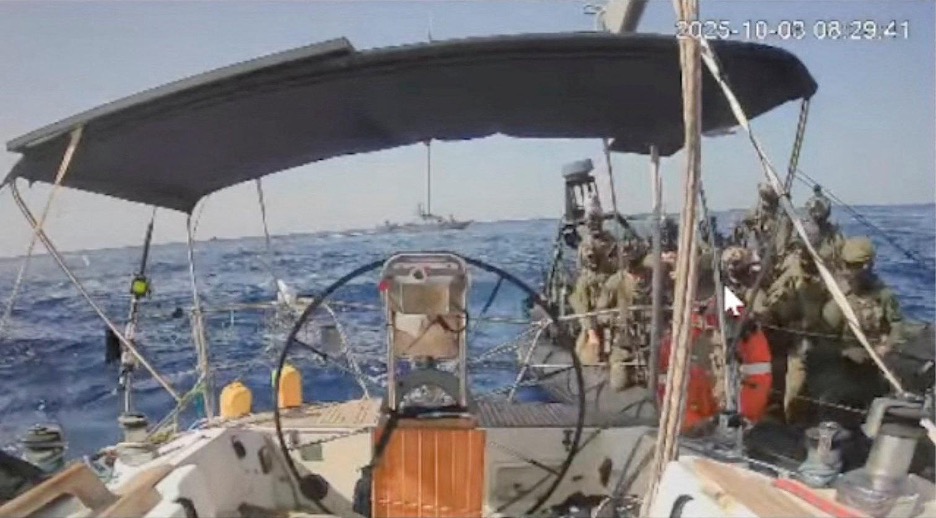
A screengrab from a live stream video shows Israeli navy forces approaching the vessel the Marinette, believed to be the only ship from the Global Sumud Flotilla still sailing towards Gaza, which flotilla organisers report has now been intercepted, October 3, 2025. Global Sumud Flotilla/Handout via REUTERS
Like other previous attempts to break the Gaza blockade since 2010 which have repeatedly been intercepted or attacked by Israel in international waters – with casualties registered among the activists in the 2010 mission carried on by the Freedom Flotilla – the Global Sumud Flotilla was intercepted between the evening of October 1 and the morning of October 3rd.[20] Using drone attacks and water cannons, the vessels were prevented from continuing their journey and 462 activists were arrested and brought to Israel, from where they were progressively repatriated.[21]
The Flotilla’s Impact on Public Opinion in Italy
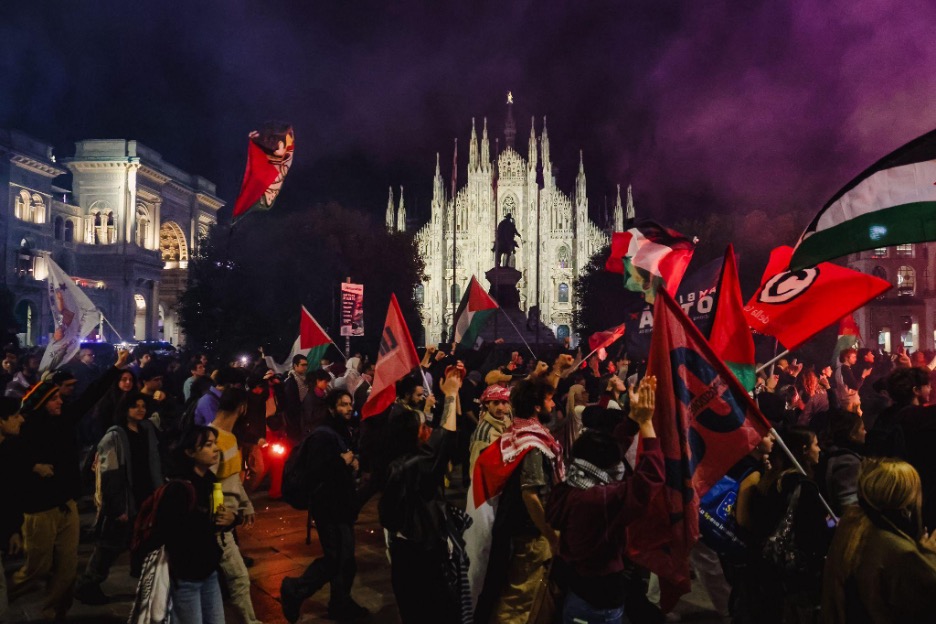
Milan, Italy. The march in support of the Global Sumud Flotilla following the Israeli army’s boarding of the ship off the coast of Gaza. Pictured: A moment from the demonstration, with flags and banners in Piazza Duomo. (Photo by Alessandro Bremec / ipa-agency.net/IPA/Sipa USA)
Tied to the Global Sumud Flotilla’s efforts has been a growing international movement that is putting pressure on European governments to review their policies towards Israel. Italy, in particular, has witnessed mass mobilizations across more than 70 municipalities, with hundreds of thousand of people showing their support to the Palestinian people and expressing the strong belief that the state of Palestine should be recognized.[22]
Italy is one among the few European (and global) states that don’t recognize Palestine. As reported by the Italian newspaper Il Fatto Quotidiano:“Meloni is considered the last bastion against the imposition of harsh European sanctions against Israel”.[23] On July 26, 2025, commenting the French recognition of Palestine, Meloni told Italian daily La Repubblica:
“I am very much in favor of the State of Palestine, but I am not in favor of recognizing it prior to establishing it… If something that doesn’t exist is recognized on paper, the problem could appear to be solved when it isn’t,” Meloni added.[24]
Yet, over the last weeks, and due to the raise of consciousness of the depth of public sentiment against Israel’s war in Gaza, Giorgia Meloni’s position shifted on the issue, and on September 23, 2025, she announced Italy would recognise the state if Israeli hostages are freed and Hamas is removed from its governmental authority.[25]
Opposition parties have since accused Meloni of bluffing: the secretary of the Democratic Party (Partito Democratico, PD) Elly Schlein declared that “This is no time for sleight of hand and mockery”, Five Star Movement (Movimento 5 Stelle, M5S) leader Giuseppe Conte defined Meloni’s words:
“a pathetic expedient that confirms our government’s sloth”, whileCarlo Calenda (Azione) pointed out that “Meloni’s two conditions for recognising Palestine are contradictory: Hamas should release the hostages and not be part of the recognition process. The second is a foregone conclusion. No leader is proposing to recognise Hamas as the legitimate government of the State of Palestine. But if this is the bottom line, and it must be, then, it is very unlikely that Hamas will release the hostages to do the Palestinian National Authority a favour. We are faced with a clever way of saying no to the recognition of Palestine.“[26]
Nationally-speaking, there is strong backing among Italians for the Palestinian cause, including a significant share of supporters of Meloni’s ruling coalition, with many Italians asking their government to recognize Palestine.[27] A crucial role in the beginning of the mass protests, for example, was played by the dockers’ determination to block weapons and stifle trade, from Genoa, Trieste and Ravenna in the north, to Salerno and Taranto in the south, which succeeded in obstructing ships believed to have been carrying weapons for Israel.[28]
Notwithstanding such a national mobilization, however, Meloni’s Brothers of Italy continues to lead in polls, at about 30%, with current regional elections being won by the right wing coalition. The widely shared pro-Gaza sentiment has thus not translated into diminished support for the current government.[29]
According to Nadia Urbinati, a political scientist at New York’s Columbia University and the University of Bologna, such an apparent short circuit can be attributed to the fact that barely half of Italian voters go to the polls and those who do, vote for the right.[30] Moreover, nation and private broadcast channels have given high visibility to the shameful, yet minoritarian, group of antagonistic forces who have taken part to the manifestations, or have cast doubts on the link between the Flotilla and Hamas: such campaigns have contributed to diverting the public opinion while raising concerns related to security issues.[31]NAPLES, ITALY – OCTOBER 3: Protesters march in the port of Naples during a general strike in Naples on October 3, 2025 to protest after the Global Sumud Flotilla was boarded on the open sea by the Israel Defense Forces (IDF) on October 1, 2025. Eliano Imperato / Anadolu
Conclusion
The difficulty of translating the nation-wide grassroots support for Global Sumud Flotilla’s cause into outcomes at the polls is proof of how grass-roots the mission remains. Despite its politicization by the Italian government, the pro-Gazan national sentiment awakened by the Global Sumud Flotilla appears to remain bottom-led and spontaneous.
And yet, considering the abstentionism has been spreading throughout Italy for the last 30 years, and one out of two Italians do not get informed about current affairs, thus expressing a silent disapproval of the current political scenario, then the mass mobilization that crossed the whole country can be considered an extraordinary result pursued by the Flotilla, whose mission to put the spotlight on what is happening in Gaza has thus been successfully met.