
Platform for Peace and Humanity

When typhoon winds match a high-speed train: Asia’s intensifying storm threats

The Peace and Security Monitor

The Indo-Pacific

Issue 7, December 2025

Key Takeways

  • Warmer seas and a hotter atmosphere are increasing the conditions for more intense typhoons, even if long-term frequency remains uncertain.
  • Typhoons carry enormous human and economic costs, with unequal impacts: vulnerable groups face the greatest disruptions to health services, food systems, water and sanitation, and livelihoods.
  • Corruption has weakened disaster preparedness, with ghost projects, inflated contracts, and major fund leakages undermining infrastructure and fueling public anger.
  • Despite governance failures, new reforms such as anticipatory disaster laws offer pathways to more transparent and proactive disaster responses, and regional examples (like Vietnam and Japan) show that strong institutions can efficiently reduce risk.
  • While climate thresholds have been reached, mitigation and adaptation remain essential, requiring fiscal tools that mobilise green investment, resilient infrastructure, as well as climate actions that prioritise the most vulnerable.

In 2024, the Philippines was hit by six typhoons in 30 days, affecting more than 13 million people.[1] This year, several storms have again formed in the Western Pacific, moving from the Philippines across China, Taiwan, Vietnam, and Thailand. While attributing any single typhoon directly to climate change is complex, scientific evidence shows that global warming is increasing the conditions that allow typhoons to become more intense and more likely to occur in clusters.[2]

This reality underscores the urgent need not only for rapid emergency responses but also for comprehensive, long-term strategies, as seen in Japan’s bōsai system,[3] which integrates prevention, mitigation, preparedness, response, recovery, and reconstruction. Achieving this will require sustained political commitment, regional coordination, innovative financing, and careful use of limited fiscal space, especially as many countries confront rising debt and declining official development assistance.

Why today’s typhoons hit harder

While scientists cannot attribute every storm directly to global warming, the overall trend is clear: warmer sea-surface temperatures and a hotter, wetter atmosphere provide more “fuel” for typhoons.[4] In the Philippines, the extreme conditions that enabled six consecutive storms in 2024 are becoming more likely due to human-caused climate change,[5] and in Japan, research on Typhoon Hagibis showed that climate change increased associated rainfall, causing catastrophic flooding and billions in damages.[6] Independent analyses similarly find that the potential intensity of Northwestern Pacific typhoons, in terms of rainfall and wind speed, is already increasing in a warmer world,[7] and additional scientific projections for Southeast China suggest that stronger winds and heavier rainfall could sharply increase future typhoon-related losses.[8]

A region under strain

According to the Climate Risk Index (CRI) – one of the longest-running global indices measuring the impacts of climate-related extreme weather – Myanmar, the Philippines, Vietnam, and Nepal were among the countries most affected in 2024.[9]

In Southeast Asia, Typhoon Yagi was especially devastating. In Myanmar, it triggered catastrophic flooding, killed more than 800 people, affected 3.4 million, and caused an estimated USD 222 million in losses. In Vietnam, Yagi brought wind gusts of 280 km/h, which is comparable to the velocity of a high-speed train and strong enough to bring down power lines. In Vietnam, typhoon Yagi killed 345 people and affected 3.6 million, inflicting nearly USD 2 billion in damage.

The Philippines was one of the worst hit, facing six typhoons in 2024 that displaced more than 11 million people, caused hundreds of deaths, and inflicted over USD 700 million in losses. In Nepal, although typhoons were not the cause, intensified monsoon rains produced comparable devastation, triggering landslides across more than 40 districts and killing over 250 people.

This pattern has continued into 2025, with several powerful storms arriving in rapid succession. Super typhoon Ragasa hit the Philippines in September, before moving to Taiwan and southern China, where it caused storm surges up to 9 feet, massive evacuations (over 2 million in China), and substantial infrastructure damage.[10]

In the same month, Bualoi followed, which formed near the Philippines and intensified as it reached Vietnam, causing 27 deaths in the Philippines, 51 in Vietnam, injuring hundreds, disrupting power for 2 million Vietnamese households, and damaging 44,000 homes.[11]

In early November, Typhoon Kalmaegi brought widespread flooding to central Vietnam, uprooting trees, damaging buildings, disrupting transport and agriculture, and leading to the evacuation of over 537,000 people.[12]
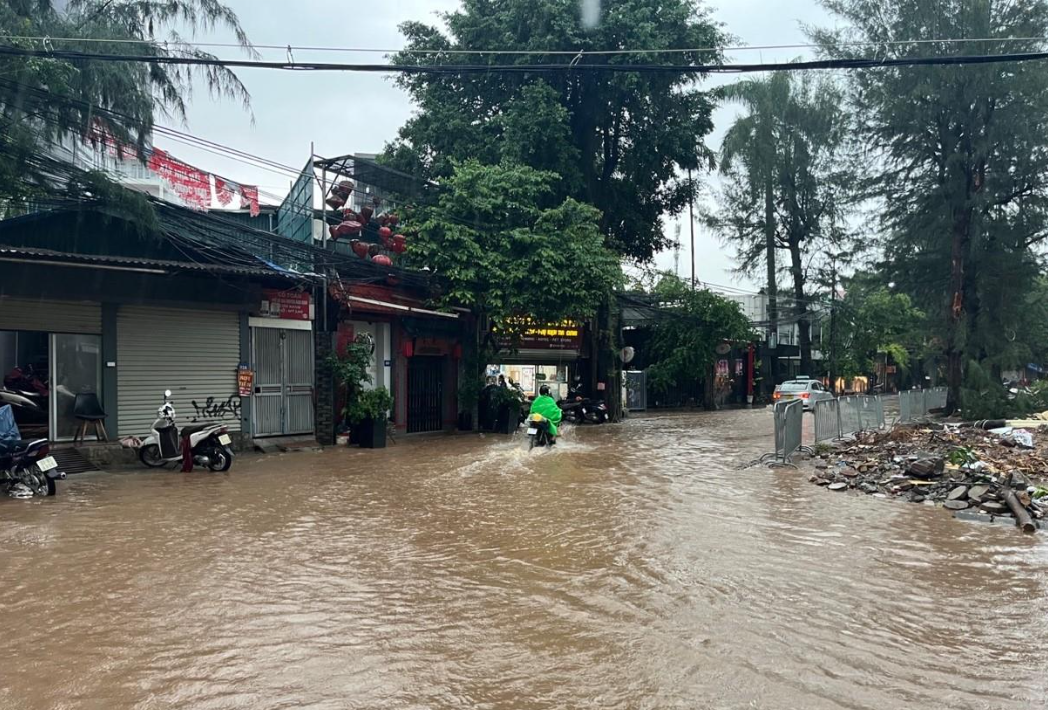
Typhoon Bualoi in Hanoi – photo by author (Claire Stein)

The most recent storm, Typhoon Fung-wong, first hit Aurora province, in the Philippines, in early November, and then headed to Taiwan, causing destructive widespread floods, power outages for entire towns, landslides, and displacing more than a million people.[13] Combined with the damage of Kalmaegi, the widespread destruction prompted President Marcos Jr. to declare a “state of national calamity” in the Philippines[14] and to unlock emergency funds. 

Beyond direct human costs, economic losses, and humanitarian fallout  

Beyond human and material tolls, typhoons cause deep economic losses and long-term impacts on livelihoods. A 2022 World Bank report estimated that annual losses from typhoons in the Philippines already reach 1.2 per cent of the Gross Domestic Product (GDP), rising to 4.6 per cent in extreme events like Super Typhoon Yolanda (Haiyan) in 2013. Climate change could push losses to 7.6 per cent of GDP by 2030 and 13.6 per cent by 2040 if left unaddressed.[15] However, the report noted that investing in adaptation, especially climate-resilient infrastructure, could help lower economic losses by 2.5 per cent by 2030 and up to 6.2 per cent in 2025.
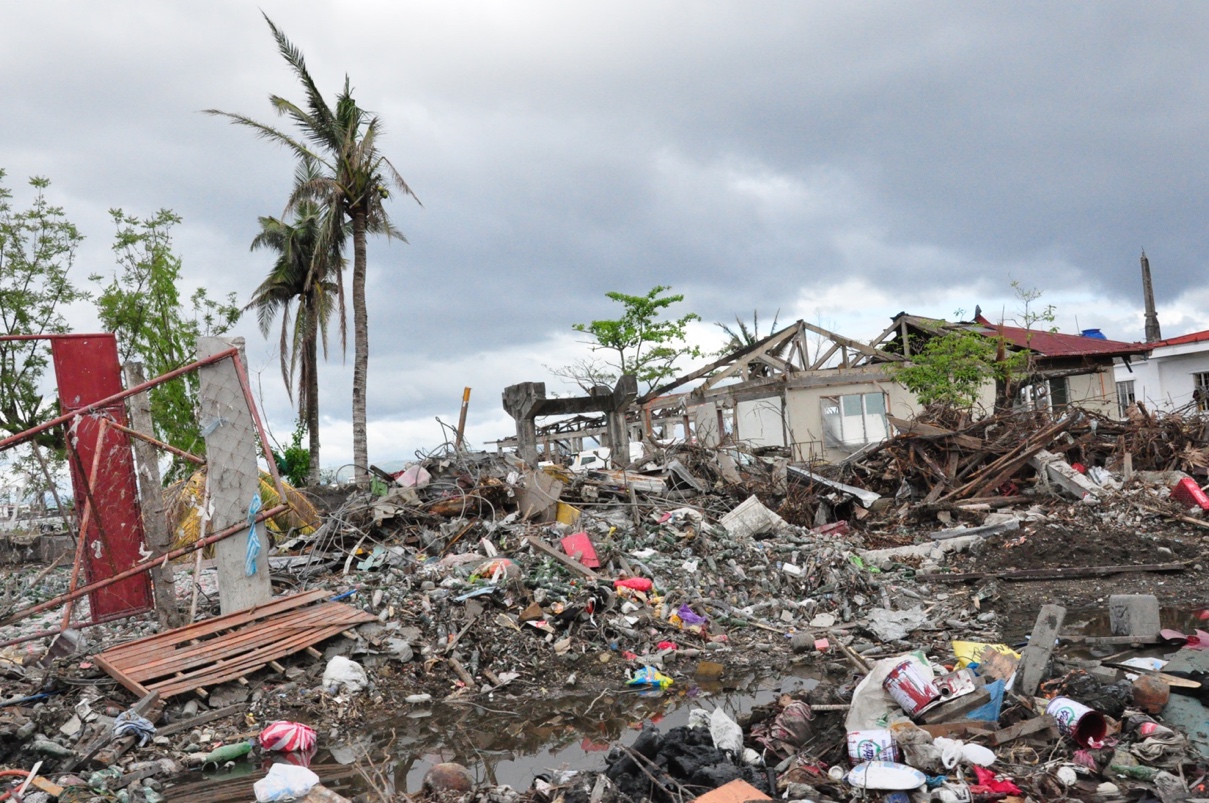
Tacloban City was the worst hit by Super Typhoon Haiyan (Flickr)

Typhoons also deepen inequalities, hitting vulnerable groups hardest, and increase humanitarian needs. For example, after Typhoon Kalmaegi in Vietnam, the United Nations Office for the Coordination of Humanitarian Affairs (OCHA) documented widespread disruptions, including damaged roads and power lines, leaving isolated communities without access to essential services such as water supply or health assistance. Storms also damage Water, Sanitation, and Hygiene (WASH) infrastructure, increasing the likelihood of waterborne or foodborne diseases. The report highlighted urgent needs for food aid, agricultural inputs, and repairs to irrigation systems to sustain livelihoods.[16] Vulnerable groups include pregnant and lactating women, young children, and people with disabilities or living with illnesses, who often face heightened risks when nutrition, water, or health services are disrupted. Last, these cascading impacts often extend beyond national borders, interrupting supply chains[17] and contributing to inflationary pressures.[18]

The missing billions in disaster spending

According to Greenpeace Philippines, there are major leakages in the country’s disaster-risk management funding. The group estimates that as much as PHP 1.089 trillion in climate-tagged spending since 2023 may have been vulnerable to corruption. This is based on government climate-finance data and testimonies indicating that only 30-40% of some flood-control budgets reach actual implementation.[19] Independent media investigations point to similar issues. The East Asia Forum reported several “ghost projects”, including a PHP 55-million flood-control structure in Bulacan that was never built.[20] The Philippine Daily Inquirer also reported widespread use of inflated contracts and “cuts” of 20-25%, which leave only a fraction of the funds for real construction.[21] The Philippine Centre for Investigative Journalism (PCIJ) reported overall deep structural corruption and inequality in the country’s flood control programmes.[22] Together, these cases reveal deeper governance failures that weaken the country’s ability to prepare for increasingly destructive typhoons. One OpEd argued that such corruption not only weakens physical infrastructure but also destroys public trust and fuels social anger,[23] highlighted by subsequent political tension and mass protests.[24]

However, there is hope for better responses. The Philippines recently passed the Declaration of State of Imminent Disaster Act (Republic Act No. 12287), which formally integrates anticipatory action into the country’s Disaster Risk Reduction and Management Framework.[25] Developed by the Office of Civil Defence with support from the World Food Programme (WFP), the law enables national and local authorities to act before a disaster strikes, using forecasts and risk assessments to release funds early, protect homes and livelihoods, and reduce humanitarian impacts.

Hope amid the storms: some models of efficient response

Vietnam provides an example of coordinated planning and rigorous monitoring response to crises. After Typhoon Yagi, it conducted a multi-sector assessment to guide evidence-based recommendations for sustainable and resilient recovery.[26] It has also invested, with World Bank support, in flood-resilient infrastructure projects in the Mekong Delta while involving local authorities in disaster monitoring and response.[27] However, Vietnamese leaders, including Prime Minister Pham Minh Chinh, have urged stronger adaptation measures, calling for improved institutions and greater risk management capacity.[28] [29]

Japan, despite facing centuries of earthquakes, tsunamis, floods, typhoons, and volcanic eruptions, has developed highly effective disaster reduction practices, grounded in community involvement and continuous innovation.[30] Its bōsai approach, which combines prevention, mitigation, preparedness, response, recovery, and reconstruction, integrates both hard technologies (such as resilient infrastructure, sensors, engineering systems) and soft strategies (including education, training, governance, community involvement).[31] Through the Asian Disaster Reduction Centre, Japan shares knowledge and builds the capacity of officials and researchers, including those from Small Island Developing States (SIDS), who face increasing threats from sea-level rise and stronger tropical cyclones, and often lack the fiscal capacity to respond.[32]

Beyond adaptation: building a fair and resilient future

While some scientists warn that the world is nearing irreversible climate thresholds, mitigation remains essential and urgent, as underscored by the United Nations (UN) Secretary-General António Guterres.[33] At this year’s UN Climate Change Conference (COP30), civil society groups, including voices like Lidy Nacpil, coordinator of the Asian Peoples’ Movement on Debt and Development, emphasised that governments must commit to climate justice, fair financing, and a just transition that protects vulnerable populations.[34]

Although the long-term frequency of storms is uncertain, their severity and destructive potential are projected to worsen, making preparedness and long-term recovery indispensable national priorities. Countries must deploy appropriate fiscal tools, such as green budgeting, targeted tax incentives, green subsidies, and climate-aligned public investment. They must expand green and resilient infrastructure and ensure that climate action supports sustainable and inclusive development, while protecting the most vulnerable communities.

Policy Recommendations

  • Independent audit institutions, civil society, and international bodies such as the United Nations Framework Convention on Climate Change (UNFCCC) can play an important role in monitoring whether climate and disaster-response are used as intended.
  • Multi-stakeholder partnerships involving national and local governments, development institutions such as the Asian Development Bank (ADB) or Japan International Cooperation Agency (JICA), engineering firms, and local communities could contribute to building and maintaining climate-resilient infrastructure.
  • Local governments could partner with meteorological agencies and humanitarian organisations to integrate typhoon impact forecasts with planned relocation and evacuation support for households in high-risk areas.
  • Collaboration between governments, UN agencies, and local non-governmental organisations (NGOs) is needed to expand crucial social protection responses, including cash transfers, livelihood support, and temporary income assistance, to help households recover from typhoons and climate impacts.
  • Humanitarian agencies, with local governments, should ensure the continuity of essential services during and after typhoons, including health care, nutrition, clean water, and food assistance, with particular attention to pregnant women, young children, people with disabilities, and isolated rural communities.

Endnotes

  1. Tandon A, ‘Record-breaking Philippines typhoon season was supercharged by climate change’ (Carbon Brief, 12 December 2024).  https://www.carbonbrief.org/record-breaking-philippines-typhoon-season-was-supercharged-by-climate-change/ accessed 12 November 2025.
  2. World Weather Attribution. ‘Climate change supercharged late typhoon season in the Philippines, highlighting the need for resilience to consecutive events’ (12 December 2024) https://www.worldweatherattribution.org/climate-change-supercharged-late-typhoon-season-in-the-philippines-highlighting-the-need-for-resilience-to-consecutive-events/ accessed 12 November 2025.
  3. Economist Impact, ‘Harnessing technology and human resources: How Japan is building Pacific disaster resilience’ https://impact.economist.com/projects/building-pacific-disaster-resilience accessed 12 November 2025.
  4. Stanway D, ‘As Typhoon Kalmaegi wreaks havoc in Southeast Asia, scientists say rising temperatures are to blame’ (Reuteurs , November 2025) https://www.reuters.com/sustainability/cop/typhoon-kalmaegi-wreaks-havoc-southeast-asia-scientists-say-rising-temperatures-2025-11-07/ accessed 12 November 2025.
  5. World Weather Attribution. ‘Climate change supercharged late typhoon season in the Philippines, highlighting the need for resilience to consecutive events’ (12 December 2024) https://www.worldweatherattribution.org/climate-change-supercharged-late-typhoon-season-in-the-philippines-highlighting-the-need-for-resilience-to-consecutive-events/ accessed 12 November 2025.
  6. Li S and Otto F, ‘The role of human-induced climate change in heavy rainfall events such as the one associated with Typhoon Hagibis’ (2022) 172(7) Climatic Change https://doi.org/10.1007/s10584-022-03344-9 accessed 13 November 2025.
  7. Tandon A, ‘Record-breaking Philippines typhoon season was supercharged by climate change’ (Carbon Brief, 12 December 2024)  https://www.carbonbrief.org/record-breaking-philippines-typhoon-season-was-supercharged-by-climate-change/ accessed 12 November 2025.
  8. Huang M et al. ‘Increasing typhoon impact and economic losses due to anthropogenic warming in Southeast China’ (8 September 2022) 12(1) Scientific reports doi:10.1038/s41598-022-17323-8 accessed 13 November 2025.
  9. Climate Risk Index https://www.germanwatch.org/sites/default/files/2025-11/CRI%20summary%20EN%202026.pdf
  10. Pang J and Kirton D, ‘Typhoon Ragasa bears down on southern China after killing 17 in Taiwan’ (Reuters, 24 September 2025) https://www.reuters.com/business/environment/super-typhoon-lashes-hong-kong-with-hurricane-force-winds-heavy-rain-2025-09-23/ accessed 14 November 2025
  11. Mai L and Poling G, ‘The Latest on Southeast Asia: Regional Natural Disasters Updates’ (9 October 2025) https://www.csis.org/blogs/latest-southeast-asia/latest-southeast-asia-regional-natural-disaster-updates accessed 14 November 2025.
  12. Channel News Asia, ‘Typhoon Kalmaegi hammers central Vietnam, killing at least 5 (7 November 2025) ’https://www.channelnewsasia.com/asia/typhoon-kalmaegi-vietnam-philippines-5452561 accessed 15 November 2025.
  13. Armstrong K, Rhoden-Paul A, Luo L, ‘Philippines hit by ‘intense’ typhoon as nearly a million evacuate’ (BBC, 9 November 2025) https://www.bbc.com/news/articles/cq509yj82y8o accessed 15 November 2025.
  14. Direct Relief, ‘Deadly Super Typhoon Slams the Philippines, Latest in a Sequence of Storms’ (11 November 2025) https://www.directrelief.org/2025/11/deadly-super-typhoon-slams-the-philippines-latest-in-a-sequence-of-storms/ accessed 14 November 2025.
  15. World Bank Group, ‘Philippines Country Climate and Development Report’ (9 November 2025) https://www.worldbank.org/en/country/philippines/publication/philippines-country-climate-and-development-report# accessed 13 November 2025.
  16. OCHA, ‘Viet Nam: Typhoon Kalmaegi (No. 13) Flash Update No. 1 (As of 11 November 2025)’ https://reliefweb.int/report/viet-nam/viet-nam-typhoon-kalmaegi-no-13-flash-update-no-1-11-november-2025 accessed 14 November 2025.
  17. LaRocco L A, ‘Typhoons causing billions in agricultural losses, disrupt global supply chains’ (Freight Waves, 23 September 2025) https://www.freightwaves.com/news/typhoons-causing-billions-in-agricultural-losses-disrupt-global-supply-chains accessed 13 November 2025.
  18. Global Logistical Connections , Inc, ‘The Impact of Typhoons on Global Supply Chains’ (2025) https://glc-inc.com/2024/09/the-impact-of-typhoons-on-global-supply-chains/ accessed 13 November 2025.
  19. Greenpeace Philippines, ‘Flood control corruption an obscene plunder of much needed climate funds’ (8 September 2025) https://www.greenpeace.org/philippines/press/68522/flood-control-corruption-an-obscene-plunder-of-much-needed-climate-funds/ accessed 13 November 2025.
  20. Lacbawan M, ‘Climate resilience in the Philippines starts with accountability’ (East Asia Forum, 15 October 2025) https://eastasiaforum.org/2025/10/15/climate-resilience-in-the-philippines-starts-with-accountability/ accessed 13 November 2025.
  21. Baclig C E, ‘How corruption drowns the Philippines climate response’ (News Info Inquirer, 9 October 205) https://newsinfo.inquirer.net/2122049/how-corruption-drowns-the-philippines-climate-response? accessed 13 November 2025.
  22. Latoza G, ‘Flood Control: Five Reveals from the Flood Control Data’ (PCIJ, 31 August 2025) https://pcij.org/2025/08/31/5-reveals-from-the-flood-control-data/ accessed 13 November 2025.
  23. Buendia R, ‘It’s Not ‘Climate Change’ After All, It’s Corruption – OpEd’ (Eurasia Review, 6 October 2025) https://www.eurasiareview.com/06102025-its-not-climate-change-after-all-its-corruption-oped/ accessed 13 November 2025.
  24. Al Jazeera ‘Enormous evil: Thousands rally in the Philippines over corruption scandal’ (16 November 2025) https://www.aljazeera.com/news/2025/11/16/enormous-evil-thousands-rally-in-the-philippines-over-corruption-scandal accessed 13 November 2025.
  25. World Food Programme, ‘Philippines passes landmark legislation on anticipatory action to protect communities before disasters strike’ (September 2025) https://www.wfp.org/news/philippines-passes-landmark-legislation-anticipatory-action-protect-communities-disasters. accessed  13 November 2025.
  26. UNDP, ‘Viet Nam multi-sector assessment (VMSA) report for typhoon Yagi recovery’ (December 2024) https://www.undp.org/sites/g/files/zskgke326/files/2024-12/vmsa_final.pdf accessed 15 November 2025.
  27. World Bank Group, ‘New Infrastructure Projects Viet Nam Mekong Delta City from Chronic Floods’ (11 August 2025) https://www.worldbank.org/en/news/feature/2025/08/12/new-infrastructure-protects-viet-nam-s-mekong-delta-city-from-chronic-floods accessed 15 November 2025.
  28. Anh L, ‘Storms expose Vietnam’s need for climate resilient infrastructure’ (Vietnam Net, 6 October 2025) https://vietnamnet.vn/en/storms-expose-vietnam-s-need-for-climate-resilient-infrastructure-2449623.html accessed 15 November 2025 accessed 14 November 2025.
  29. Vietnam Law Magazine, ‘Prime Minister calls for better forecasting capacity in response to natural disasters’ (9 October 2025) https://vietnamlawmagazine.vn/prime-minister-calls-for-better-forecasting-capacity-in-response-to-natural-disasters-75453.html accessed 15 November 2025.
  30. Aldrich D, ‘What Japan can teach the world about disaster risk reduction’ (East Asia Forum, 20 August 2024) https://eastasiaforum.org/2024/08/20/what-japan-can-teach-the-world-about-disaster-risk-reduction/ accessed 15 November 2025.
  31. Economist Impact, ‘Harnessing technology and human resources: How Japan is building Pacific disaster resilience’ https://impact.economist.com/projects/building-pacific-disaster-resilience accessed 12 November 2025.
  32. Asia Disaster Reduction Center. 2024 Annual Report. https://www.adrc.asia/publications/annual/24/24eng/index.php
  33. Watts J and Xipai W, ‘Change course now: humanity has missed 1.5C climate target, says UN head’ (28 October 2025) https://www.theguardian.com/environment/2025/oct/28/change-course-now-humanity-has-missed-15c-climate-target-says-un-head accessed 15 November 2025.
  34. Climate Action Network, ‘Global marches call on governments at COP30 to deliver climate justice’ (15 November 2025) https://climatenetwork.org/2025/11/15/global-marches-call-on-governments-at-cop30-to-deliver-climate-justice/ accessed 16 November 2025.