
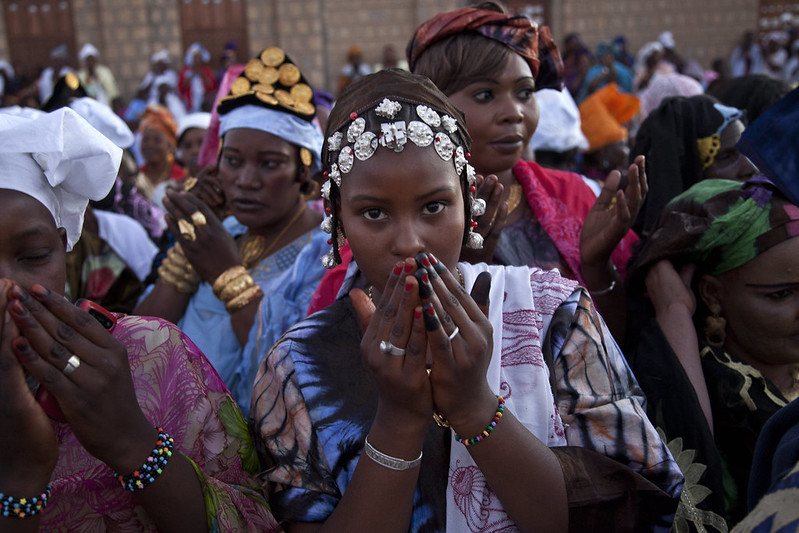
© Photo by United Nations Photo via Flickr
The ICC is set to deliver its judgment on the Al Hassan case – a potentially significant development in international law.
Case Summary
The Office of the Prosecutor alleges that – amongst other charges – both gender and religious persecution took place during the ten months the Malian city of Timbuktu was under the control of two armed groups, Ansar Dine and Al-Qaeda in the Islamic Maghreb (AQIM), from 2012-2013.
Al Hassan is an alleged member of Islamic militant group Ansar Eddine / Al Qaeda and was the de facto chief of Islamic police. Mr Al Hassan was involved in the work of the Islamic court in Timbuktu and participated in executing its decisions.
Gender-Based Persecution (GBP) and Gender-Based Violence (GBV)
The Al Hassan case represents the ICC’s first-ever prosecution of the crime against humanity of persecution on grounds of gender, found in Article 7(1)(h) of the Rome Statute.
Article 7
Crimes against humanity
1. For the purpose of this Statute, “crime against humanity” means any of the following acts when committed as part of a widespread or systematic attack directed against any civilian population, with knowledge of the attack:
(h) Persecution against any identifiable group or collectivity on political, racial, national, ethnic, cultural, religious, gender as defined in paragraph 3, or other grounds that are universally recognized as impermissible under international law, in connection with any act referred to in this paragraph or any crime within the jurisdiction of the Court;
As stated in the ICC’s December 2023 Policy on Gender Based Crimes, both GBP and GBV are categorised as a catch-all term of gender-based crimes (GBC). It is crucial to note that gender-based persecution is distinct from gender-based violence (GBV).
GBV is defined as violence committed against persons, whether male or female, because of their sex and/or gender roles.
GBP by contrast, is a subset of the crime of persecution which inter alia can be on the grounds of gender and/or gender roles. Religious persecution is another example. Persecution is a crime against humanity crystallised as an international crime during the International Military Tribunals following World War Two.
Gender persecution is committed against persons because of what the ICC describes as their “sex characteristics and/or because of the social constructs and criteria used to define gender.” Groups and individuals targeted for gender persecution include, for example women, girls, men, boys and LGBTQI+ persons, and subsets of these groups.
GBP is clearly not new in conflict, but there has been a lack of jurisprudence in international criminal law – the Al Hassan case is set to change this.
As with all forms of persecution, accountability for gender persecution requires recognition and understanding of the discrimination that underlies the crime. In other words, there must be clear mens rea, or intent (Article 7(2)(g)) to persecute – intent is understood to progressively mean subjective intent.
Some examples of GBP include slavery; torture; restrictions on basic freedoms such as expression, assembly, bodily integrity, political or cultural participation; the regulation of clothing; the restriction of interactions between men and women; denying girls education; psychological abuse; cultural destruction or confiscation.
Other examples which are looked at by the international criminal community includes allegations of GBP by the Taliban to women and girls, and ISIL to Yazidi women in Iraq.
Operational Impact in the Field
Comparable to the precedent set by the Al Mahdi case, which significantly advanced policy in the realm of cultural property protection, a successful conviction in the Al Hassan case will carry both operational and analytical implications for professionals such as gender advisors, human security advisors and investigators operating in the field, as well as military and humanitarian planners at HQs.
This could include:
- During the analysis and understanding phase of planning, an intersectional approach must be taken. This is because justice, humanitarianism, development and peacebuilding require a holistic understanding as to why perpetrators committed such acts, in order to contribute to the elimination of discrimination and efforts to break cycles of violence.
- Field staff and planners should promote inclusivity in conflict resolution strategies. Guided by the lessons from the forthcoming Al Hassan ruling and recognizing the diverse impacts of GBP on different groups, planners should design interventions that are sensitive to the unique needs of women, girls, men, boys, and LGBTQI+ individuals.
- When operating in the field, language or actions which seem to be discriminatory towards marginalised groups should be considered an indicator and warning for possible future persecution during conflict.
- Planners should ensure that their operational design and mission accounts for the potential impact on diverse groups, particularly being cognisant of the specific vulnerabilities and risks associated with GBP.
- Field staff should be well trained in cultural sensitivity and localized engagement. Recognising that GBP can be deeply intertwined with cultural norms and practices, staff should engage with local communities to understand the context and perceptions surrounding gender issues. This approach not only fosters trust but also enables the development of targeted interventions that respect cultural nuances and empower local communities to address GBP within their specific context.
Conclusion
The intersection of legal outcomes and operational ramifications underscores the evolving nature of international law and its impact on those engaged in promoting justice and security on the ground. This judgment will likely contribute not only to legal precedent but also to shaping strategies and practices of those committed to upholding human rights and security in conflict zones.