
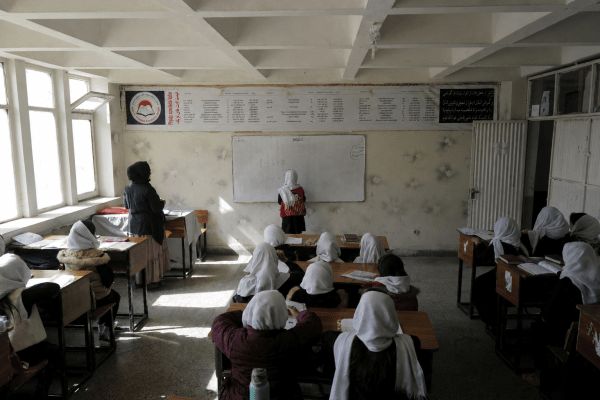
Afghanistan’s Gender Apartheid: Five Years of Repression and the Risk of Normalisation
Five years after the Taliban’s return, Afghanistan’s gender crisis risks entering a new phase.
© Ministry of Defence of Republic of Serbia, via Wikimedia Commons
With the conclusion of the 1990’s conflict in Yugoslavia, and the Dayton Peace Accords [1] ushering in a negative peace with a sui generis (‘of its own kind’) representational government, social cohesion and the legitimacy of political processes have been on the verge of, yet have avoided ultimate fragmentation and breakdown. The power-sharing model of government, which distributes power among the main three constitutive nations of the state as outlined in the Dayton Peace Accords: Bosnian/ Bosnijak, Serb, and Croatian, in accordance with the spirit of the Accords and the conclusion of the conflict. The Dayton Peace Accords also provided for the implementation of an institution as a short-term representative of peacekeeping in the state, known as the Office of the High Representative, a representational institution responsible for the smooth processing of judicial, executive, social, and legislative processes in the state [2].
As the Bosnian War concluded and regular elections were established, key political players were continuously re-elected amid leftover nationalistic resentments from the 1990’s conflict of the region, with many harnessing such leftover grief and nationalistic emotions in a populist manner for successful re-election [3]. Milorad Dodik, the current president of the Republika Srpska entity, is an illustration of this. He has managed to play a key role in state politics at both the national and entity level. Milorad Dodik, known to many for his sanctioning by various organisations and governments for diverse violations of democratic processes and corruption [4] [5] and for his anti-Dayton separatist policies, began his career as Republika Srpska’s Prime Minister in 1998, rising to the level of the tripartite presidency where he served until 2022, and now resides as the President of the entity [6]. President Milorad Dodik’s policies and antics have been outlined as unconstitutional and a threat to the fragile peace established in the state, as well as seemingly being the main local obstacle to achieving European Union Membership due to his consistent blockades of reforms necessary for progress. However, with his recent dethronement from leadership, and arrest warrants issued in his name, the following article will examine the build-up to his fall from political grace, and the role of state and institutional actors in his descent.
Following his conviction rendered by the Constitutional Court of Bosnia and Herzegovina, no shortage of chaotic rhetoric and threatening ultimatums have been issued. With the former President’s fall from grace and his defiance to appear on an arrest warrant issued by the constitutional court, Bosnia and Herzegovina’s state institutions have now stepped up to issue a nationwide arrest warrant for the defiant leader [7]. A detention order was served prior to the issuing of the nationwide arrest warrant, however following his conviction, Milorad Dodik has been accused of engaging in attacks on the constitutional order, which warranted a nationwide arrest. Should Milorad Dodik resist detention and evade arrest or flee Bosnia, an Interpol warrant for his arrest may be implemented. Since his conviction, the assembly of Republika Srpska approved unconstitutional laws essentially banning and negating the legitimacy of a cohort of state institutions; including the state-level prosecution and court, the High Judicial and Prosecutorial Council, and the State Investigation and Protection Agency. While the constitutional court suspended the implementation of these laws, the former president insists on their actualisation, thereby engaging once again in unconstitutional and anti-Dayton acts.
With the proclamation that “Bosnia is more divided than ever,” [8] former president Milorad Dodik underlined the growing tensions and turmoil that surround the state’s future sovereignty and independence; an atmosphere that the president himself had contributed to and strived to emphasise among the ethnic and national lines of the state’s society. Due to recent events prior to his conviction explored further below including judicial prosecution and a radical political change, Dodik’s future in the decision-making processes of Bosnian and Herzegovinian politics has seemingly come to an end, in a long-awaited declaration for his replacement.
The governing tripartite coalition “Trojka”, made up of the Social Democratic Party, the People and Justice Party, and the Our Party party, declared their intentions to replace president Milorad Dodik and his ministers in the House of Representatives and beyond [9]. This was presented as a courageous attempt to unblock Dodik’s determined anti-EU decisions, and questions arose about the stability of social cohesion and future cooperation between entities. The Trojka coalition announced the termination of the coalition agreement with Dodik’s Alliance of Independent Social Democrats (SNSD) after deputies of his party abstained from voting on two key European laws in the House of Representatives of the Parliament of Bosnia and Herzegovina [10]. Such a blockage of pro-European reforms was expected for state policymakers, considering Milorad Dodik’s past unwillingness to cooperate with the Office of the High Representative’s declarations or the rulings of the Constitutional Court of Bosnia and Herzegovina [11]. Dodik’s replacement indicates a new beginning for the future of the state towards EU membership, however, it has been met with fierce opposition from the Bosnian Serb constituents and supporters of Milorad Dodik’s regime. In place of Dodik’s representatives in the House of Representatives, the newly formed coalition between the “Trojka” and the oppositional party of Republika Srpska, the Serb Democratic Party, freshly initiated the establishment of MP Darko Babalj, as a representative with the interests of the Bosnian Serb people [12]. This emergency appointment, as discussed above, served to eliminate the obstruction to Bosnia and Herzegovina’s EU integration. The Trojka cited that SNSD’s political actions severely diminished this ability to flourish as the state’s main foreign policy objective, as reported by N1. Following MP Darko Babalj’s appointment, Dodik has reiterated his disapproval for the oppositional candidate, further straining the political scene especially on the entity level [13].
Dodik’s supporters were key in disrupting the course of his trial at the Constitutional Court, and as the date of his conviction drew nearer, there were no shortage of threats and pressure emitting from Republika Srpska. There was a noticeable absences of support from the side of the EU, the OHR, as well as the High Judicial and Prosecutorial Council of Bosnia and Herzegovina regarding the necessary protection for Judge Sena Uzunovic, the lead judicial figure in the trial, in order for her to render a fair and impartial verdict [14]. As observed online, immense pressure was placed on Judge Sena Uzunovic, who became a target of pressurising and threatening messages, and in a manner of speaking became a symbol for the legitimacy of the judicial system. Her then potential verdict was described as the move that could cause an unprecedented crisis and bury the country. The continuous berating messages and threats online foreshadowed a difficult test ahead for Judge Uzunovic, and the legitimacy of the judicial system, should she succumb to the pressure of Milorad Dodik and his supporters in Republika Srpska [15]. While International institutions alike pledged support in the event of a crisis breaking out, greater assistance was required to sustain the judicial infrastructure especially in the face of a leader who delegitimised the Constitutional Court of the State before. While rule of law was maintained in this case under intense pressure and turmoil, its potential erosion in the future remains a possibility, raising questions on the topic of the country’s future sovereignty, social cohesion, democratic processes and institutions, and finally, the path to EU accession.
While a seemingly recent development, President Dodik’s replacement had reportedly been on the table for years, due to his uncooperative tendencies, devaluation of state institutions and the High Representative, and accusations of corruption [16]. However, with an affirmative conviction on charges of unlawful signing of presidential decrees and two unconstitutional laws (which provide for the devaluation of the Constitutional Court’s and the OHR’s decisions in Republika Srpska) previously annulled by the High Representative on the horizon, Milorad Dodik’s reign in politics on the entity level has resoundingly wrapped up [17]. However, with the backing of his loyal supporters and party, it is uncertain whether his conviction will lead to further societal breakdown or heightened nationalistic emotions despite the inhabitants of Republika Srpska’s current ambiguousness to his threats and calls for separatism [18]. By consistently defying the High Representative’s authority and action, suspending recognition of the state’s constitutional court through the passing of unconstitutional laws mentioned above, and striving to establish an independent electoral law on the level of the entity [19] [20], the president clearly aimed to bring Bosnia and Herzegovina’s boiling ethnic tensions to a breaking point. Such actions were seemingly implemented in hopes of achieving the nostalgic Greater Serbia dream and positions left over from the Bosnian war of the 1900’s. With his descent from political processes however, peace, democracy, social cohesion and the road to EU membership may be back on track.
Despite succession threats following the state’s political and societal climate from 2006, the president’s efforts in 2024 demonstrated his increasing will to formalise such actions and synergise this ideology with Serbian head of state president Vucic. He seemingly strived to connect Republika Srpska’s capital Banja Luka with Belgrade in economic, social, and demographical terms. The ushering in of 2024 witnessed Dodik embrace worrying legal actions and steps towards this expansionist ideal, by aiming to establish a separate electoral law on the entity level. These actions thereby signified Republika Srpska’s formal position on sovereignty and the division of the state.
In the days leading up to his conviction and ban from political participation, Dodik’s supporters and colleagues extended threats to include certain secessionism, the formation of the Republika Srpska Army, and a referendum for the implementation of a constitution of Republika Srpska [21]. In a press conference address, the Bosnian Serb leader claimed that the entity would “fight for the Constitution of Bosnia & Herzegovina,” threatened to pursue an abolishment of state ministries, and rallied supporters to the National Assembly of Republika Srpska. He radically compared himself to the convicted war criminal Radovan Karadzic, as reported by N1, and reiterated previous threats. While blatant inflammatory rhetoric presents no new skill in Dodik’s policies over the years, Ramiz Salkic, Bosnijak Representative in the Republika Srpska National Assembly advised that Republika Srpska retains the capacity to produce incidents; further advising that this radicalisation of politics and nationalistic tendencies were a desired outcome for the Bosnian Serb Belgrade-backed leader [22]. Ramiz Salkic advised that maintaining trust in the Bosnian institutions to uphold the rule of law is crucial, and further analysed the motivations behind the inception of the political turmoil as a means to achieve wartime goals. As stated by Ramiz Salkic “We should not underestimate the intentions of the authorities in this entity and Serbia to destabilize the situation in BiH, and they will use this verdict, if it is a conviction, as an argument, as a pretext for such actions. In fact, for all these years, they have been looking for any reason to radicalize the situation and attempt to achieve their unrealized wartime goals […]” [23].
With growing divisions on ethnic and nationalistic lines fanned by passive stances from the West, as explored below, in an attempt to evade the total breakdown of state sovereignty, jurisdiction, and the rule of law, the potential division of the state may ultimately preside as the only viable option to prevent history from repeating. Such a potential division may serve additionally to avoid the utter demolishment of the fragile peace established since the dissolution of Yugoslavia. An awakening of policies of nationalistic and religious differences, risk the mobilisation and indoctrination of extremism in the youth which may seek to emphasise the gains, and right the loss of the Bosnian Serb separatist aims of the 1990s. With overreaching support from the Serbian Deputy Prime Minister Aleksandar Vulin, who claimed that “the process of unification of all Serbs has begun and no one can stop it,” [24] a seemingly general consensus among the administrations of Republika Srpska and Serbia on the desire of unification preceding state sovereignty and integrity has been observed. Non-democratic stances and ideologies may be utilised to indoctrinate the youth of the next generation, in an attempt to relive the events of the 1990s.
Ahead of Milorad Dodik’s conviction, much inflammatory rhetoric was captured by media outlets. EUFOR reportedly monitored the situation carefully and stated prior to his sentencing that “in accordance with its mandate, EUFOR will continue to provide full support for peace, stability, and security throughout the entire territory of Bosnia and Herzegovina.” [25] Major General Barbu assured N1 reporters of EUFOR’s commitment and respect of the legal frameworks and institutions of the state. Amidst incoming threats from Republika Srpska of secessionism, organised protests in support of Milorad Dodik, and a radical proclamation of the implementation of a constitution for the Entity, NATO additionally pledged its support and aid to halt potential destabilisation in the state should it materialise. NATO headquarters in Sarajevo “stressed the importance of maintaining stability”, along with the support of the EU’s Althea mission, and committed to the prevention of the emergence of a security vacuum [26].
President Dodik’s current policies are nothing if not consistent with his appeals to Serbian nationalistic and separatist passions, which are remnants of general Serbian rhetoric from the 1990s. Since the establishment of the Dayton Peace Accords, which has proven to not conform to any ethnic constituency’s ideal conclusion to the war, Milorad Dodik has from the beginning, emphasised his visions for a greater Serbia; alongside his denial of the volume of atrocities committed during the war. While the war was concluded over thirty years ago, the underlying tensions and animosity towards the other constituents remains and seemingly will not end until the inauguration and revival of the conflict of the 1990s.
Considering Milorad Dodik’s conviction, awaiting incarceration, and replacement in his role as President of Republika Srpska, the possible implications for the future differ, in diverse thematic spheres. Potential conflict could erupt as a result of the opposition’s coalition with the Trojka to oust him from the political scene. However, the opposition in Republika Srpska secured the votes of the two biggest cities in the entity, and the general population has not engaged in expected inflammatory and violent behaviour in protest of his incarceration. The majority has also refrained from answering his call to desert their posts in state institutions, therefore it may be inferred that the inhabitants of Republika Srpska have decided to turn the page on the Alliance of Independent Social Democrats and its nationalistic populism. With the prime political obstacles to EU reforms out of the way, social cohesion, EU support, and peacebuilding measures as well as a strengthened capacity of rule of law may be established. Considering the facts laid out in this article above, a recommendation for greater EU institutional support for the constitutional court and political institutions in order for rule of law to prevail and progress, is in order. Further, the Office of the High Representative should be empowered with additional resources and support to conduct its mandate and supervise the state’s progress in tackling corruption and unlawful political antics. Additionally, in light of Milorad Dodik’s failed attempt to coerce the people of his entity to abandon their posts in state institutions, enhanced international institutionally-implemented dialogue between entities and the constituents of Bosnia and Herzegovina should be implemented to take advantage of this opportunity for reconciliation and to forge a shared future together in spite of the raging nationalistic rhetorics that have governed Bosnian and Herzegovinian politics for the last 30 years.
[1] ‘The General Framework Agreement for Peace in Bosnia and Herzegovina’ (Office of the High Representative) <https://www.ohr.int/dayton-peace-agreement/> accessed 10 February 2025
[2] ‘Mandate’ (Office of the High Representative) <https://www.ohr.int/about-ohr/mandate/> accessed 24 February 2025
[3] Sokol A, Petković B and Hodžić S, Resilience: For Media Free of Hate and Disinformation. Propaganda, Disinformation and Hate Models of Media and Communication in Bosnia and Herzegovina Anida Sokol (SEENPM : Peace Institute : ǂFoundation ǂMediacentar 2020)
[4] Reported by OCCRP, ‘US Sanctions Target Dodik Family Network in Bosnia’ (OCCRP, 19 June 2024) <https://www.occrp.org/en/news/us-sanctions-target-dodik-family-network-in-bosnia> accessed 10 February 2025
[5] Foreign C& DO, ‘UK Announces Sanctions under Bosnia and Herzegovina Sanctions Regime: 11 April 2022’ (GOV.UK, 11 April 2022) <https://www.gov.uk/government/news/uk-announces-sanctions-under-bosnia-and-herzegovina-sanctions-regime-11-april-2021> accessed 10 February 2025
[6] ‘Milorad Dodik’ (President of the Republic of Srpska Milorad Dodik Milorad Dodik Comments) <https://www.predsjednikrs.rs/en/biography/> accessed 11 February 2025
[7] ‘Bosnia Steps up Efforts to Arrest Dodik with Nationwide Warrant’ (Balkan Insight, 17 March 2025) <https://balkaninsight.com/2025/03/17/bosnia-steps-up-efforts-to-arrest-dodik-with-nationwide-warrant/> accessed 21 March 2025
[8] ‘Milorad Dodik Says Bosnia Is “More Divided Than Ever”’ (YouTube, 10 January 2024) <https://www.youtube.com/watch?v=OPdWQ0FHCuo> accessed 11 February 2025
[9] Admin, ‘“the Coalition of Three” No Longer in Coalition with SNSD’ (Sarajevo Times, 23 January 2025) <https://sarajevotimes.com/the-coalition-of-three-no-longer-in-coalition-with-snsd/> accessed 24 February 2025
[10] Radio Slobodna Evropa, ‘Pokrenuta Inicijativa Za Smjenu Kadrova Milorada Dodika Iz Vijeća Ministara BiH’ (Radio Slobodna Evropa, 5 February 2025) <https://www.slobodnaevropa.org/a/trojka-snsd-milorad-dodik-amidjic-kosarac-/33304285.html> accessed 11 February 2025
[11] Service RB, ‘Dodik Signs Controversial Law Blocking Publication of Decisions by International Envoy to Bosnia’ (RadioFreeEurope/RadioLiberty, 7 July 2023) <https://www.rferl.org/a/bosnia-dodik-signs-law-schmidt-decisions-high-representative/32493786.html> accessed 23 February 2025
[12] N1 Sarajevo F, ‘Darko Babalj New Member of BiH Pa Hor Board, Replacing Radmanovic’ (N1, 20 February 2025) <https://n1info.ba/english/news/darko-babalj-new-member-of-bih-pa-hor-board-replacing-radmanovic/> accessed 24 February 2025
[13] ‘Bosnia and Herzegovina’s Political Scene Heats up like Never Before’ (Sarajevo Times, 22 February 2025) <https://sarajevotimes.com/bosnia-and-herzegovinas-political-scene-heats-up-like-never-before/> accessed 24 February 2025
[14] Hambo S, ‘Ohr, EU, Ambasade, VSTV… Zašto Šutite Na Neviđene Pritiske Na Sutkinju Senu Uzunović?’ (Klix.ba, 21 February 2025) <https://www.klix.ba/vijesti/bih/ohr-eu-ambasade-vstv-zasto-sutite-na-nevidene-pritiske-na-sutkinju-senu-uzunovic/250221008?widget%5C> accessed 24 February 2025
[15] AL Jazeera, ‘Pritisci Na Sutkinju Uzunović: Oglasili SE OSCE i Eufor, Institucije BiH Bez Reakcije’ (Al Jazeera Balkans) <https://balkans.aljazeera.net/videos/2025/2/21/pritisci-na-sutkinju-uzunovic-oglasili-se-osce-i-eufor-institucije-bih-bez-reakcije> accessed 24 February 2025
[16] Fenix Magazin, ‘Napetosti u BiH: Moguća Je Smjena Dodika Zbog Kršenja Daytonskog Sporazuma’ (Fenix Magazin, 13 September 2023) <https://fenix-magazin.de/napetosti-u-bih-moguca-je-smjena-dodika-zbog-krsenja-daytonskog-sporazuma/> accessed 11 February 2025
[17] Zvijerac P, ‘Suđenje Dodiku U Završnoj Fazi: Šta Se Sve Događalo?’ (Radio Slobodna Evropa, 7 February 2025) <https://www.slobodnaevropa.org/a/sudjenje-miloradu-dodiku-bih/33305791.html> accessed 11 February 2025
[18] Cantone S, ‘High Stakes in Bosnia: Dodik’s Trial Could Ignite Ethnic Tensions’ (euronews) <https://www.euronews.com/my-europe/2025/02/19/why-bosnias-political-integrity-could-depend-on-sarajevo-courts-republika-srpska-verdict> accessed 24 February 2025
[19] Kurtic A, ‘Bosnian Serbs Adopt Election Law Draft, Hitting Back at High Representative’ (Balkan Insight, 29 March 2024) <https://balkaninsight.com/2024/03/29/bosnian-serbs-adopt-election-law-draft-hitting-back-at-high-representative/> accessed 24 February 2025
[20] Sarajevo N, ‘Dodik Criticizes Constitutional Court and Affirms Commitment to RS Election Law’ (N1, 24 July 2024) <https://n1info.ba/english/news/dodik-criticizes-constitutional-court-and-affirms-commitment-to-rs-election-law/> accessed 24 February 2025
[21] ‘Dodik Issues Series of Threats Ahead of His Sentencing’ (N1, 21 February 2025) <https://n1info.ba/english/news/dodik-issues-series-of-threats-ahead-of-his-sentencing/> accessed 24 February 2025
[22] ‘“Republika Srpska Has Sufficient Capacities to Produce Incidents”’ (N1, 21 February 2025) <https://n1info.ba/english/news/republika-srpska-has-sufficient-capacities-to-produce-incidents/> accessed 24 February 2025
[23] Hina and Hina (2024) Vulin: Proces Stvaranja srpskog svijeta je započeo i ne može Se Zaustaviti, index.hr. Available at: https://www.index.hr/vijesti/clanak/vulin-ujedinjenje-svih-srba-je-zapocelo-i-ne-moze-se-zaustaviti/2617495.aspx (Accessed: 02 December 2024).
[24] Sarajevo N, ‘EUFOR “Monitoring the Situation” in BiH after Threats from Republika Srpska’ (N1, 21 February 2025) <https://n1info.ba/english/news/eufor-monitoring-the-situation-in-bih-after-threats-from-republika-srpska/> accessed 23 February 2025
[25] Hina, ‘Ahead of Dodik Verdict: NATO, EUFOR Ready to Stop Destabilisation of Bih’ (N1, 22 February 2025) <https://n1info.ba/english/news/ahead-of-dodik-verdict-nato-eufor-ready-to-stop-destabilisation-of-bih/> accessed 23 February 2025
[26] Međedović F, ‘Opozicija SNSD-U Uzela Dva Najveća Grada, Sad I Državu? “Grčevito Će Se Boriti”’ (N1, 5 February 2025) <https://n1info.ba/vijesti/nebojsa-drinic-o-snsd/> accessed 23 February 2025
Five years after the Taliban’s return, Afghanistan’s gender crisis risks entering a new phase.

Central Asia’s drug trade has changed faster than many of its legal frameworks. As synthetic substances, online sales, and domestic consumption reshape the market, states have responded unevenly.

On 1 July 2026, a sweeping set of constitutional reforms came into force in Kazakhstan, ending the sitting parliament and launching a significant legal transformation in the Central Asian state.