
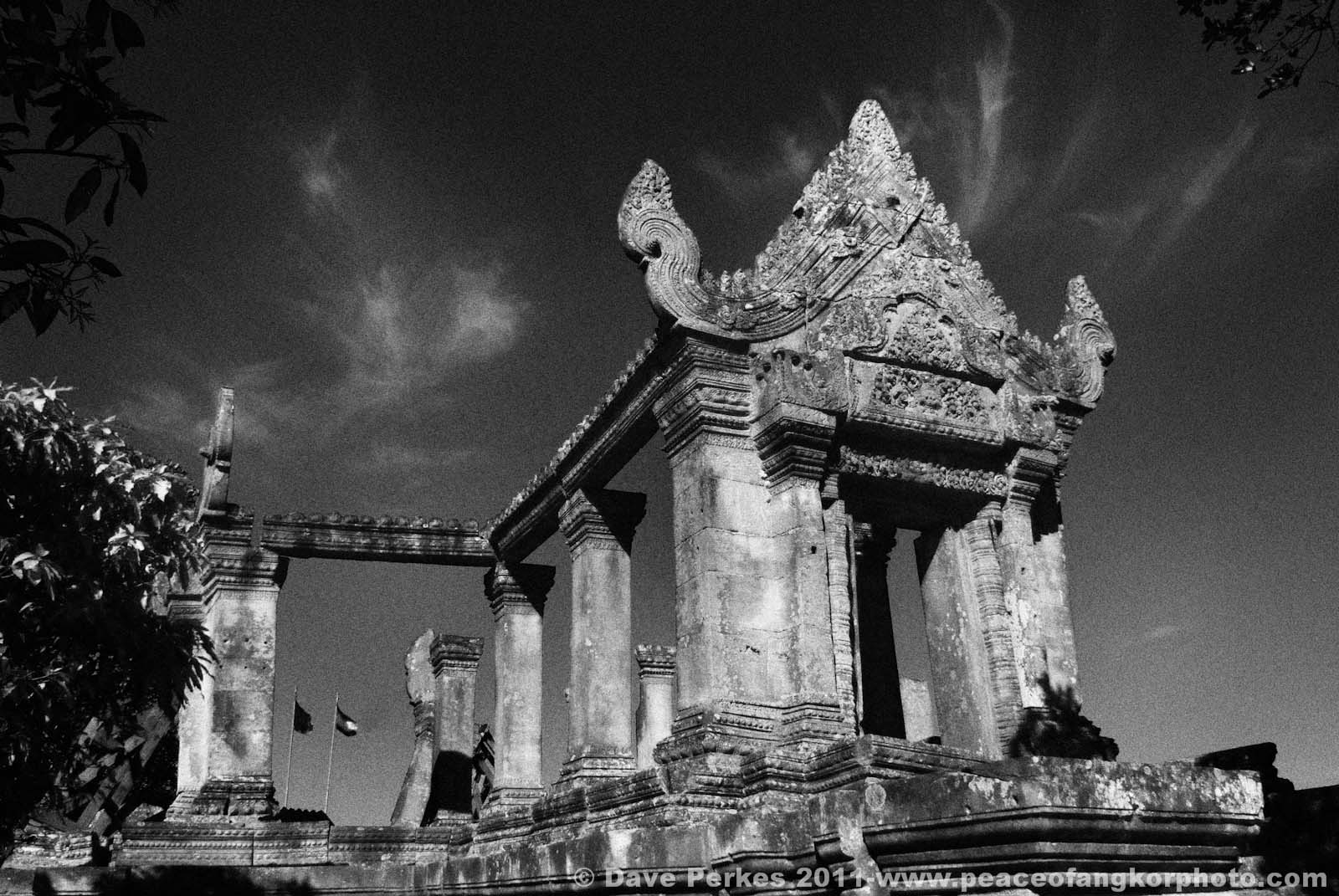
The recent Thailand and Cambodia border rift marks a serious escalation of a long standing territorial conflict in the Southeast Asian region. Cambodia and Thailand have maintained cordial bilateral relations; Thailand is Cambodia’s fourth largest trading partner and political elites of both countries share close personal ties.2 The two former leaders of Cambodia and Thailand, Hun Sen and Thaksin Shinawatra respectively, are close friends.3 Thailand is also a major destination for Cambodian migrant workers and remittances from these workers contribute to Cambodia’s national economy.4 However, irrespective of these ties, the two countries have been in disagreement over their border demarcation, drawn during the colonial era. In the 803-kilometre land border shared by the two countries, the contentious area lies in the northern section, specifically around the Preah Vihear Temple. The core dispute lies over a 4.6-square- kilometre tract of land surrounding the temple.5 This area has been the site of military standoffs and occasional skirmishes, most notably in the late 2000s and early 2010s. The latest escalation, triggered in May 2025, has proven to be the most intense in over a decade, resulting in major disruptions in the lives of people and impacting security.
History of the Conflict
The roots of this conflict can be traced back to the colonial demarcation of Cambodia’s border by the French in the 20th century. The 1907 Franco-Siamese treaty granted Cambodia control over Battambang, Siem Reap, Serei Saophoan, the Temple of Preah Vihear, and other contested territories, to Thailand’s dismay.6 Disregarding the outcome, Thailand reoccupied the Temple of Preah Vihear in1941 and Cambodia took the dispute to the International Court of Justice (ICJ) in 1959.7 The ICJ ruled in favour of Cambodia and the Temple of Preah Vihear was officially returned to Cambodia. In 2008, when Cambodia applied for the Temple of Preah Vihear to be listed as a United Nations Educational,Scientific and Cultural Organisation (UNESCO) World Heritage site, tensions resurfaced, as Cambodia had also included territory that Thailand claimed as its own in its application.8 Thai nationalist groups protested against the UNESCO application and claimed that it infringed on the sovereignty of Thailand.Subsequently, the government increased military presence in the area and Cambodia responded similarly. The confrontations that occurred in 2008-2011 between the two countries, resulted in the death of nearly 34 people and left many displaced.9 Fighting that was mostly concentrated around Preah Vihear spread to the Ta Krabey and Ta Moan temples areas, further west along the border. At the time, the ASEAN was not able to bring the parties to a peaceful settlement. In 2013, when Cambodia referred to the ICJ again, the courts reconfirmed that the temple and its immediate vicinity lay within Cambodian territory.10 However, Thailand has refused to accept the ICJ ruling.
Current Context
The recent escalation of the conflict was triggered by the death of a Cambodian soldier during a border skirmish that took place on 28 May.11 This propelled the Cambodian government to move troops towards theEmerald Triangle region and Thailand responded in a similar manner. Relations between the two countriescontinued to deteriorate leading Thailand to close its shared borders. Cambodia also placed restrictions on trade, travel and broadcasting of Thai dramas.12 Amidst rising tensions, the then Thai Prime Minister, Paetongtarn Shinawatra, contacted the former Prime Minister of Cambodia, Hun Sen, to negotiate and resolve the issue. However, the phone call got leaked and the public became aware that Shinawatra called the former Cambodian prime minister “uncle” and told him to ignore a Thai military commander who “just wanted to look cool.”13 This led to Shinawatra being criticised for ‘undermining Thailand’s politically influential army’. This eventually resulted in Shinawatra being suspended from office on 1 July 2025.14Further, the Bhumjaithai party, a major partner in the prime minister’s coalition government, left the coalition.15 Afterwards, a Thai soldier was injured due to a new land mine allegedly placed by Cambodia, violating Cambodia’s obligations under the Ottawa Convention. On 24 July, after months of escalating tensions, fighting ensued near the Ta Muen Thom temple,16 but expanded to other areas with heavy artillery and airstrikes, leading to thousands being displaced by the conflict along the border. Thailand reported fighting in its Surin, Ubon Ratchathani and Srisaket provinces, along the border with Cambodia. It consequently declared martial law in eight districts bordering Cambodia.17
After five days of fighting, on 28 July, under the mediation of Malaysian Prime Minister, Anwar Ibrahim, Cambodia and Thailand agreed to an “immediate and unconditional” ceasefire, scheduled to take effect at midnight.18 The United States also intervened by pressing the two countries to come to a ceasefire agreement, leveraging its trade talks and the imposition of a 36% tax unless the two countries came to an agreement, and China facilitated further diplomatic talks.19 However, not long after the ceasefire, there were reports of attacks by either party on one another, including Thai soldiers being injured by landmines. The ceasefire brokered seems to be fragile and nationalistic rhetoric and disinformation are still fostering deeper social divisions in both countries.
Impacts on Security and Livelihoods
Over the course of the five days of intense fighting and the weeks of escalating tensions that preceded it, Thai and Cambodian citizens have borne the brunt of the violence, particularly those living in border villages, as their lives, livelihoods, and personal safety were negatively impacted. According to Reuters, at least 43 people have been killed and over 300,000 displaced on both sides of the border.20 Reports captured how people have been killed while engaging in everyday activities in border villages. According to the Cambodian Ministry of National Defence, as of 4 August, there are 124,940 civilians displaced in Cambodia in the areas of Oddar Meanchey, Preah Vihear, Siem Reap, Banteay Meanchey and Pursat.21 Displaced people have been evacuated to makeshift refugee camps, government evacuation centres, relatives’ houses outside the border provinces, and even temples.22 However, displaced civilians have nowbegun to return to their homes in border provinces, still with fear of the looming conflict.23
In this conflict, one of the most affected parties is Cambodian migrant workers employed in Thailand.Thousands of migrant workers were compelled to return to Cambodia due to fear of violence, rising discrimination and hate speech against Cambodians24 as well as rumours that their Cambodian citizenship would be revoked if they continued to live in Thailand. Further, there have been reports of Cambodians being harassed by Thai gangs.25 According to the Cambodian Ministry of Labour and Vocational Training, around 1.2 million Cambodians were working in Thailand when the conflict erupted in June but that number has drastically reduced with about 65% having returned to Cambodia by August.26 The returnees from Thailand are now highly anxious about finding a source of income, specifically since the income they earned in Thailand is comparatively higher than what they earn working in Cambodia. Many returnees were placed in a precarious situation due to the loss of income as they rely on it to pay off debts.27 Furthermore, there is a lack of economic safeguards for these migrant workers, without state-sponsored safety nets in place when they return. Cambodia nearly earns USD 3 billion in remittances from these workers, contributing to their national foreign reserves.28 Therefore, the lack of remittances itself will have a direct impact on the state as well and the state will find it difficult to find employment for the returnees. Furthermore, even though a ceasefire is in place, whether Cambodian migrant workers can return to their previous workplaces remains doubtful. Indeed, the Thai government has already reached out to other states such as Sri Lanka to replace the Cambodian workforce that has left the country.29 Further, the border closures impacted the people whose livelihoods were driven by border exchanges. Thailand has 17 border crossings including Ban Khlong Luek, Aranyaprathet district in the Sa Kaeo province which is one of the busiest checkpoints between the two countries, as traders, merchants

and tourists use this crossing on a daily basis.30 With the escalation of the conflict, small-scale traders and merchants from both countries, who conducted their businesses across the two states, are finding it difficult to carry on with their work during the limited border opening hours.31 Small business owners thus risk losing money to support their families. They also face psychological pressure, especially those who rent houses near Rong Kluea Market and have children going to school in Cambodia, as they have to travel back and forth. Street vendors and small shop owners who operate their business on the border towns report a decline in their sales. Thousands of Cambodian vendors rely on the Ban Khlong Luek Border Market to sell their products. Further, many Thai gamblers cross this border to enter the Poipet area. These are notmonolithic groups, but individuals operating within complex networks of supply and demand. Suddenly, these networks were severed, leaving people stranded, livelihoods threatened, and the local economy thrown into disarray. While the border conflict is a major national security threat, the impact at socio-economic level is often overlooked.
Conclusion
The 2025 Cambodia–Thailand border conflict highlights how deeply rooted territorial disputes, left unresolved since the colonial era, can still destabilise regional peace. Even though Cambodia and Thailand have maintained cordial relations through political and economic ties, nationalist politics and competing interests in the border area can disrupt stability. This escalation has not only caused loss of life and displacement but also disrupted cross-border trade, strained livelihoods, and forced thousands of Cambodian migrant workers to return home under uncertain economic conditions. Although a ceasefire has been brokered by the ASEAN with Malaysia acting as the mediator, it remains fragile. Ultimately, without a long-term settlement grounded in international law and mutual trust, the cycle of escalation can yet repeat.