
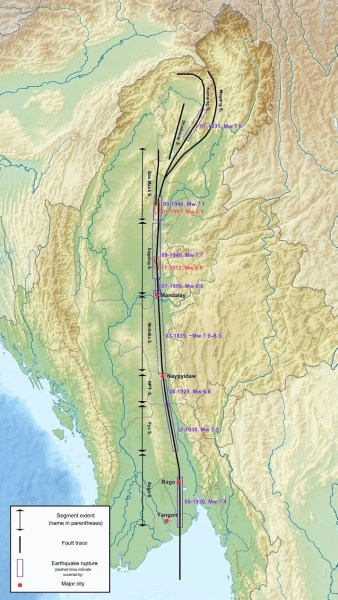
Damage Caused by the Earthquake
The earthquake cost 3,700 deaths, injured 4,800, and left 129 missing – with the death toll continuing to rise.2 The earthquake severely damaged critical infrastructure across multiple sectors: transportation (103 bridges, 83 railway segments, 11 railway bridges), communications (6,730 mobile stations), power (10 transmission lines, 3,435 towers). Additionally, many schools and hospitals were affected. This widespread destruction has left people struggling to access basic necessities. Similarly, temples, stupas, and religious buildings were demolished by the earthquake.3
After-Effects of the Earthquake
The damage caused by the earthquake has had far-reaching and compounding consequences, disrupting not only immediate relief efforts but also critical sectors that sustain people’s everyday lives. In particular, food security, access to healthcare, economic stability, and internal displacement have all been deeply affected. This would result in harsh conditions for the people of Myanmar who lost their homes and livelihoods over the coming months and years.

Screenshot of a video from China News Service that shows the aftermath of the 2025 Myanmar earthquake (China News Service 2025)
Economic Sector
The collapse of infrastructure has severely disrupted and delayed the delivery of aid and trade in the region. Power lines, irrigation systems, and storage facilities were rendered inoperable. This led to businesses facing supply shortage, factory closure, and job losses, etc. which in turn resulted in decline in productivity and trade, a sharp blow to household incomes and food security.
Undoubtedly, both macroeconomic and microeconomic sectors will be in distress, leading to a more drastic poverty and lack of human capacity. According to the Global Rapid Post-Disaster Damage Estimation (GRADE) Report from the World Bank, the total direct economic damage is projected at US$ 10.97 billion, approximately equivalent to 14% of Myanmar’s Gross Domestic Product (GDP) for the 2024-2025 financial year.4 Obstructions of infrastructure, supply chains, logistics, and a 14% loss in GDP can steer a more adverse financial instability and inflation along with the shortages of food, fuel, and other basic commodities.
Since before the earthquake, the country has been embroiled in civil war and mass displacement crises across the country and to other nations due to conflicts, human rights abuses, and conscription laws. Thus, the human capacity has dwindled significantly during the last five years. Youth, once a backbone of social resilience and grassroot recovery efforts5 have fled to other countries because of political instability and lack of assurance for their future. The economic disruption, infrastructure loss, and dwindling human capacity signal not just temporary torment but long-lasting setbacks to the country’s capacity to recover, govern, or develop sustainably. Unless the situation is handled wisely, the country will be locked in a cycle of poverty, instability, and dependency for years to come.
Food Insecurity and Healthcare Insufficiency
Malnutrition becomes a mounting concern for the people in Myanmar. The damage to the irrigation systems has resulted in the failure of agriculture and production of paddies and vegetables, further reducing an already inadequate amount of food for the country, especially in the earthquake-affected areas. According to the World Food Programme, an estimated 2.8 million people are severely affected by food insecurity and facing a hunger crisis as an outcome of the quake. These will add to the 15.2 million people who were already facing famine – driven by the political crisis, conflict, poverty, natural disasters, and economic contraction.6
In addition, the seismic activity has contaminated water, making people in the affected areas suffer from water-borne diseases, diarrhoea and gastrointestinal problems.7 Despite this critical situation, the depleted healthcare system has been overwhelmed due to the lack of healthcare facilities and medical doctors. Since the 2021 military takeover, many healthcare workers such as doctors and nurses, have taken part in the Civil Disobedience Movement, and some of them are now under arrest, fleeing or forbidden from practice. Shortages of medical equipment and human resources also brought about a high number of avoidable deaths during the earthquake.8
Displacement
Displacement is not a new trend to Myanmar anymore. People in Myanmar have had to flee their homes. Before the earthquake, there were over 3.6 million internally displaced persons (IDPs) due to ongoing conflict. Regions near the epicentre, such as Sagaing, are hosting nearly half of these IDPs, placing immense strain on already vulnerable communities.9 There has been an urgent need for humanitarian aid for these victims.
After the devastating earthquake hit Myanmar, more than 40,000 people are living in 145 temporary shelters that are not resistant to severe weather conditions such as heavy rain and extreme heat.10 With the monsoon season approaching, these makeshift shelters offer little to no protection against the weather. The situation is especially dire for children, the elderly, and people with disabilities. Humanitarian agencies are also calling

for international support, otherwise, thousands could be pushed deeper into suffering. This unfolding crisis underscores the urgent need not only for immediate relief, but for a long-term strategy that ensures the recovery and safety of the communities.
Response
No sooner had the earthquake caused numerous casualties than the local community and philanthropic organisations started to rescue the people from the rubble, without equipment but their bare hands.11 Despite Myanmar being historically prone to intense seismic activity and increases in military spending for “national stability”, the military junta has had no budget dedicated to disaster relief.12 The absence of prior framework or logistics plan or specialised equipment severely delayed the rescue operations. With limited resources and no formal training in the community as well as a slow official response, local civil society groups stepped in to search for survivors, distributing food and medicine, and offering psychological and emotional support for the traumatised people.
Although local communities have contributed to these endeavours and efforts, the junta conducted airstrikes in Naung Cho, Northern Shan state in less than three hours after the earthquake, killing at least seven people. Aerial bombing was also reported in north western Sagaing despite being at the epicentre of the earthquake. Other airstrikes were also carried out in Thai border regions.13
Faced with a lack of rescue equipment, the SAC declared a state of emergency and appealed for international aid. Several countries offered to provide assistance with relief efforts, personnel, and financial aid. However, the SAC was selective in accepting assistance from foreign countries, leaning towards those in support of the junta. The SAC was for instance more likely to accept rescue forces from Bangladesh, China, India, Malaysia, Russia, Singapore, Thailand, and Vietnam. On the other hand, an offer of assistance from Taiwan search-and-rescue team, although experienced in earthquake relief, was turned down.14 This selective receiving of assistance highlights the politicisation of humanitarian response in Myanmar with severe consequences on the affected population.

In spite of the international community mobilising to support relief efforts, the lack of coordination and preparedness from the authorities drastically hampered the effectiveness of aid delivery. Such failures in preparedness are alarming, especially for a country sitting on a fault line, and with the next major earthquake drawing near. The international relief efforts suffered from the lack of coordination on the ground by the authorities, resulting in inefficiency of aid delivery to the worst-hit areas. The slow responses and overly bureaucratic procedures, for instance border checkpoints delaying rescue teams and operations, negatively affected relief efforts in the critical 72-hours window.
In many cases, relief teams were not given access to affected zones or were sent out without guidance. In some areas, the internet was blocked and people could not receive or share information about the needs and conditions on the ground. Oftentimes, this led to duplication of aid in some areas and total neglect in others. The SAC is allegedly not distributing aid in areas out of its control, such as Sagaing, one of the regions controlled by the People’s Defense Forces (PDFs),15 thus complicating relief efforts. This sheds light on the junta’s political priority over humanitarian response.16
Conclusion
The pre-existing civil war, the previous natural disasters such as Cyclone Mocha, Typhoon Yagi, and now the earthquake, are exacerbating the crises and crashing the nation into pieces. The blockage of humanitarian aid also revealed that the regime is more focused on consolidating power than on responding to a national emergency, and that is deepening the crisis for vulnerable populations.
The 2025 earthquake needs long-term rehabilitation – not only in terms of infrastructure and material recovery, but also in rebuilding the lives and well-being of its people. The disaster has exposed the deep-rooted political neglect, chronic unpreparedness, and fragility of Myanmar at socio-economic level. Systemic restrictions and the collapse of logistical infrastructure have undermined aid delivery, creating further challenges for both survivors and rescuers. As Myanmar’s economy worsens and mass displacement increases, the lack of access to basic necessities continues to drive the country deeper into crisis. This is not merely about the collapse of the country, but of lives being trapped under the weight of failed leadership.