
Violence has surged in the Pakistani province of Balochistan as non-state armed factions have become increasingly bold in the face of serious weakness exhibited by the state, both within Balochistan and other provinces. This security crisis for Pakistan is reaching a dramatic crescendo as an increasingly unified insurgency openly confronts the armed forces.
Always on the periphery of Pakistan, Baloch have periodically engaged in armed resistance in order to assert their interests against Islamabad, or to protest abuses.1 The 21st Century has seen a marked shift in the social and tactical-operational dynamics of the conflict, as Baloch formations have slowly transitioned from being principally rural and organised along tribal lines, to a more urbanised and politically nationalist stance.2
Key drivers of conflict between Baloch nationalists and the Pakistani state have included the long-standing under-development of the region, interference in the province’s politics by the central government, and systematic abuses and violence conducted by security forces.3 The growing frustration in the province over high Chinese investments in the region has further inflamed the situation. The projects have not responded to citizens’ interests or concerns so far, and have rather brought about segregation, restrictions on access to the sea for fishing, and suspicions around the true motives behind the investments. This ultimately translated into violence and an increase in military and security presence in the region.4
Military and Political Struggle
Most news media, when describing the Baloch insurgency, ascribe actions simply to the Balochistan Liberation Army (BLA), founded in 2000. According to analysis from West Point’s Combating Terrorism Centre, the BLA underwent a split in 2017, producing the BLA-Jeeyand and the BLA-Azad.5 It is specifically the BLA-J which has been responsible for the uptick in major attacks through their Operations “Zir Pahahzag,” which targets Chinese workers and personnel; and “Dara-e-Bolan/Herof”, which aimed to temporarily occupy highways and even urban areas.6
Since 2018, the BLA-J and other major factions, the Balochistan Liberation Front and the Baloch Republican Guard, have been coordinating their activities through the Baloch Raaji Aajoi Sangar (BRAS), and on 3 March announced plans to further coalesce into a “Baloch National Army”.7 Perhaps the clearest sign of the Baloch factions’ bolder stance is the hijacking of the “Jaffar Express” on 11 March, during which BLA gunmen successfully stopped the train and took as many as 200 hostages.8 Casualty reports from the incident are inconsistent, with the Pakistani Armed Forces claiming to have killed 33 militants alongside 26 hostages and military deaths, while the BLA claimed to have ultimately executed 214 “enemy personnel” (that is, members of the armed forces or paramilitary travelling on the train).9
Witness reports from hostages describing the execution of multiple groups of hostages by militants, as well as others being shot when they attempted to flee, lends credence to a higher number of deaths than the official count.10 Additionally, while a great amount of attention is naturally garnered by the Baloch’s increasingly brazen and spectacular attacks, a sustained civil protest movement has been peacefully demonstrating in Balochistan’s cities.11 The main organisation within this movement, the Baloch Yakjehti (“Unity”) Committee (BYC), is led largely by Baloch women. The BYC emerged in 2020, and its main effort has been towards resolving the human rights situation in the province, confronting the impunity and rampant violence of the State.12 Although formal political unity between the civic and militant arms is not yet fully evident, Pakistani government claims notwithstanding13, the BYC’s existence is a clear indication of the nationalist movement’s increasing embeddedness in Baloch society.
Dirty War
The Pakistani Armed Forces and security services have resorted to brutal tactics in order to suppress Baloch nationalist sentiments and organising. Over 200 cases of disappearances, torture and extrajudicial killings in custody have been recorded by the Human Rights Council of Balochistan by March.14 Although many of those targeted are activists or public sympathisers of the nationalist movement, just as many lack even nominal links. The Government has largely dismissed the problem, claiming that some 80% of the 2900 missing persons cases reported since 2011 have been “resolved”, but these numbers have little to no credence amongst the families of the missing.15 Many Baloch men have been subject to repeated detention and torture by Police or Frontier Corps personnel, often seemingly as reprisal for nearby insurgent activity.16 Some families have seen multiple members disappear, such as the father and brother of Dr. Mahrang Baloch, one of the BYC’s most prominent leaders and activists.17 Further recent disappearances were reported in May, with Mehrullah Ahmed taken on 18 May in Tasp, Naveed Jamaldini on 19 May in Nushki, and Mir Balach Baloch on 20 May in Karachi.18
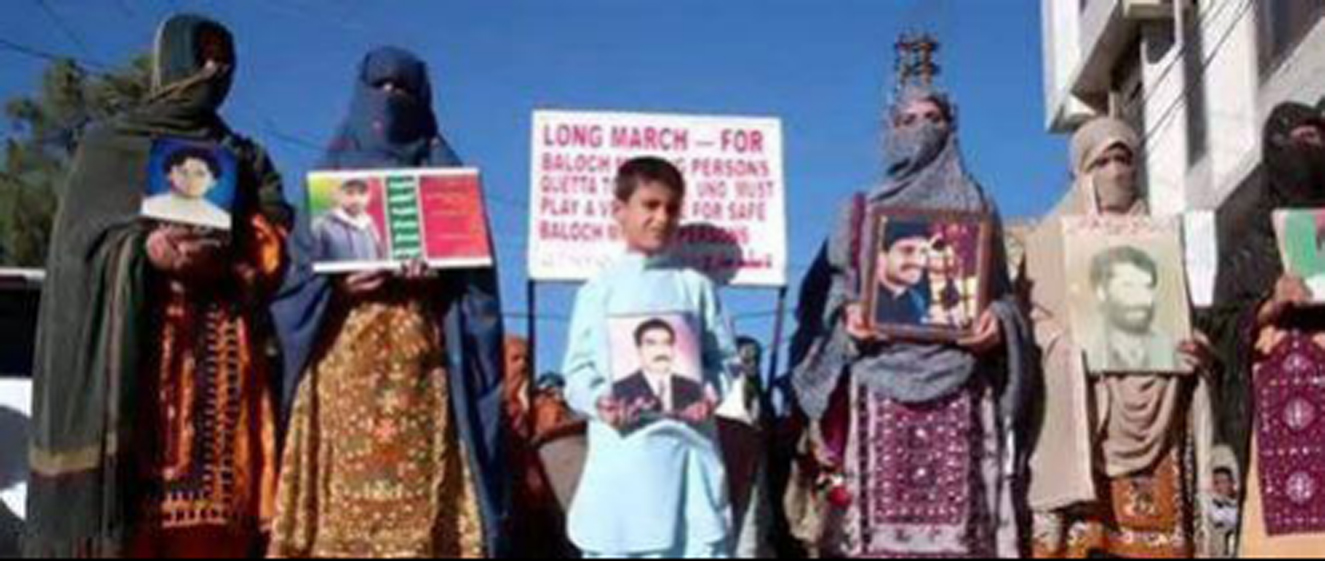
While many of those taken into custody by Pakistani security forces are later released, the recovery of “tortured and mutilated” bodies is “routine” in Balochistan, and many are identified as having been arrested or detained. Recent examples of this pattern of extrajudicial killing include Sajid Nasir, taken in a raid on his home in Kolwah Gishang by “Pakistani forces and state-backed armed groups” the night of 23 May; his body being found the following morning.19
Security forces habitually employ violence in reaction to civil protest, often inflaming public sentiment, which yet more violence is used to control. Events in mid-March in the city of Quetta are illustrative here. When two BYC activists, brothers Bebarg and Hammal Zehri were arrested by the Counter Terrorism Department on 20 March, the BYC conducted a rally calling for their and other’s release the following day.20 Police opened fire on the gathering, killing three, including a 12-year-old child. Protests the following day in response to the killings were attacked by Police, and leading BYC activists, including Dr. Mahrang Baluch, were arrested. The Pakistani legal system has also moved against Baloch activists, charging them with “terrorism” and “sedition”.21 Subsequent demonstrations across Balochistan protesting these arrests were met with further Police violence, including gunfire in Panjgur and Lasbela.22
On the Baloch side, their tactics have also become increasingly ruthless, with certain BLA splinter factions having embraced suicide bombing. Such actions conducted by the BLA include the 4 March attack on a Frontier Corps convoy on the Quetta-Karachi highway,23 and against a similar target in Nuskhi on 16 March, which resulted in the deaths of at least nine, although the BLA claimed to have killed ninety.24 A car bomb also hit a market in Qillah Abdullah on 18 May, killing four, although no party has claimed this attack as yet,25 while another struck a school bus in Khuzdar on 21 May, killing at least six.26
The so-called “Majeed Brigade” of the BLA-J is the main formation tasked with conducting these attacks, and has increasingly recruited women as its operatives.27

International Contexts
The escalating conflict in Balochistan should also be considered in the context of the broader political and security crisis in Pakistan.
The growing involvement of Chinese capital in Balochistan through its China-Pakistan Economic Corridor (CPEC) projects further complicates the resolution of the conflict. The CPEC program has been directed from outside the province, and is oriented principally towards transnational resource extraction and transport objectives, and has been accompanied by a major influx of ‘foreign’ workers and bureaucrats.28
Economic and infrastructure development is badly needed in Balochistan, the poorest province in Pakistan, yet for most Baloch, whatever material benefits might be gained from CPEC developments are monopolised by ‘Punjabi’ or Chinese workers and business interests. A key example is the CPEC’s centrepiece port at Gwadar, from which Balochistan province benefits only indirectly as 9% of revenue goes to the federal government, the other 91% are retained by the China Overseas Ports Holding Company.29
The sensitivity of the massive investments which underpin the CPEC has further incentivised the militarised security environment in Balochistan, while China pressures Pakistan to maintain order, and is escalating its own security contributions in the wake of BLA attacks on Chinese workers.30
The CPEC is thus something of a double-edged sword for the Pakistani government: Chinese economic support is critical for national infrastructure development, but that very development is driving conflict. The Pakistani military is facing not only the insurgency in Balochistan, but a tense and violent border with Afghanistan and a strategic standoff with India. Especially in relation to the latter, Chinese support is critical, which greatly incentivises against substantial reform to the CPEC so as not to alienate them.
Conclusion
In the short-term at least, the violence in Balochistan is likely to continue unabated. The Baloch seem more committed than ever to their separatist objective, while the Pakistani state shows little appetite for concession or reform. Even with the growing rate and sophistication of attacks however, no insurgent group has been able to actually push back Pakistani state control over the province, simply accelerating the violence without any apparent strategic gains or effect. However, Balochistan is not the only crisis Islamabad has to contend with; Khyber-Pakhtunkhwa is seeing an even higher rate of violence, there are the stirrings of yet another separatist struggle in Sindh,31 and they are hobbled by a deeply troubled economy.32
Barring a major turnaround in its strategic fortunes, Pakistan may well find itself stretched too thinly in coming years to hold any of its periphery.