
Contextual Background
On 11 March 2025, the ICC publicly issued an arrest warrant against former Filipino President RodrigoDuterte, based on allegations of crimes against humanity. The ICC considered Duterte guilty of inciting extrajudicial killings committed during his administration’s “war on drugs,” which reportedly resulted in thousands of deaths. Duterte’s policy of extrajudicial killings meant that many victims were killed without arrest, charges, or trial.1 Additionally, Amnesty International reported in 2025 that Duterte supported killings in Davao City by the alleged Davao Death Squad while Duterte was mayorfrom 2001 to 2010, and again from 2013 to 2026.2 On 12 March 2025, Duterte was arrested in Manila and sent into ICC custody afterwards.3 According to Amnesty International’s Secretary General Agnès Callamard, “Duterte’s arrest on an ICC warrant is a hopeful sign for victims in the Philippines and beyond.4 It shows that suspected perpetrators of the worst crimes, including government leaders, can and will face justice, wherever they are in the world. At a time when too many governments renege on their ICC obligations while others attack or sanction international courts, Duterte’s arrest is a significant moment for the power of international law”.5 Although the Philippines’ withdrawal from the RomeStatute took effect on 17 March 2019, the ICC retains jurisdiction over alleged crimes committed while the country was a member and for 1 year following the notification of withdrawal, specifically from 1November 2011 up to 16 March 2019.6
Duterte’s arrest warrant and forthcoming trial have the potential to galvanise support from Filipinonon-governmental organisations advocating for victims of the “war on drugs.” These organisations, such as Karapatan, iDEFEND, and the PAHRA, play a significant role in monitoring and identifying incidents of alleged extrajudicial killings as well as collaborating with local networks. Karapatan, for example, documented the killings of 422 political activists and the attempted killings of 544 others.7 Similarly, iDEFEND reports specific cases of extrajudicial killings. For instance, iDEFEND called on the Commission on Human Rights, an international body tasked with human rights protection and investigation, to investigate the extrajudicial killing of labour leaders named Edilberto Miralles and Orlando Abangan, alongside other unresolved killings of activists and farmers.8 On the other hand, PAHRA has maintained a civil society organisation People’s Monitoring Mechanism (CSO–PMM), that gathers reports on human rights violations like extrajudicial killings and ensures that they are formally submitted to relevant agencies.9 The resulting case files establish a narrative for each killing, linking the violence to the operational climate of Duterte’s anti-drug campaign and providing essential qualitative evidence to verify patterns ofabuse for international accountability mechanisms.

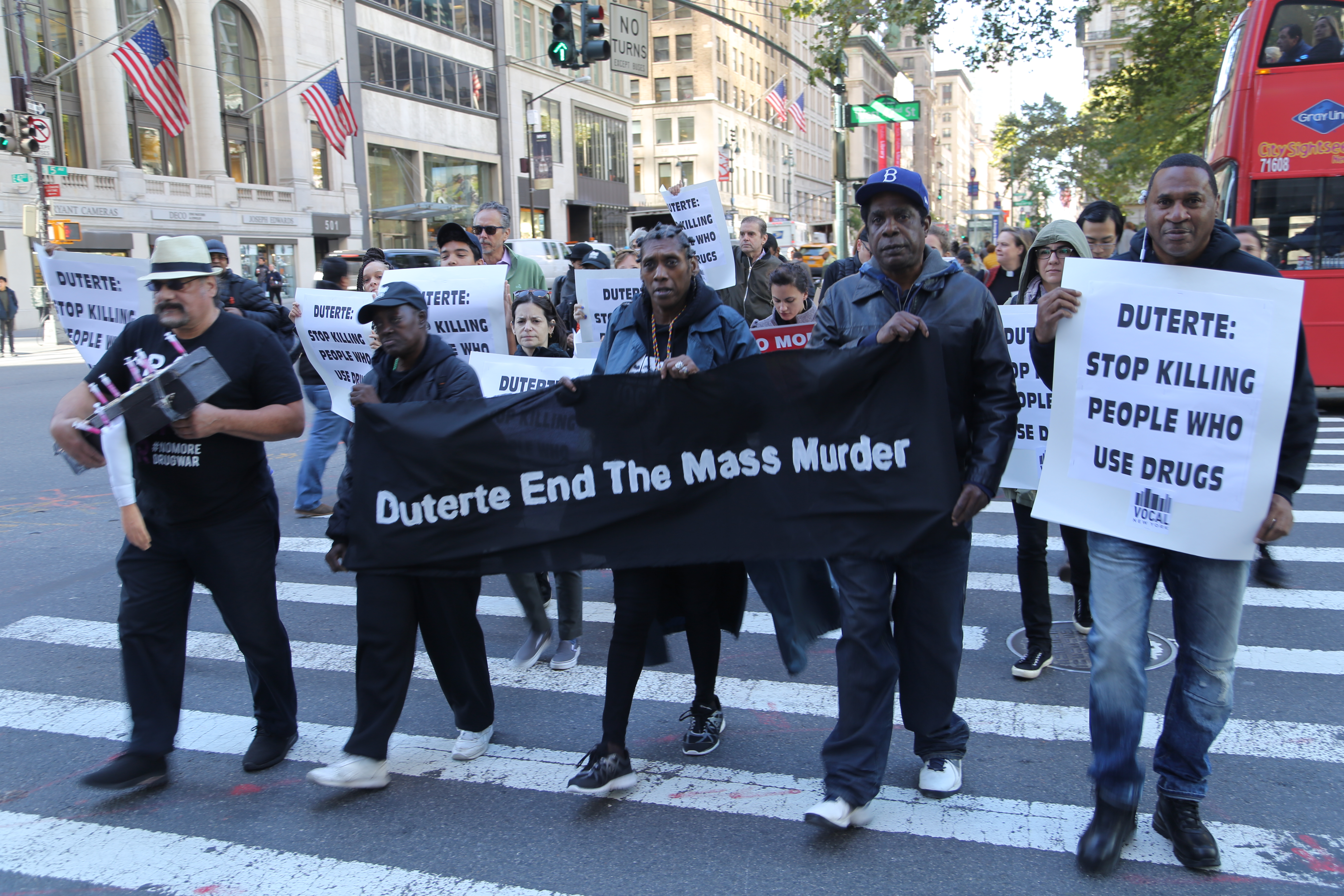
on September 28 (PCOO EDP via Wikimedia Commons 2016)
Victim and survivor testimonies are central to the ICC’s investigation, serving as both first- hand accounts of killings and as narrative evidence that connects individual incidents to systemic state practices.10 Investigators use these testimonies to identify recurring methods, such as police operational tactics, the targeting of particular communities, and the framing of killings as “nanlaban” (fought back). Such accountsare often supported by autopsy reports, crime scene photographs, and media coverage, strengthening their credibility. They also reveal an atmosphere of fear, coercion, and impunity that hindered victims’ access to justice through domestic channels, underscoring the role of state actors in enabling or committing the killings.
Before the ICC warrant, families of victims often reported being ignored or intimidated by police whenseeking answers. Contributing factors included institutional bias, where police were often the alleged perpetrators or complicit actors, and fear of reprisals, with officers avoiding engagement to protect themselves or colleagues.11 Nelson B. Cabreros, writing in Sunstar Cebu, noted that the political climateunder Duterte enabled law enforcement officers implicated in extrajudicial killings to act with impunity. The government viewed these officers as fulfilling their duties, encouraging such conduct. Legal professionals challenging the killings or advocating for victims faced threats, while judges and lawyers involved in human rights cases were victims of harassment, intimidation, and sometimes physical violence. Independent inquiries were rare, and the Commission on Human Rights, tasked with investigating abuses, was marginalised and under-resourced by the Duterte administration.12
Analysis
The survivors’ testimonies have an impact on Duterte’s trial as they play a critical role in Duterte’s trial at The Hague providing direct, human evidence of the extrajudicial killings and systemic abuses committed during the “war on drugs.” Relatives of drug war victims are actively applying to participate in the ICC proceedings, with many expressing willingness to testify in person, believing their accounts are vital to establishing the facts.13 These first-hand accounts strengthen the factual basis of the charges by illustrating how state policies translated into patterns of widespread violence and victimisation. TIME14 covers how victims see the ICC proceedings as validation of their suffering, framing their testimonies as crucial evidence in the international arena. They also establish the credibility of victims’ experiences in the international legal arena, challenging official denials and impunity.
Survivors’ testimonies highlight not only the emotional devastation and material loss caused by the killings, but also the long-term, intergenerational consequences for those left behind. Philippine Daily Inquirer15describes families being pushed into insecure livelihood conditions after losing their breadwinner. Innumerous communities, fear generated by the violence has eroded traditional neighbourly solidarity, with residents avoiding interaction or collective action to escape association with alleged drug suspects.16 Testimonies further indicate that stigmatisation extended beyond the immediate community, affecting access to housing, employment, and public services. Some survivors report harassment or intimidation by local officials or police when seeking justice, deepening feelings of abandonment by the state and reinforcing perceptions that the rule of law is selectively applied.
In the Philippines, testimonies from Duterte’s “war on drugs” have become a political touchstone, mobilisedby opposing factions to reinforce competing narratives. Supporters of Duterte often frame them as exaggerated, manipulated by foreign interests, or driven by opposition-backed groups. Lawyers working for the government have doubted the witnesses’ testimonies, saying their stories might be rehearsed ordriven by money. By contrast, opposition politicians, human rights advocates, and some independent lawmakers elevate these testimonies as evidence of systemic abuse, using them to call for domestic reforms and legitimise international scrutiny, including the ICC investigation.17 In this context, the Department of Justice has a lack of witness protection programmes including relocation, anonymity guarantees, and psychosocial support. Without robust safeguards, victims and witnesses risk re-victimisation andintimidation, which has already undermined domestic accountability efforts in past cases.
President Marcos Jr.’s cautious position on the ICC warrant reflects a balancing act between domestic politicalrealities and international expectations. At home, a significant portion of the electorate remains sympatheticto Duterte or views the drug war as a legitimate anti- crime policy, making full ICC cooperation politically risky. The Duterte family retains
influence in Congress and in certain regions, and the domestic justice system has been criticised for its slow handling of extrajudicial killing cases.18 Furthermore, the Philippines News Agency19 reports that Marcos’ administration argues these matters should be addressed internally to assert sovereignty. Internationally, Marcos has sought to differentiate himself from Duterte, partly to attract investment, improve the Philippines’ global image, and avoid reputational damage in multilateral forums. While stopping short of rejoining the ICC, he has engaged with United Nations human rights mechanisms to signal cooperation without accepting external judicial oversight. This dual strategy allows him to appease international partners rhetorically while reassuring domestic allies that ICC operations in the country will remain limited.
Conclusion
The ICC’s arrest warrant for former Philippine President Rodrigo Duterte over alleged crimes againsthumanity marks a watershed moment for international justice and accountability. Amnesty International and other human rights advocates see this as an opportunity for victims of extrajudicial killings to finally havetheir voices heard. Civil society organizations have been crucial in documenting these abuses, gathering and preserving testimonies, and corroborating accounts with forensic and photographic evidence. Their work, often carried out under threat of harassment, surveillance, and “red-tagging,” has fed into international legalmechanisms, keeping victims’ stories alive despite domestic pushback.
In the Philippines, these narratives have become deeply politicised. Duterte’s allies portray testimonies asexaggerated or foreign-influenced, while opposition figures use them to press for justice. Social media has become a key battleground, with disinformation campaigns and online harassment aimed at discrediting survivors and their families. At the same time, public opinion surveys and search data suggest that the ICC warrant has sustained debate over accountability, even if no new political party has emerged explicitly to represent victims. Instead, the issue is being fought within existing political alignments, where PresidentFerdinand Marcos Jr. has taken a guarded position, signalling limited human rights cooperation abroad while maintaining alliances at home. The unfolding process will test whether survivors’ voices can influence Philippine politics beyond entrenched factional divides.