
Introduction
BiH is now experiencing its worst political crisis since the 1992-95 civil war. Bosnian Serb leader, Milorad Dodik, has been embroiled in a long-running clash with the country’s High Representative, Christian Schmidt. Dodik, who started his political career as a moderate reformer, has over the last two decades become one of the main drivers of nationalist and secessionist rhetoric. He has also worked to undermine state-level institutions and the authority of the High Representative in Republika Srpska. This power struggle between Dodik and Schmidt has escalated into legal battles, secession threats, and fears of constitutional collapse, leaving the country on the brink of a major political crisis. This article will examine Dodik’s confrontation with the High Representative and Republika Srpska’s uncertain political future.
Background
The Dayton Peace Agreement signed in 1995 officially ended the three-year civil war in BiH.[1] The political structure of BiH was also established in Dayton, which essentially served as both a peace settlement and state-building framework. The Dayton Agreement sought to accommodate, rather than solve, the tensions between the three main ethnic groups, Bosniaks, Serbs, and Croats. Under the Dayton Agreement, BiH was recognised as an independent state consisting of two entities: the Bosniak-Croat Federation of Bosnia and Herzegovina and the Serb Republika Srpska. Both entities hold significant autonomous powers, held together by a weak central government with limited powers.[2] Additionally, the Dayton Agreement established the position of a High Representative of the International Community, who is tasked with the civilian implementation of the Dayton Peace Agreement.[3] The High Representative is the top international authority in BiH and the overseer of the country’s post-war peace agreement. Under the so-called ‘Bonn Powers,’ the High Representative has extraordinary authority to intervene by removing public officials from office and imposing laws on BiH as necessary to safeguard the peace agreement.[4]
The Rise of Milorad Dodik
Dodik has been a high-level figure in BiH politics for nearly three decades. In the late 1990s, Dodik was considered an early reformer, and was the first Serb politician to publicly recognise the 1995 massacre at Srebrenica as a genocide. During the Bosnian war, Dodik was part of a pro-reform movement, criticised war criminals, and opposed nationalists. After the US-sponsored Dayton Peace Agreement ended the war, the West looked for a new Serb leader to cooperate with the international community and bring BiH into a new era away from wartime nationalism, with Dodik deemed a good candidate.[5] It was around this time that former US Secretary of State Madeleine Albright described Dodik as “a breath of fresh air in the Balkans.”[6]
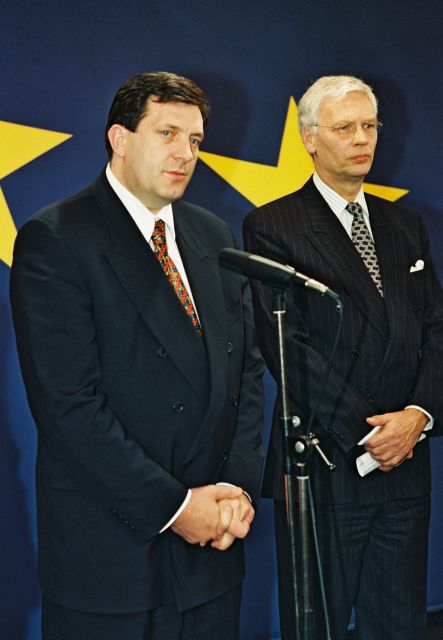
In 1998, with the support from Western countries, Dodik became the prime minister of Republika Srpska. However, after an election loss in 2001, Dodik changed his stance, and began embracing nationalist rhetoric, aligning himself with Serb identity politics. This rebuilding of his political base led him to be re-elected for a second term as Prime Minister in 2006.[7] Dodik’s return to power at this time marked a drastic change on his stance on the war, he increasingly embraced ultra-nationalist, separatist positions, including denying Srebrenica as genocide.[8]
In the years since, Dodik has become one of the most vocal denialists of genocide in Republika Srpska, calling it “a fabricated myth” and “the greatest deception of the twentieth century.”[9] Dodik has held several high-ranking leadership positions, including President of Republika Srpska from 2010 to 2018, while he was also a member of BiH’s tripartite presidency from 2018 to 2022. In 2022, Dodik was re-elected as President of Republika Srpska.[10]
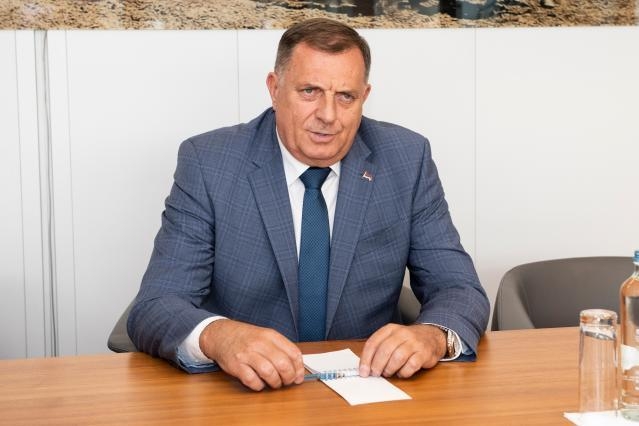
During his political career, Dodik has become increasingly nationalistic and pro-Russian, frequently advocating for the secession of Republika Srpska from BiH and unification with Serbia. He has been accused of violating the terms of the Dayton Agreement and putting peace and security in BiH at risk, resulting in the US and UK imposing sanctions on him.[11] Dodik has also worked to undermine BiH’s state-level institutions and has consistently challenged the authority of the High Representative. His defiance has now escalated into a confrontation with High Representative Christian Schmidt, leading to a broader legal and political crisis that risks the stability of the entire country.[12]
Dodik’s Legal Proceedings
Dodik’s legal struggles stem from a long-running power struggle between him and the BiH’s High Representative, Christian Schmidt. In June 2023, the situation in BiH intensified after the Republika Srpska National Assembly approved two controversial laws;[13] one to prevent the implementation of BiH’s Constitutional Court’s decisions in Republika Srpska and the other to block the publication of the High Representative’s decisions in the Official Gazette, the state publication where laws, regulations, and official decisions are published. By introducing these measures, Dodik effectively tried to undermine the High Representative’s authority in the Serb entity.[14]
However, before the laws could take effect, Schmidt swiftly repealed them. Nevertheless, Dodik announced his intention to pass the laws regardless of the High Representative’s annulment. In response, Schmidt enacted his own legal reforms; he amended the Criminal Code of BiH to make non-compliance with the High Representative a criminal offence.[15]
The amendments introduced strict sanctions, including removal from office, termination of public service employment, and a ban from serving in public office. Schmidt subsequently introduced an ‘integrity package’ which amended the Election Law of BiH, allowing for the termination of a political mandate if a binding court ruling prohibits the individual from carrying out their duties.[16] This move intensified the pressure on Dodik and other Republika Srpska officials. By implementing these reforms and outlawing non-compliance with the High Representative, Schmidt reinforced the Dayton framework and underscored BiH’s responsibilities under international law.

In August 2023, the Prosecutor’s Office of BiH filed charges against Dodik and Miloš Lukić under Article 203a (1) of the Criminal Code of BiH, which criminalises “the non-execution decisions of the High Representative.”[17] Dodik’s co-accused, Lukić, was the former acting director of Republika Srpska’s Official Gazette.[18]
Dodik’s landmark trial began in early February 2025. On 26 February, he was convicted of defying the High Representative’s rulings and was sentenced to one year in prison and banned from participating in politics for six years.[19] Lukić was acquitted on his charges. Dodik rejected the court’s ruling, and the next day, the Republika Srpska National Assembly adopted legislation to ban BiH state judicial authorities and the State Investigation and Police Agency (SIPA) from operating in Republika Srpska.[20]
On 12 March 2025, the Prosecutor’s Office of BiH issued an arrest warrant for Dodik and two other Bosnian Serb officials for ignoring a court order. This was a separate court investigation into Dodik for attacks on the BiH constitutional order.[21] The following day, the Republika Srpska National Assembly adopted a new draft constitution and a draft provision aimed at safeguarding constitutional order in the entity. The drafts established independent institutions for Republika Srpska, including its own army and judiciary, as well as provisions for self-determination and the authority to form partnerships with other nations.[22]
Despite the charges, a defiant Dodik travelled abroad for several state visits, including to Serbia, Israel, and Russia. On 27 March 2025, the Prosecutor’s Office of BiH requested that Interpol issue an international arrest warrant for him. However, Interpol rejected the request, citing its principles of neutrality and non-interference in political matters.[23] On 24 April 2025, officials from SIPA attempted to arrest Dodik in East Sarajevo, but withdrew following an armed stand-off with Republika Srpska police.[24]
On 4 July 2025, the Court of BiH lifted the arrest warrant for Dodik after he voluntarily appeared for questioning. The court instead imposed precautionary measures requiring him to regularly report to state authorities.[25]
On 1 August 2025, an appeals court in BiH upheld the first-instance verdict against Dodik from February for failing to implement the decisions of the High Representative. Following this, on 6 August, the Central Election Commission (CEC) ordered Dodik’s removal as President of Republika Srpska. Under Article 1.10 of BiH’s Election Law, any official sentenced to more than six months in prison is automatically disqualified from holding office.[26] On 12 August, the Court replaced Dodik’s one-year prison sentence with a fine of €18,660, but upheld his six-year ban from politics.[27] Dodik appealed against the CEC decision, but this was rejected on 18 August, and his mandate as Republika Srpska President was officially terminated. Dodik has strongly rejected the decision and declared “I will not respect it. I will respect the will of the Serbian people.”[28]
Recent Developments
Dodik’s conviction and removal from office marked a turning point in his longstanding battle with Schmidt. However, the situation is far from resolved, instead, it has triggered a new wave of instability within Republika Srpska’s leadership and has set the stage for further clashes with BiH state institutions.
On 18 August 2025, the Prime Minister of Republika Srpska, Radovan Višković, resigned after seven years in office. This decision is part of a wider political strategy by the Dodik-led Alliance of Independent Social Democrats (SNSD) to form a government based on a broader coalition with more decision-making power.[29] At a press conference alongside Dodik and party officials, Višković outlined that he will continue to hold high-level political positions within the SNSD until their “ultimate goal” of secession from BiH is reached.[30]
Just days later, on 22 August 2025, the Republika Srpska National Assembly voted to hold a referendum in a bid to keep Dodik in power. The referendum seeks public approval to reject both the Court of BiH’s termination of Dodik’s presidential mandate and the CEC ruling barring him from politics. The referendum is scheduled for 25 October 2025.[31] Additionally, the CEC of BiH has scheduled an early presidential election in Republika Srpska to replace Dodik on 23 November 2025.[32]
Political Turmoil
With Dodik’s political mandate revoked and both a referendum and election looming, BiH faces an uncertain political future. Legally, Dodik is no longer the legitimate President of Republika Srpska. He cannot sign or enforce any laws, and his presidential authority has been dissolved. Despite this, he refuses to accept the ruling, claiming that the BiH court’s decisions contradict the Republika Srpska’s constitution.[33]
Dodik’s defiance and hardline nationalist agenda highlight the fragility of state institutions established in the Dayton Agreement. BiH’s political structure allows ethno-nationalists to manipulate Dayton’s provisions to consolidate their grip on power, often invoking the entity-level autonomy to their advantage, even if it violates state-level laws or institutions.[34] A clear example of this is Dodik’s planned referendum. The Republika Srpska National Assembly’s announcement to hold a referendum is inconsistent with the BiH constitution, which does not allow entities to vote on the rulings of state institutions.[35]
Tanja Topić, a political analyst, stated that the proposed referendum would not be legally binding, and promoting the idea that it could abolish a court judgment leads citizens into “a dangerous illusion and destroys the already fragile rule of law.”[36]
Conclusion
BiH has a long history of volatility and political instability, but the current political crisis represents one of the biggest threats to the country since the war. Dodik’s removal from power is not just a personal setback, it is a reflection of BiH’s fragile governance and the growing divisions that continue to dent the country’s progress. BiH’s state institutions are continuously undermined and disregarded by nationalist politicians such as Dodik, whose secessionist rhetoric and genocide denial further destabilise and divide the country. As for Dodik’s political career, he will likely try to cling to power, but it is hard to predict what the future brings for him and for BiH.