Platform for Peace and Humanity

Inside the Kashmir Crisis: India’s Strikes, Pakistan’s Response, and a Region on Edge

<- Back to Monitor Issue

The Peace and Security Monitor

Key Takeways

• The Pahalgam attack marked a serious intelligence failure and triggered regional escalation.

• India’s Operation Sindoor demonstrated a calibrated but assertive counterterror strategy targeting terror infrastructure in Pakistan.

• Pakistan responded with Operation Marka-e-Haq, leading to the first major India– Pakistan aerial and missile standoff since Balakot (2019).

• The conflict underlined the instability of the deterrence framework and the limitations of diplomatic mechanisms like the Indus Waters Treaty and Shimla Agreement.

On 22 April, India’s scenic Kashmiri valley of Pahalgam witnessed the attack and subsequent killing of 26 tourists by terrorists. The attack drew sharp criticism from the Indian Prime Minister and world leaders, rebuking the heinous attack.1 2 3 In light of the attack, political strategists and policymakers highlighted India’s previous counter

terrorist measures against Pakistan and evaluated further how India would react to its civilian casualties.4

After a series of tactical, diplomatic, commercial, and strategic retaliatory countermeasures between the two countries, on 7 May, after a 15-day hiatus, India attacked nine alleged terrorist bases in Pakistan, four of which were in Pakistan administered Kashmir and five in Pakistan’s mainland. These attacks led to a four day-long “near war” situation wherein India’s Operation Sindoor (Hindi for “vermillion powder worn by Indian women on their forehead”) and Pakistan’s Operation “Marka e-Haq” (“Battle for Justice”), made world headlines.

The Attack: Facts and Immediate Response

The Pahalgam attack highlighted security loopholes in India’s Internal security architecture, noteworthy at the time of American Vice President J.D. Vance’s 4-day visit to India.5 The Vice President’s visit was significant in bolstering India-United States (US) relations amidst the US-China trade war. Moreover, the strategic timing of the attack can be linked to the recent internal security issues in India’s rival nation, Pakistan.

On 11 March, the Balochistan Liberation Army (BLA) hijacked the Jaffar Express, killing 21 civilians.6 7 Pakistan accused the BLA of using Indian weapons which were rejected by Indian authorities as “baseless”.8 Not long after, Pakistan’s ISI Chief General Asim Munir’s controversial comments distinguishing Pakistanis from Hindus and reaffirming Pakistan’s support for Kashmir stirred public debate in India.9 10

The Pahalgam attack reportedly had a sectarian nature as victims were selected based on their religious identity as Hindu and Christian men.11 12 The assailants killed 25 Indian civilians and one Nepali civilian, all of whom were spending their vacation in the “mini Switzerland” of India.13 A few hours after the Pahalgam attack, the Resistance Front, an offshoot of Lashkar-e-Taiba, a Pakistan-based non state armed group, claimed responsibility for the attack.14 However, a few days after the claim, the group reversed its stance, stating that the group “unequivocally denies any involvement in the Pahalgam incident.”15

Max Abrahms, Professor of Political Science at Northeastern University and an expert on credit-claiming patterns of terrorist groups, states that such moves by terrorist organisations have historically been observed if the attacks seem to be on civilians rather than military personnel.16

India responded to the attack by putting the Indus Waters Treaty “in abeyance”, which was considered an “act of war” by Pakistan.17 The 1960 Indus Waters Treaty, brokered by the World Bank, ensured equitable distribution of the Indus River water and its tributaries to both India and Pakistan.

A series of retaliatory measures ensued between both countries wherein Pakistan suspended the Shimla Agreement, further closing Pakistan’s airspace for Indian aircraft. India, on the other hand, closed the Integrated Attari check post and banned Pakistani nationals from traveling under its SAARC Visa Exemption Scheme (SVES).18 19
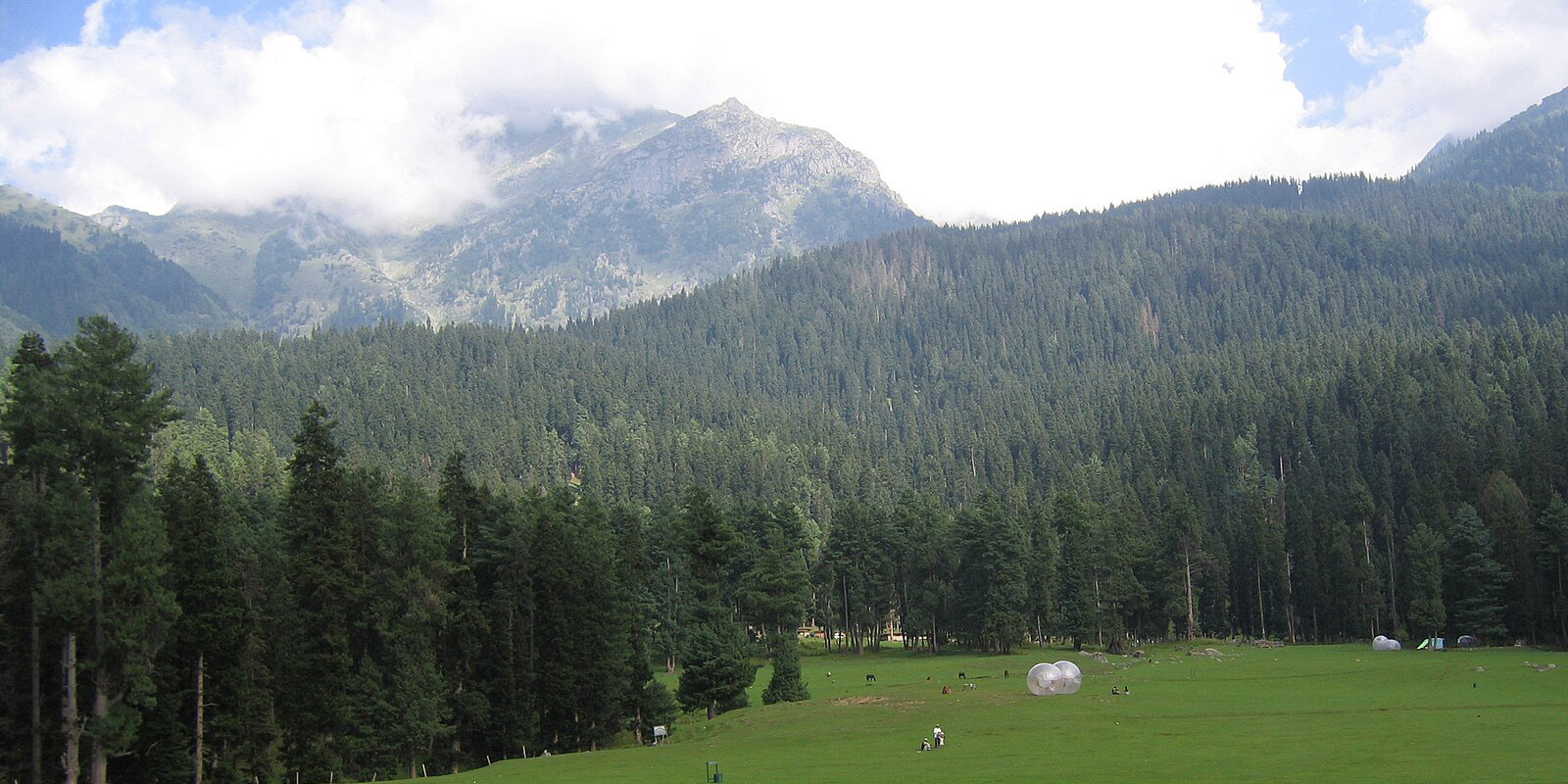
Baisaran Meadow/Valley near Pahalgam (Vinayaraj, Wikimedia Commons 2012)

The Military Escalation: Operations Sindoor and Marka-e-Haq

After much anticipatory deliberation, on 7 May at midnight, the Indian military carried out a series of “focused, measured and non-escalatory” strikes on nine alleged terrorist camps, four of which were situated in Pakistan-administered Kashmir and another five in Pakistan’s mainland.20 Termed “Operation Sindoor”, the operation symbolised the woes of recently widowed spouses of the Pahalgam attack.

In its counterattack operation “Marka-e-Haq” (“Battle for Justice”), Pakistan claimed to have shot down six Indian Air Force jets by Chinese-built J-10s.21 The number was likely overstated by the Pakistani authorities as investigative reports found debris from only three jets.22 23

Both countries made unprecedented military choices with state-of-the-art artillery. While Pakistan employed short-range ballistic missiles, such as Fatah-I and Fatah-II, India used the Brahmos cruise missile and European SCALP-EG.24 Throughout the next three days (8- 10 May), both countries were embroiled in drone warfare to cause significant damage to the other side.

The Indian Director General of Air Operations termed these drone attacks as a “raid”, operationalised to compromise and “saturate” the Indian air defense system.25 Pakistan, on the other hand, witnessed and intercepted around 11 attack sites by Indian drones.26 In terms of drone technology, India identified the Turkish-origin “Asisguard Songar” and another unnamed “armed UAV” used by Pakistan in a target site in Punjab.27 India itself used a variety of Israel-origin Harpy and Harop drones.28

IMF Bailout

9 May brought a completely new turn to the hostility with the International Monetary Fund’s (IMF) long-standing decision. The international body released the last tranche of a US$ 1 billion bailout to Pakistan under its Extended Fund Facility (E.E.F.).29 The total corpus of the E.E.F. was US$ 7 billion, approved in 2024, to be utilised for 37 months for “building resilience and enabling sustainable growth” in Pakistan.

Pakistan’s Prime Minister’s Office released a statement expressing Prime Minister Shehbaz Sharif’s satisfaction over the approval of US$ 1 billion.30 India, on the other hand, strongly condemned IMF’s move questioning the “efficacy” of such bailouts which ultimately “sponsor cross border terrorism” and send a “dangerous message to the global community”.31

The IMF bailout, however, failed to de-escalate the entrenched military confrontation.

The De-escalation

The situation reached its escalatory zenith on 10 May when India attacked the Nur Khan airbase at 2:30 am.32 The Nur Khan Base, as a part of the large Chaklala military cantonment near Rawalpindi, was a strategic military outpost for Pakistan’s Joint staff headquarters.

Pakistan immediately responded with its new subsumed operation under Marka-e-Haq- “Bunyan-um-Marsoos”, proclaiming that “whenever Pakistan’s sovereignty is threatened, response will be decisive”.33 The operation’s name signified a steel wall against “Indian media’s disinformation blitz and reckless war-mongering”.34 The Pakistan Air Force claimed to attack several Indian military outposts including Srinagar, Jammu, and Pathankot, all of which sustained major damages.35

To appease the hostile neighbours, the US Secretary of State Marco Rubio spoke with Pakistan’s army chief General Syed Asim Munir as well as India’s foreign minister, S. Jaishankar.36 Shortly after, US President Donald Trump posted on his X channel- “After a long night of talks mediated by the United States, I am pleased to announce that India and Pakistan have agreed to a FULL AND IMMEDIATE CEASEFIRE”.37

According to an Indian press release, Pakistan “approached the United States to broker calm” and subsequently Pakistan initiated the ceasefire after its Director General of Military Operations approached its Indian counterpart.38 On 10 May 2025, at 1700 hours both sides agreed to halt military actions on land, air, and sea.39
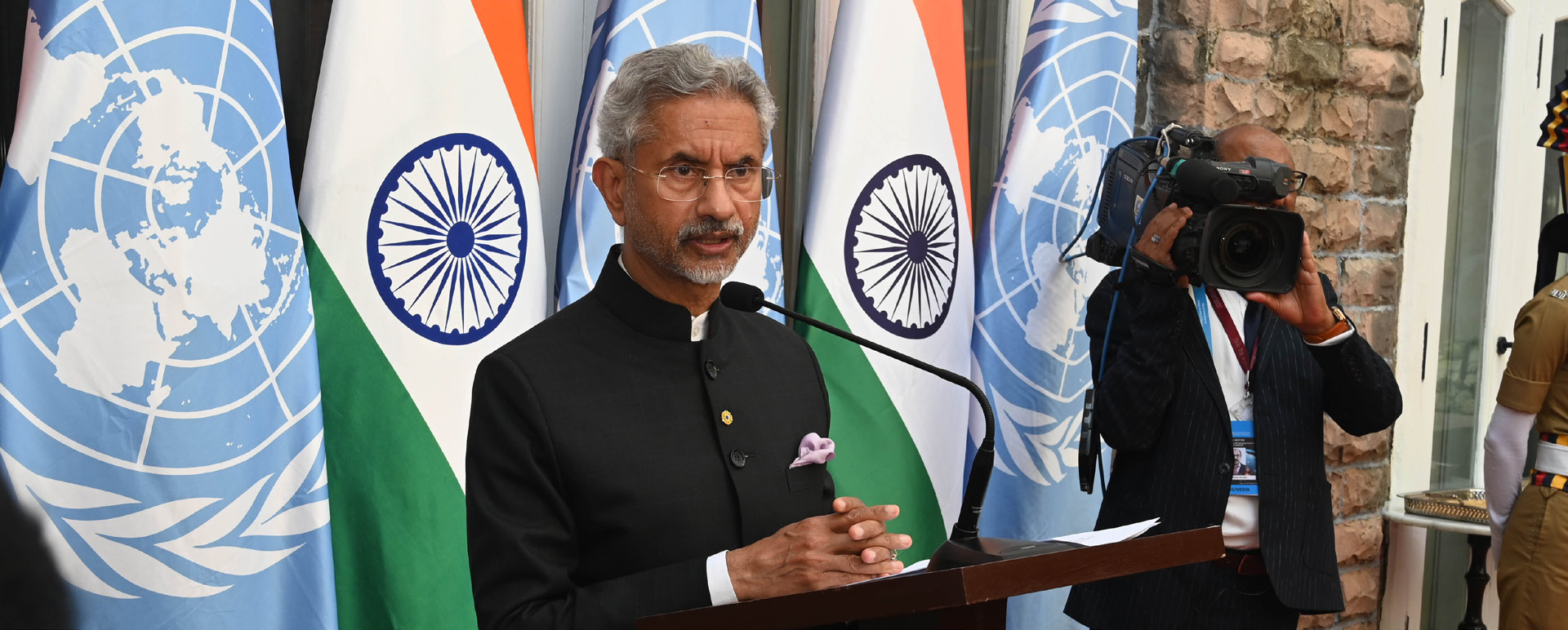
External Affairs Minister Dr. S. Jaishankar paid tributes to 26/11 terror attack victims at the UNSC Special Meeting of Counter Terrorism Committee on 28 and 29 October 2022 (MEAphotogallery on Flickr 2022)

Conclusion

The Pahalgam terror attack and the subsequent military operations underscore the fragility of South Asia’s strategic stability. The swift escalation from a localised attack to cross border aerial warfare highlighted enduring fault lines in India–Pakistan relations.

Despite significant technological advancements and global mediation, the crisis revealed the limited deterrent value of past treaties and the precarious nature of regional peace. As India recalibrates its defence posture and diplomatic strategies, it must weigh decisive military responses against the risks of miscalculation in a nuclearised environment.

Policy Recommendations

• Institutionalise Intelligence Sharing Mechanisms: bilateral and multilateral cooperation frameworks must be strengthened to prevent surprise attacks, similar to recommendations by Rajagopalan and Narang in their study on deterrence instability in South Asia.40

• Reevaluate the Strategic Use of the Indus Waters Treaty: while suspending the treaty served as strategic pressure, long-term abeyance could backfire diplomatically and environmentally. Analysts suggest India could explore “gradual coercion” strategies instead.41

• Leverage Multilateral Forums to Isolate Terror Support: India must proactively use platforms like BRICS, G20, and SCO to highlight cross-border terror funding and push for international accountability of state sponsors.42

• Promote Confidence Building Measures (CBMs): India and Pakistan must revive dormant CBMs, particularly military hotlines and early warning protocols, to avoid accidental escalation.43

Endnotes

1 UN Security Council (2025), ‘Security Council Press Statement on Terrorist Attack in Jammu and Kashmir’ (UN Press Release SC/16050, 8 May 2025) https://press.un.org/en/2025/sc16050.doc.htm accessed 23 May 2025.

2 ‘Kashmir Massacre: Trump, Putin, Iran, Israel Condemn Jihadist Attack on Hindu Tourists’ (Newsweek, 8 May 2025) https://www.newsweek. com/kashmir-massacre-trump-putin-iran-israel condemn-jihadist-attack-hindu-tourists-2062760 accessed 23 May 2025.

3 US Commission on International Religious Freedom, ‘USCIRF Condemns Attack in Kashmir’ (USCIRF, 25 April 2025) https://www.uscirf.gov/news-room/ releases-statements/uscirf-condemns-attack kashmir accessed 1 June 2025.

4 Biswas S, ‘Deadly Kashmir attack risks India military escalation against Pakistan’ (BBC News, 23 April 2025) https://www.bbc.com/news/articles/ cwynx7kgyqvo accessed 1 June 2025.

5 All India Radio News, ‘US Vice President J D Vance arrives in New Delhi for 4-day official visit’ (All India Radio News, 21 April 2025) https://www.newsonair. gov.in/pm-modi-to-hold-meeting-with-us-vice president-j-d-vance-in-new-delhi/ accessed 1 June 2025.

6 Gavin Butler and BBC Urdu, ‘Killed in front of our eyes: How the Pakistan train hijacking unfolded’ (BBC News, 13 March 2025) https://www.bbc.com/ news/articles/cy0d5y9ew24o accessed 1 June 2025.

7 The Hindu, ‘Pakistan army says 18 of 26 hostages killed in Balochistan train attack were soldiers’ (The Hindu, 14 March 2025) https://www.thehindu.com/ news/international/pakistan-army-says-18-of-26- hostages-killed-in-balochistan-train-attack-were soldiers/article69332752.ece accessed 10 May 2025.

8 The Hindu, ‘India denies role in Pakistan train attack’ (The Hindu, 14 March 2025) https://www.thehindu. com/news/national/india-pakistan-terrorism train-attack/article69328869.ece accessed 11 May 2025.

9 Farhat Javed, ‘Pakistan army chief’s Kashmir remarks cause anger in India’ (BBC News, 30 April 2025) https://www.bbc.com/news/articles/ c39j3p14mg4o accessed 10 May 2025.

10 Nayanika Sengupta, ‘‘Different from Hindus’: What did Pakistan Army chief say days before Pahalgam horror’ (Hindustan Times, 23 April 2025) https:// http://www.hindustantimes.com/india-news/different from-hindus-pakistan-army-chief-asim-munir two-nation-theory-jugular-vein-pahalgam-terror attack-101745382805306.html accessed 1 June 2025.

11 Fayaz Bukhari, ‘Militants in Indian Kashmir segregate men from women and children before opening fire’ (Reuters, 23 April 2025) https:// http://www.reuters.com/world/india/militants-indian kashmir-segregate-men-women-children-before opening-fire-2025-04-23/ accessed 25 May 2025.

12 The Hindu, ‘Terrorists kept firing for 25-30 minutes, recalls Pahalgam eyewitness’ (The Hindu, 23 April

2025) https://www.thehindu.com/news/national/ terrorists-kept-firing-for-25-30-minutes-recalls pahalgam-eyewitness/article69483296.ece accessed 5 May 2025.

13 The Hindu, ‘Pahalgam Terror Attack Victims: Tribute’ (The Hindu, 24 April 2025) https://www.thehindu. com/infographics/2025-04-24/pahalgam-terror attack-victims-tribute/index.html accessed 25 May 2025.

14 M Sudhir Selvaraj, ‘A Primer on The Resistance Front, the Group Behind the Pahalgam Attack’ (The Diplomat, 30 April 2025) https://thediplomat. com/2025/04/a-primer-on-the-resistance front-the-group-behind-the-pahalgam-attack/ accessed 25 May 2025.

15 Mukesh Ranjan, ‘Lashkar proxy, The Resistance Front, now denies its role in Pahalgam terror attack’ (The New Indian Express, 26 April 2025) https:// http://www.newindianexpress.com/nation/2025/Apr/26/ lashkar-proxy-the-resistance-front-now-denies its-role-in-pahalgam-terror-attack accessed 25 May 2025.

16 Max Abrahms, ‘PacNet #35 – The Pahalgam Attack in Kashmir: Why We Should Expect a Forceful Response from India’ (Pacific Forum, 2 May 2025) https://pacforum.org/publications/pacnet-35-the

pahalgam-attack-in-kashmir-why-we-should expect-a-forceful-response-from-india/ accessed 25 May 2025.

17 Safwat Zargar, ‘How India’s withdrawal from Indus Water Treaty can hurt Pakistan’ (Scroll.in, 1 June 2025) https://scroll.in/article/1081724/how-indias withdrawal-from-indus-water-treaty-can-hurt pakistan accessed 28 May 2025.

18 Arman Ahmed, ‘Regional Reverberations: The Pahalgam Attack and Its Impact on South Asia’s Security Landscape’ (Australian Institute of International Affairs, 5 May 2025) https://www.

internationalaffairs.org.au/australianoutlook/ regional-reverberations-the-pahalgam-attack and-its-impact-on-south-asias-security landscape/ accessed 1 June 2025.

19 Dawn.com, ‘Trade, ties and flights off-limits as Pakistan retaliates to India’s moves’ (Dawn, 24 April 2025) https://www.dawn.com/news/1906284/ trade-ties-and-flights-off-limits-as-pakistan retaliates-to-indias-moves accessed 28 May 2025.

20 Ministry of Defence, ‘Operation Sindoor: Indian Armed Forces Carried Out Precision Strike at Terrorist Camps’ (Press Information Bureau, 7 May 2025) https://www.pib.gov.in/PressReleasePage.

aspx?PRID=2127370 accessed 29 May 2025.

21 Baqir Sajjad Syed, ‘Pakistan’s army chief Gen Asim Munir says India’s actions in Kashmir are “unacceptable” and warns of consequences’ (X, 21 April 2025) https://x.com/baqirsajjad/

status/1923057726566932892 accessed 28 May 2025.

22 Imogen Piper, Jarrett Ley, Evan Hill, and Maham Javaid, ‘At least two Indian jets appear to have

crashed during Pakistan strikes, visuals show’ (The Washington Post, 9 May 2025) https://www. washingtonpost.com/world/2025/05/09/fighter jets-india-pakistan-attack/ accessed 28 May 2025.

23 Fayaz Bukhari, ‘Three fighter jets crashed in India’s Jammu and Kashmir, local govt sources say’ (Reuters, 7 May 2025) https://www.reuters.com/ world/asia-pacific/three-fighter-jets-crashed indias-jammu-kashmir-local-govt-sources say-2025-05-07/ accessed 1 June 2025.

24 Christopher Clary, Four Days in May: The India‑Pakistan Crisis of 2025 (Stimson Center Working Paper, 28 May 2025) https://www.stimson. org/2025/four-days-in-may-the-india-pakistan crisis-of-2025/ accessed 1 June 2025

25 ‘1st DGMO briefing on# Operation Sindoor?”’ (Times Now, X, 11 May 2025) https://x.com/ TimesNow/status/1921559229657240039 accessed 15 May 2025.

26 ‘Have India and Pakistan started a drone war?’ (Al Jazeera, 8 May 2025) https://www.aljazeera. com/news/2025/5/8/have-india-and-pakistan started-a-drone-war accessed 20 May 2025.

27 Ministry of External Affairs, Transcript of Special briefing on OPERATION SINDOOR (Press Briefing, 9 May 2025) https://www.mea.gov.in/media briefings.htm?dtl/39482/Transcript_of_Special_ briefing_on_OPERATION_SINDOOR_May_09_2025 accessed 14 May 2025.

28 Kunal Raj, ‘Harpy drones used by Indian military to target enemy air defence systems’ (The Economic Times, 9 May 2025) https://economictimes. indiatimes.com/news/defence/harpy-drones used-by-indian-military-to-target-enemy-air defence-systems/articleshow/120996897.cms accessed 22 May 2025.

29 International Monetary Fund, ‘IMF Executive Board Completes First Review of the Extended Fund Facility Arrangement with Pakistan and Approves Request for Arrangement under the Resilience and Sustainability Facility’ (IMF, 9 May 2025) https://

http://www.imf.org/en/News/Articles/2025/05/09/pr 25137-pakistan-imf-completes-1st-rev-of-eff arrang-and-approves-req-for-arrang-under-rsf accessed 15 May 2025.

30 ‘Pakistan PMO says IMF has approved $1 billion loan’ (The Hindu, 9 June 2025) https://www.thehindu. com/news/international/pakistan-pmo-says-imf has-approved-1-billion-loan/article69558903.ece accessed 15 May 2025.

31 Press Information Bureau, ‘India’s Position at the IMF’ (Press Information Bureau, 2025) https://www. pib.gov.in/PressReleasePage.aspx?PRID=2127998 accessed 15 May 2025.

32 Kunal Raj, ‘India hits key Pakistani military base: What makes Nur Khan crucial?’ (LiveMint, May 2025) https://www.livemint.com/news/india-hits-key pakistani-military-base-what-makes-nur-khan crucial-11747051654445.html accessed 16 May 2025.

33 TN Web Desk, ‘Pakistan army releases details of

Bunyan‑um‑Marsoos”, terms clashes with India “Marka‑e‑Haq”’ (The News, 12 May 2025) https:// http://www.thenews.com.pk/latest/1310899-pakistan army-releases-details-of-bunyan-um-marsoos terms-clashes-with-india-marka-e-haq accessed 20 May 2025.

34 Ibid.

35 Ibid.

36 TN Web Desk, ‘Bunyan‑um‑Marsoos’

37 Donald J. Trump, ‘After a long night of talks mediated by the United States, I am pleased to to announce that India and Pakistan have agreed to a full and immediate ceasefire’ (X, 10 May 2025) https://x.

com/realDonaldTrump/status/1921174163848401313 accessed 29 May 2025.

38 Press Information Bureau, ‘Global Solidarity with India: A United Front Against Cross-Border Terrorism’ (Press Information Bureau, 14 May 2025) https://www.pib.gov.in/PressReleseDetailm.

aspx?PRID=2128747 accessed 25 May 2025. 39 Ibid.

40 Rajesh Rajagopalan and Vipin Narang, ‘India’s Nuclear Strategy and Deterrence Stability’ (2017) 26 Security Studies 563 https://www.tandfonline.com/ doi/full/10.1080/09636412.2017.1280304 accessed 18 May 2025.

41 Rohan Mukherjee, ‘Crisis on Repeat: The IMF, Pakistan and Failed Reform’ Observer Research Foundation (18 May 2025) https://www.orfonline. org/expert-speak/crisis-on-repeat-the-imf pakistan-and-failed-reform accessed 18 May 2025.

42 Harsh V Pant and Aarshi Tirkey, ‘India’s Multilateral Approach to Counterterrorism’ (2023) Observer Research Foundation https://www.orfonline.org/ expert-speak/indias-multilateral-approach-to counterterrorism accessed 30 May 2025.

43 Moeed Yusuf, Brokering Peace in Nuclear Environments: U.S. Crisis Management in South Asia (Stanford University Press 2018) https://www.sup. org/books/title/?id=28434 accessed 30 May 2025.