
Background: Political Situation and Human Rights
The political situation in Tunisia has, in recent years, been increasingly turbulent and marked by a climate of repression. Once held up as an example of democratic transition in the region as the birthplace of the Arab Spring protests in 2011, since 2021 the country has been backsliding into authoritarianism following President Saied’s self-coup whereby he began dismantling the fledgling democracy and suppressing dissent.[1]
There are a number of major human rights concerns in Tunisia, notably in regards to repressing opposition, judicial independence, freedom of expression and attacking civil society. The most recent presidential election in October 2024 saw President Saied win with 90.69% of the vote from a voter turnout of 28.8%. These elections took place in a climate of fear through a “wholesale political crackdown” as “Tunisian authorities intensified repression in the run-up to the election and targeted several potential presidential challengers to Saied”, including detaining or convicting at least 10 prospective candidates.[2]
Human Rights Watch further notes that authorities have intensified repression by carrying out mass arrests, imprisoning journalists and targeting civil society groups, highlighting that:
“as of November, over 80 people were detained on political grounds or for exercising their fundamental rights, including political opponents, activists, lawyers, journalists, human rights defenders, and social media users.”[3]
There have also been “shocking reports” of human rights abuses against migrants and refugees by Tunisian security forces during crossings and search and rescue operations.[4]
It is therefore evident that Tunisia is no longer the beacon of democracy that it once was, however, the European Union continues to work with Tunisia on migration control deals despite ongoing human rights violations and escalating repression in the country.

The ‘Conspiracy Case’: Violating the Right to a Fair Trial
On 19 April 2025, the Tunis Court of First Instance sentenced 37 defendants to between 4 and 66 years in prison in the “Conspiracy Against the State Case”, nicknamed the “Conspiracy Case”. The defendants include lawyers, politicians, human rights defenders, researchers and journalists who were charged in May 2024 under the 2015 Counterterrorism law and articles of Tunisia’s penal code. A Tunis prosecutor alleged that lawyers, political opponents, activists, researchers, and businessmen were plotting to overthrow President Saied, or even assassinate him, in order to destabilize the country.[5] Judicial sources have further said that the charges include conspiracy against state security, forming a terrorist alliance, assault to change the state structure, inciting unrest and murder.[6]
The trial has been widely condemned as a politically motivated “sham”, aimed at eliminating political opposition.[7] As such, the charges were denounced as an “absurdity” on the first day of the trial by defence lawyer Abdelaziz Essid.[8] Amnesty International echoed this, stating that the investigation “relied on questionable evidence”.[9] Throughout the case, Tunisian authorities have violated the right to a fair trial in a number of ways. Most defendants were tried in absentia as they were not in the country, but at least 12 were arrested in February 2023 and 8 remained in detention as of January 2025. Some had also been in pretrial detention for longer than 2 years, which is the maximum amount of time permitted under Tunisian law. Taking place across only 3 sessions, beginning in March 2025, the trial did not allow the defendants to adequately provide defences and they were ordered to only appear via videoconference rather than being allowed to attend their own trial in person. In addition, journalists and other observers were barred from the courtroom.[10]
On 21 April 2025, there was a further arrest of lawyer and former judge Ahmed Souab who was accused of “terrorist offences” following public statements made by him criticising the case and denouncing the executive’s interference in judicial affairs.[11]
Unsurprisingly, the reaction from human rights groups has been strong. The International Federation for Human Rights (FIDH) and its member organisations jointly expressed their concern in a press release, accusing Tunisian authorities of “fabricating” the case and emphasising that political persecution in Tunisia will likely continue.[12] Yosra Frawes, Director of the Maghreb and Middle East Office at FIDH, described the sentences as “cruel and undignified”, while Aissa Rahmoune, Secretary General of FIDH, stated that the trial has left them with:
“the bitter realisation that a dictatorship worse than the previous one has taken hold in Tunisia, one that stages mock trials and sentences political prisoners by the dozens.”[13]
Bassam Khawaja, deputy Middle East and North Africa Director at Human Rights Watch, similarly highlighted how the case demonstrates a broader backslide into authoritarianism in Tunisia, stating that:
“the sham ‘Conspiracy Case’ trial reflects the depths to which President Kais Saied’s government will go to eliminate the last vestiges of political opposition and free speech in the country.”[14]
Erika Guavara Rosas, Senior Director for Research, Policy, Advocacy and Campaigns at Amnesty International, asserted that:
“the verdict is a travesty of justice and illustrates the authorities’ complete disregard for Tunisia’s international human rights obligations” and argues that the defendants were “convicted solely for the peaceful exercise of their human rights” based on “unsubstantiated charges.”[15]
The UN High Commissioner for Human Rights, Volker Türk, also made a statement condemning the trial. He affirmed that:
“the process was marred by violations of fair trial and due process rights, raising serious concerns about political motivations” and urged Tunisia “to refrain from using broad national security and counter terrorism legislation to silence dissent and curb civic space.”[16]
In response to this widespread condemnation, President Saied rejected the criticism, denouncing “blatant foreign interference” in Tunisia’s affairs and arguing that he is fighting against a “corrupt elite” and “traitors”.[17] However, the actions of Tunisian authorities in this case undoubtedly violates laws and conventions agreed to by Tunisia, which is party to the International Covenant on Civil and Political Rights and the African Charter on Human and Peoples’ Rights which guarantee the right to a fair trial and not to be subject to arbitrary detention.[18]
Crushing Dissent: Arbitrary Detention in Tunisia
As already alluded to, the Conspiracy Case can be situated within a broader trend of crushing dissent and suppressing political freedom in Tunisia. Whilst it has been met with a greater international response and is somewhat unprecedented in its scope, this is largely due to the prominent nature of the defendants.[19] In reality, it is not an isolated incident, rather, there have been repeated attacks on the judiciary and increased use of arbitrary detention in Tunisia since President Saied’s coup in 2021.
Judicial independence and consequently the right to a fair trial have been progressively dismantled by Saied. In February 2022, he unilaterally dissolved the High Judicial Council (HJC), which was previously one of the few bodies still able to act independently, replacing it with a provisional council whose members would be at least in part appointed by Saied himself.[20] The day after, Tunisian police were deployed to lock the doors to the HJC headquarters to prevent staff from entering.[21] This was described by Heba Morayef, Amnesty International’s Regional Director for the Middle East and North Africa, as “the death knell for judicial independence in the country.”[22]
In April 2025, Human Rights Watch released a report on how Tunisia used arbitrary detention to crush dissent, arguing that it is a “cornerstone of its repressive policy” which uses “politically motivated prosecutions, based on abusive or trumped-up charges, to target, intimidate, and ultimately silence critical voices.”[23] It reports that, as of January 2025, over 50 people were being held on political grounds for exercising their rights, many of whom have been held for longer than the legal maximum of 14 months with additional charges often issued without bringing the detainee before a judge.[24] Crucially, one group of people who have been subject to arbitrary detention is human rights defenders, which further illustrates an abandonment of human rights protections in Tunisia.[25]
In short, the “Conspiracy Case” is a high profile example of the wider practice of using arbitrary detention to suppress opposition voices in Tunisia. It illustrates the increasing authoritarianism under President Saied’s regime since his self-coup and represents a major concern for political figures and critics within Tunisia and for the wider international community committed to civil liberties and human rights.
EU Silence: Migration Control Deals at the Expense of Human Rights
Another major part of the increasing human rights abuses in Tunisia is the role of the European Union. There appears to be little political will from the EU to promote human rights in Tunisia, allowing Saied to gain funding from them whilst continuing to consolidate his power. There could be multiple reasons for this, including Tunisia being politically removed from the EU, or it not being a key concern whilst they are involved in a range of matters on a global level. However, the EU is to some extent politically engaged with Tunisia, as it has been actively making migration deals with Saied’s government. As such, some have accused the EU of remaining silent on the Tunisian authorities’ violations in order to maintain their migration control deals.
In May 2025, Bassam Khawaja from Human Rights Watch stated in an article that “the EU has simply abandoned human rights in Tunisia” due to their silence on the “escalating repression”, despite being one of Tunisia’s main international partners.[26] The response of the EU to the “Conspiracy Case” is described as “feeble” with a Commission spokesperson merely stating that it “has taken note of the verdict” and affirmed that it regularly reiterates the importance of human rights in its dealings with Tunisia.[27] This rather vague statement could be read as a reluctance to strongly condemn Tunisian authorities for their violations.
It has been suggested that the EU’s silence reflects their focus on migration deals with Tunisia at the expense of human rights commitments. Khawaja writes that:
“Tunisians are paying a steep price for the European Union’s singular focus on migration and abandonment of human rights priorities.”[28]
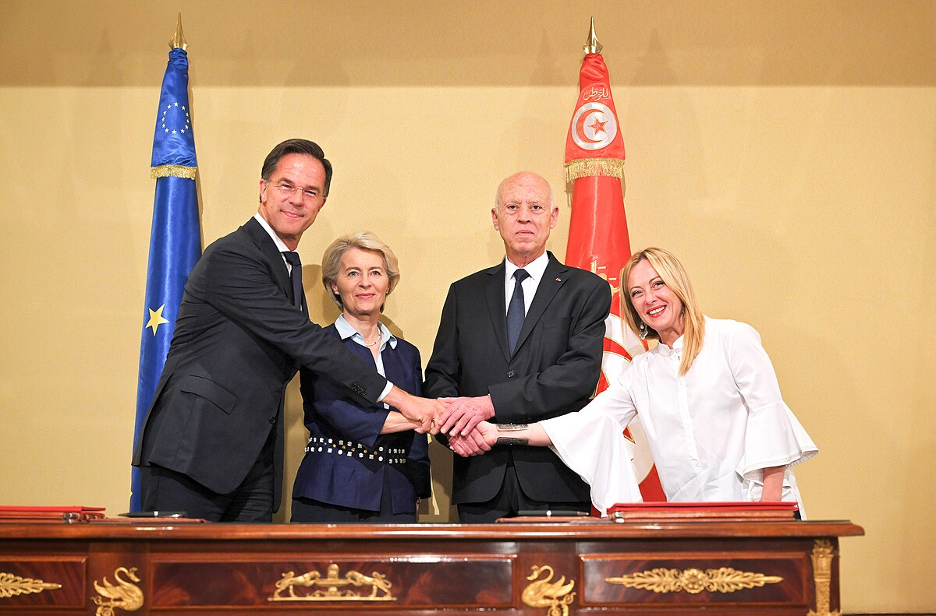
In July 2023, the EU finalised a deal with Tunisia to tackle irregular migration, which included £90 million to stop smuggling, strengthen borders and return migrants entering Europe.[29] It also involved providing money to Tunisia in areas such as trade, investment and energy cooperation.[30]
However, critics have highlighted that the deal failed to include any specific human rights guarantees for migrants and asylum seekers. Phillipe Dam from Human Rights Watch states that:
“demonstrates once again how the EU’s obsession with sealing its borders over saving lives enables partners like Tunisia to not only go unchallenged for abuses they commit, but to also pressure the EU for more financial aid.”[31]
The lack of protections is particularly concerning given Tunisia’s record on migrant rights. In 2023, the same year that the new deal was signed, reports revealed that Tunisian security forces were committing serious human rights violations against black African migrants, refugees and asylum seekers. This included beatings, use of excessive force, some cases of torture, arbritary arrests and detention, collective expulsions, forced evictions, and theft of belongings.[32]
It is important to note that the EU purportedly backed the popular uprising in Tunisia in 2011, expressing solidarity with the Tunisian people after the dictatorship was toppled.[33] Yet now they appear willing to make deals and provide financial support to the new dictatorship that has formed in Tunisia. Tarek Megerisi, Senior Policy Fellow at European Council on Foreign Relations, suggests that European governments “have the tools to support Tunisian reform and resilience if they can look beyond short-term migration management.”[34] He argues that Europe should make future aid conditional on legal reforms and protection of civil liberties in order to incentivise reform and put pressure on Tunisian authorities to uphold Tunisian law.[35]
Human Rights Watch echoes this, stating that:
“the EU leadership should end its silence, publicly condemn the deteriorating human rights situation in Tunisia, and make it clear that future partnerships will be linked to genuine human rights progress and key reforms.”[36]
Similarly, the International Federation for Human Rights called on the EU to:
“reevaluate all ongoing cooperation agreements with the Tunisian government and to make them strictly conditional on the respect of human rights, as well as to provide increased support to Tunisian civil society, the last remaining guardian of democratic hopes in the country.”[37]
Conclusion
It is clear that Tunisia has experienced a return to dictatorship, despite once being a beacon of hope for democratic reform in the region. In particular, the right to freedom of expression is being restricted through the use of arbitrary detention to suppress and silence opposition, including human rights defenders. This trend is epitomised by the high profile “Conspiracy Case”, which has been met with widespread criticism. Despite this, the European Union has remained relatively silent on both this case and wider violations in Tunisia, despite being a key partner actively giving financial aid to a government restricting people’s freedoms.
This has been interpreted by critics as a prioritisation of migration control due to the EU-Tunisia migration deal signed in 2023, rather than encouraging a return to democracy in the country. This is particularly relevant given that migrants and refugees have themselves been victims of human rights violations in Tunisia, meaning that migration control deals with the country potentially putting more migrants and refugees at risk. However, such financial aid and deals in fact put the EU in a strong position to incentivise reform by making further aid conditional on human rights protections.