
Background
On 1 March 2025, Israel and Hamas announced the conclusion of a two-month truce, a development that provoked the obstruction of the external humanitarian missions and import of essential to subsistence supplies to the Gaza strip.[1] According to the World Health Organisation (WHO), this situation exacerbated the adverse living conditions like malnutrition and disease for Palestinians, primarily for children.[2]
The essence of this reality has been concentrated in two phenomena, the systematic blockage of humanitarian missions and the premeditated destruction of water infrastructure in the Gaza strip by Israel. A recent manifestation of the former case concerns the seizure of the Madleen, a ship carrying humanitarian aid bound for Gaza crewed by Greta Thunberg and other activists. The individuals aboard were detained after their arrival at Israel’s port of Ashdod on 2 June.[3] The second phenomenon has demonstrated that Israel’s military forces have targeted water facilities supplying the Palestinian people, leading to a shortage of potable water and inadequate wastewater sanitation. Both phenomena contributed to the insufficient availability of hygiene kits, menstrual products and a shortage of water containers, which has rendered vulnerable groups —especially women and children —more susceptible to infections, exuding a loss of dignity in already dire conditions.[4]
The afore-mentioned actions by Israel are not a one-off mistake, rather they appear to be part of a consistent policy of denial of access to water and basic needs. Beginning in October 2023, at the onset of the war, Israel imposed a full blockade on the Gaza Strip, cutting off access to essential resources. Despite the temporary ceasefires on 24 November, 2023 and 19 January 2025 that enabled a slight amelioration of the state of Palestinians, another hunger crisis took shape in the Gaza strip in March 2025.[5] Throughout the 18-month conflict in Gaza, Israel has regularly “weaponised” water and international humanitarian aid in order to exert pressure against Palestinian people, according to the Hamas-run Health Ministry.[6]
As a consequence, a minimum of 60.000 children in the Gaza Strip now face severe health risks from dehydration and malnutrition, with food shortages worsening amid Israel’s continued restriction of aid.[7] The unfolded succession of events sparked intense debate regarding the lawfulness of Israel’s actions and their compliance with International Humanitarian Law.
The ICC & the Palestine Crisis
In this regard, the Prosecutor of the International Criminal Court initiated an investigation into the Situation in the State of Palestine for potential criminal actions that fall within the jurisdiction of Rome Statute.[8] The Chamber advanced issuing warrants of arrest for two individuals, Benjamin Netanyahu and Yoav Gallant, for crimes against humanity and war crimes committed from at least 8 October, 2023 until at least 20 May, 2024, the day the Prosecution filed the applications for arrest warrants.[9]
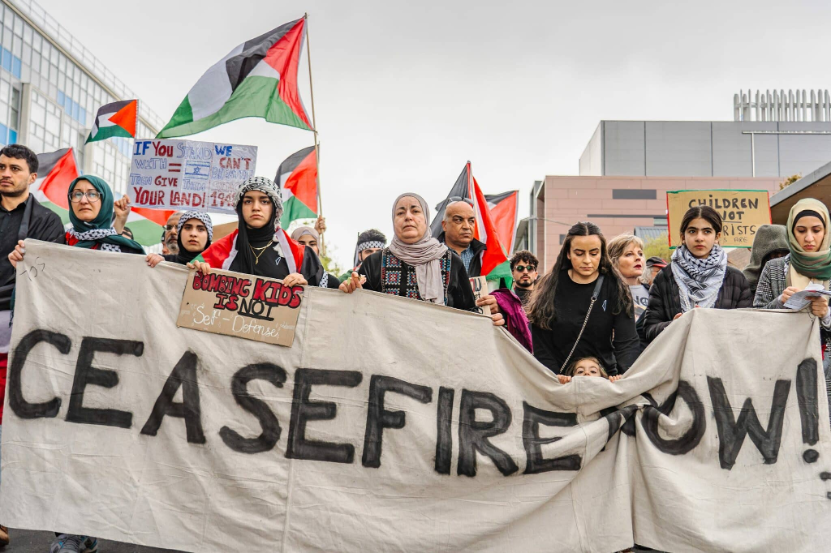
(Creative Commons Attribution 3.0 New Zealand (CC BY 3.0 NZ) 9 November, 2023
The Chamber seemingly found reasonable grounds to believe that, during the relevant time, IHL related to international armed conflict (IAC) between Israel and Palestine applied. This classification substantiated on Israel’s occupation of Palestinian territories since 1967, and the fact that both Israel and Palestine are parties to the 1949 Geneva Conventions (GC) as the Common Article 2 provides.[10] On the other hand, the conflict between Israel and Hamas was classified as a non-IAC, since Hamas is a non-state actor and its actions cannot be attributed to another state.[11] Taking all these into consideration, the Court established that the GC and the Additional Protocol I (API) apply in the case of Palestinian occupation governing the conduct of hostilities and the protection of civilians, whereas the Israel-Hamas hostility is regulated by Common Article 3 of the GC and the APII.[12]
In light of these preliminary considerations, the Chamber considered that there are reasonable grounds to believe that both individuals intentionally and knowingly deprived the civilian population in Gaza of objects indispensable to their survival, including food, water, and medicine and medical supplies, as well as fuel and electricity.[13] Evidence of this practice can be derived from the recent incident of the seizure of the Madleen, a civilian aid vessel part of the Freedom Flotilla Coalition directed to provide humanitarian aid in Gaza. The BBC reported that the crew was abducted and illegally detained by Israel’s naval forces, on 9 June 2025, violating their IHL obligations.[14] Due to the persistent blockade, there was a severe shortage of medical supplies and medication. According to verified reports, doctors had no choice but to perform surgeries and amputations – even on children – without the use of anesthetics, subjecting them to intense pain.[15]
Based on the evidence submitted by the Prosecution, the Chamber concluded that the two individuals bear criminal responsibility for the war crime of starvation as a method of warfare. Yet, it could not determine that all elements of the crime against humanity of extermination were met.[16] Nonetheless, the Chamber did find that there are reasonable grounds to believe that the crime against humanity of murder was committed against these victims, under Article 7(1)(a) of Rome Statute.[17]
Deprivation of Essentials Under the Scope of IHL
In the context of the intentional and systematic deprivation of essentials, Israel’s destruction of Gaza’s water infrastructure and the denial of access to clean water for Palestinians amid its ongoing war are creating a mounting humanitarian catastrophe. It seems that this development constitutes part of a widespread and systematic attack against the civilian population of Gaza, raising discourse around the compliance with IHL.[18]
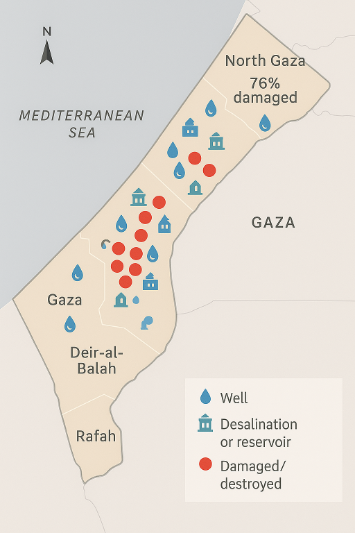
Since October 2023, Israel’s military operations have resulted in the destruction of approximately 70% of Gaza’s water infrastructure, including desalination plants, pipelines and wells, crippling the region’s capacity to provide clean water.[19] Around 180 kilometers of water networks have been damaged or destroyed, raising serious concerns about deliberate targeting of essential civilian infrastructure.[20] Notably, on 29 July, 2024, the 401st Brigade bombed a drinking water reservoir in Rafah without authorisation from senior command, and on 25 January 2025, the Palestinian Water Authority reported that Israeli forces destroyed the only water desalination plant serving northern Gaza and Wadi Gaza.[21] Under IHL, particularly Article 54 of API and Customary IHL Rules 53 and 54, objects indispensable to civilian survival, such as water installations, are afforded special protection.[22] These provisions prohibit attacks on water infrastructure and the use of deprivation of water as a method of warfare. In this context, legal experts and humanitarian bodies have argued there was no clear military necessity justifying such actions, and that these measures may constitute unlawful targeting of civilian needs and obstruction of humanitarian relief.[23]
Another alarming phenomenon made its occurrence one month ago, which unveils that the aid distribution mechanism was designed to contribute to the extermination of Palestinians. Without including the latest deaths, the UN has said that more than 410 Palestinians are reported to have been killed by Israeli gunfire or shelling since the Gaza Humanitarian Foundation (GHF) began work in late May.[24] It is remarkable that children constitute the major victims of these attacks, as they attempt to collect food at distribution points.[25] This phenomenon coupled with the general blockage of humanitarian missions reflects an alleged “weaponisation” of humanitarian aid, which has a nuanced correlation with IHL. Besides the principle of distinction between combatants and non-combatants solidified on Article 48 API, targeting humanitarian aid workers, convoys, or locations where aid is being distributed contravenes Article 70 API.[26] Therefore, Israel shall refrain from methods of warfare that either cannot distinguish between civilians and combatants or deny or misuse access to food, water, and humanitarian aid, following additionally the provisions of Articles 51(4)-(5) and 54 API.[27]
In light of the scale, pattern and apparent intent behind the destruction of Gaza’s water infrastructure and the deliberate targeting of humanitarian aid missions, these actions have raised serious concerns of violations of IHL. The overall policy that has caused disproportionate harm to objects essential for civilian survival may amount to war crimes under international legal standards, hence it is essential to assign responsibility.[28]
The Right to Water & Health
Apart from IHL, Israel’s actions fall within the scope of International human rights law and of the International Covenant on Economic, Social and Cultural Rights (ICESCR), which apply to its conduct as an occupying power in the West Bank and the Gaza strip. The Committee on Economic, Social and Cultural Rights (CESCR) has repeatedly reiterated that states must comply with certain core obligations that represent the minimum essential levels of these rights, non-compliance with which cannot be justified even in times of conflict, as they are non-derogable.[29]
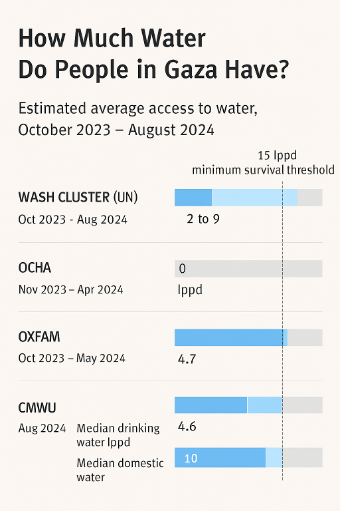
A fundamental right is the right to water, which has been affirmed by reference to the right to an adequate standard of living in article 11(1) of the ICESCR, while the CESCR elaborated the particular qualities of this entitlement in its General Comment No. 15.[30] In this comment the Committee elaborated the particular qualities of this entitlement, setting 15 litres of water as a minimum level of subsistence according to international standards.[31] The right contemplates a degree of adequacy in the sense that it is accessible to individual users, both physically and economically. Despite these international standards, various estimates of average water access indicate a shortage of water in Gaza’s territory. Oxfam and Human Rights Watch found that much of the water infrastructure it and its partners built or repaired between 2017 and 2023 has been damaged or destroyed by Israeli attacks since 7 October 2025, leaving it largely inoperable.[32] Consequently, between October 2023 and August 2024, the Water, Sanitation and Hygiene (WASH) Cluster and United Nations (UN) agencies reported average water access in Gaza ranging from 2 to 9 litres per person per day —well below the 15-liter survival standard— while UN Office for the Coordination of Humanitarian Affairs (OCHA) and the Coastal Municipalities Water Utility (CMWU) in Gaza Strip reported no access to potable water in northern Gaza between November 2023 and April 2024.[33]
Likewise, Israel was committed to safeguarding the right to health as a party to ICESCR.[34] Article 12(1) of the ICESCR provides a “right of everyone to the highest attainable standard of physical and mental health”.[35] While the Covenant does not articulate a right to be healthy, it rather recognises the right to enjoy high standards of health with positive obligations. General Comment No. 14 stressed the core obligation with a twofold nature. On the one hand, they require the provision of adequate health care services, while on the other they oblige the authorities to satisfy the underlying determinants of health, including basic shelter, food, water, sanitation, disease prevention and others.[36] Contrary to these obligations, news outlets reported Israel to damage 32 out of 36 hospitals in Gaza, rendering only 16 partially functioning, as of August 20, 2024.[37] The WHO reported that of the 16, 12 are partially accessible due to insecurity or physical barriers, such as damage to both patient and ambulance entrances, and surrounding roads.[38]
These patterns suggest a failure to fulfill Israel’s legal responsibilities as an occupying power under IHRL and they may constitute violations of peremptory norms that are impermissible even in times of conflict. The situation underscores the urgent need for accountability and the restoration of basic human rights protections for the Palestinian population in Gaza.[39]
Conclusion
All things considered, the documented and escalating destruction of Gaza’s water infrastructure in conjunction with the systematic obstruction and “weaponisation” of humanitarian aid constitutes a grave humanitarian crisis with profound legal implications. The fundamental provisions of IHL and its customary rules along with the right to water, health, and dignity are being egregiously undermined, as evidenced by the drastic reduction of per capita water access, widespread attacks on hospitals, and fatal assaults on civilians, including children, at aid distribution points. In this context, the legal discourse about the protection of non-combatants needs to be upheld more than ever during these critical times amid the newly erupted war between Iran and Israel.[40] Urgent accountability and independent investigation are required to assess the legality of these attacks and to ensure the protection of civilians and humanitarian infrastructure in accordance with the principles of distinction, proportionality, and necessity.[41]