Introduction
A recent report from Radio Free Europe/Radio Liberty’s Turkmen service, Azatlyk, has revealed that officials in Turkmenistan’s eastern Lebab Province have begun requiring that new parents name their children using traditional Turkmen names. While this is reportedly not a new practice, it was previously a suggestion rather than a rule.1 Though Turkmenistan’s opaque government and the limited availability of independent news sources make it difficult to reliably verify reports, the new law would prohibit ethnic minorities such as Uzbeks, Tajiks, and Russians from choosing names to reflect their own cultures and languages.
The Lebab province spans the majority of Turkmenistan’s shared border with Uzbekistan, as well as a small segment of Afghanistan. Given its close proximity to Uzbekistan and the historical lack of a border separating the two areas, this region has long been home to a high concentration of ethnic Uzbeks. The history of these two ethnic groups is intertwined, from families spanning across both sides of the border and conversations a jumble of both Uzbek and Turkmen languages.2 This new law ignores this shared history and cultural heritage and aims to create a homogenous population, or at least the appearance of one, where it does not exist.

Turkmenization
As of 2022, Turkmens account for a vast majority (86.7%) of Turkmenistan’s ethnic makeup. Uzbeks make up roughly 9.1% of the population, followed by Russians (1.6%) and Balochis (1.2%). This is a marked difference from 2003 data, where Turkmens accounted for 85%, Uzbeks made up only 5% of the population and Russians represented a healthier proportion (4%) of the county. 3 Uzbeks make up a sizable—and growing—proportion of the population. Thus, while Turkmens largely dominate the ethnic makeup of Turkmenistan, they are not alone in the country, as this policy, and others like it, may aim to represent.
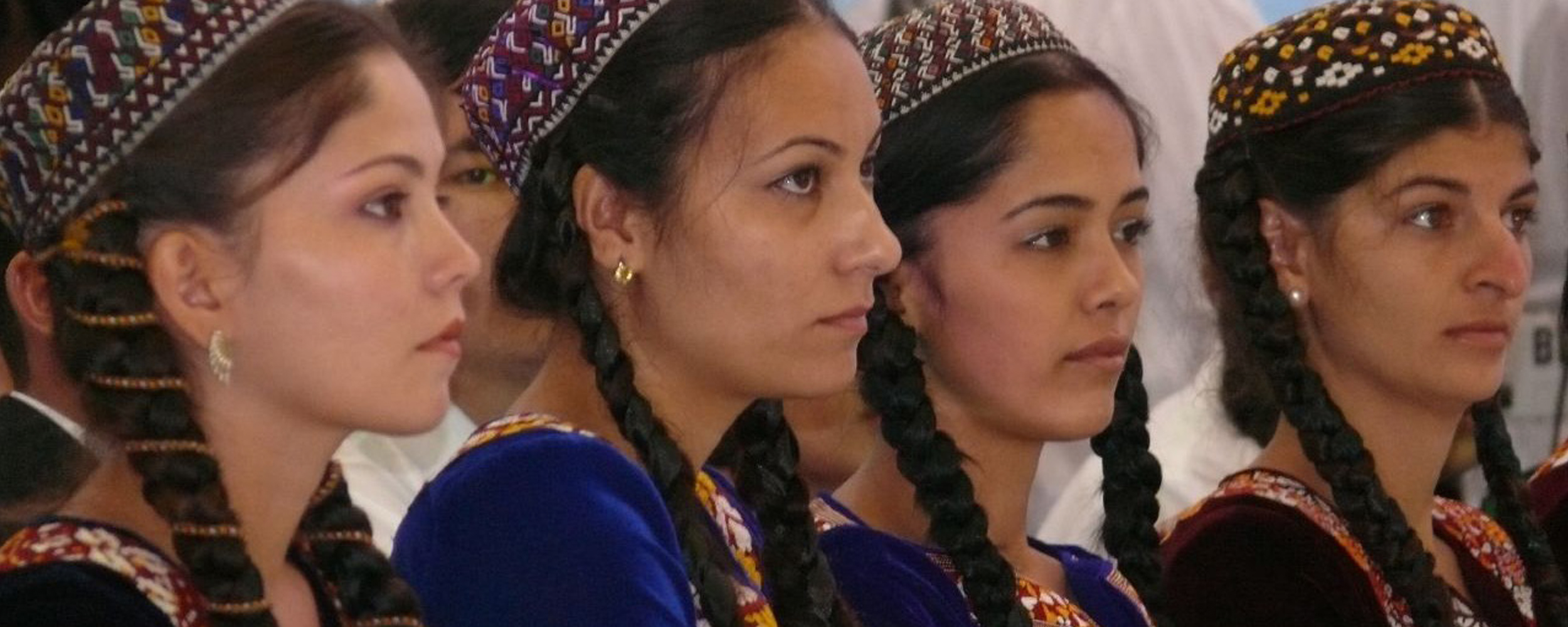
The suppression of ethnic minorities is not a new phenomenon in Turkmenistan. The current development is just one in a long series of policies in what has been coined as the process of “Turkmenization.” Turkmenization refers to the enforcement of policies and practices designed to force minorities to adopt Turkmen culture. This trend began in the early 1990s with the collapse of the Soviet Union and the appointment of Saparmurat Niyazov as Turkmenistan’s first president. 4 His lengthy rule saw the beginning of a series of bans and requirements—now referred to as Turkmenization—which restricted minorities’ freedom of expression. In the 1990s, Russian language instruction was suppressed. In the early 2000s, schoolgirls were required to dress in traditional Turkmen attire, barring those without the obligatory garb from attending. In 2003, dual citizens of both Russia and Turkmenistan were required to choose between the two nationalities, and those who wished to maintain both were refused Turkmen passports, prompting many to leave Turkmenistan in favour of their Russian citizenship. 5

Long after Niyazov’s death in 2006, Turkmenization policies are still prevalent and expanding. In addition to the ban of non-Turkmen baby names in the Lebab region, a law in March 2025 dictated that young women, already required to wear traditional Turkmen dresses, must wear either yellow headscarves or yellow dresses to denote their marital status, punishable by firing. 6 Newlyweds are now prohibited from playing foreign music at their wedding celebrations, given verbal instructions at registry offices to avoid such music when applying for marriage licenses. 7 For decades, state officials have been required to provide proof of Turkmen lineage going back three generations. Since 2006, the government has expelled many young Uzbek women and their half-Turkmen children from Turkmenistan, leaving them at the Uzbek border. 8 These are just several of the more prominent, and known, examples of Turkmenization. As can be seen, these policies are aimed at the expulsion and concealment of ethnic minorities and their cultures, in favour of a Turkmenistan for and of ethnic Turkmens. Ethnic diversity, both via population size and freedom of cultural expression, is under threat.
One’s Name; One’s Identity
This latest development—the requirement that newborn children be given traditional Turkmen names—is problematic for a multitude of reasons. Not only because it is yet another act in a long history of ethnic suppression, but because of the individual and personal implications for one’s identity. Psychologists have long recognized that a name carries more meaning than simple semantic representation. In particular, first names serve “as an identity marker for the individual and for those who interact with him or her.” 9 Parents’ choices as to what to name their children reflect a consequential decision as to how they would like their children to be perceived by not only those close to them, but the community broadly. This is particularly the case for immigrants or those from ethnic minorities, as they are often faced with the decision between culturally assimilative names or those reflecting their personal cultural identities.
Names are intrinsically tied to one’s sense of self, and a key component of many’s self identity is their cultural background. 10 By forbidding parents to name their children according to their culture’s customs and traditions, Turkmenistan potentially interferes with these children’s understanding of themselves and their personal and cultural identities. They threaten the cultural wealth of ethnic minorities by robbing next generations of the same personal connection to their culture via their names.
A closer look at the naming customs of Uzbeks, the largest minority in Turkmenistan, demonstrates the specific importance of naming customs in the region and the consequences of infringing on these customs. According to Uzbek scholar and pedagogist Gulshoda Avloyorova, many Uzbeks believe that the name given to a newborn child will determine their path forward—their health, future life, and more. Considering this, men have traditionally been given names that represent “strength, courage, bravery, and patriotism”. Women’s names are inspired by “beauty, chastity, purity, elegance, and sophistication”. 11
Thus, a name represents new parents’ hope for their child. It is much more than simply a label or moniker; a name holds personal and cultural value.
While the mandate that children have Turkmen names may seem trivial when considered amongst the vast array of serious and life-threatening human rights violations occurring both across the world and specifically within Central Asia, it should not be ignored. Naming is a personal, and often profound, decision, and one that should be entirely the choice of the parents or the individual. To restrict this choice by imposing naming requirements of any kind, let alone those of a different cultural identity, is a violation of universal human rights.
According to the United Nations Educational, Scientific, and Cultural Organization’s Universal Declaration on Cultural Diversity, “Cultural rights are an integral part of human rights, which are universal, indivisible and interdependent….All persons should therefore be able to express themselves and to create and disseminate their work in the language of their choice, and particularly in their mother tongue; all persons should be entitled to quality education and training that fully respect their cultural identity; and all persons have the right to participate in the cultural life of their choice and conduct their own cultural practices, subject to respect for human rights and fundamental freedoms”.12 The various policies of Turkmenization, including the Turkmen naming mandate, clearly violate these universal human rights dictated by the United Nations.
Conclusion
Names are an integral part of a culture’s customs and traditions, and psychological research and works demonstrate their impact on individual identity and personal cultural connection. Turkmenistan continues to enact policies which threaten universal human rights, specifically those related to cultural expression and identity.
The recent naming restriction is just one of the latest of such instances. Unfortunately, there is little evidence suggesting the new development will be the last of such policies, unless serious changes are made.