
© Photo by USAID U.S. Agency for International Development via Flickr
by Chris Fitzgerald, Sabrina Lavrut, Saher Husain, Fatima Umar and Marta Verano Sánchez
- The international community tip toes towards official recognition of the Taliban (Chris Fitzgerald)
Recent events suggest the world is getting closer to recognising the Taliban as the official government of Afghanistan. Early this month the Taliban sent its first Ambassador to China, its first officially accredited envoy, and follows the first official meeting between Kabul and the United States in Qatar since the return of the Taliban in August 2021. This suggests a warming of relations, with some, such as China, seeing a beneficial economic, while others, like Uzbekistan, see the Taliban as a partner in tackling Islamic extremism. However, all states, including China, have stressed that the Taliban needs to form an inclusive government and respect the human rights of women and minority groups if it is to be officially recognised and for it to gain Afghanistan’s seat at the United Nations. Whether states will preference political convenience in recognising the Taliban and potential economic opportunities through trade rather than an ultimatum to respect human rights will be the decision to watch in early 2024.
- Turkmenistan’s women rights under scrutiny in the upcoming 2024 CEDAW review (Sabrina Lavrut)
This year, women in Turkmenistan will continue to face significant challenges. Domestic violence remains prevalent, with one in six women experiencing it in their lifetime. Moreover, state-promoted patriarchal attitudes and gender-based discrimination are prevalent and continue to restrict women’s fundamental rights. Nearly 60 per cent of Turkmenistan’s women cannot make independent decisions on healthcare, contraception and consenting to sex. In January and February 2024, The United Nations Committee on the Elimination of Discrimination (CEDAW) will review Turkmenistan’s women’s rights record which could bring international attention to this issue, but the onus is on the Turkmenistan’s government to drive change through policy, legislation and education.
- Russia’s war in Ukraine will continue and will distance Central Asia from its former hegemon (Chris Fitzgerald)
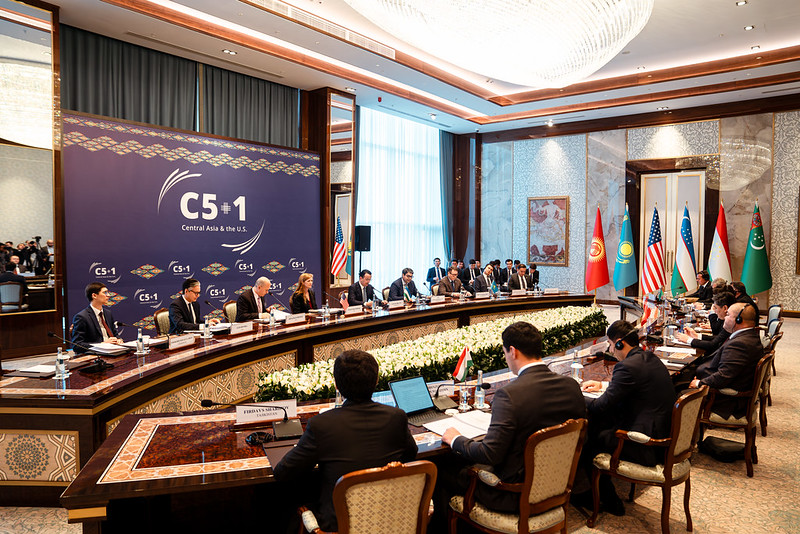
Russia’s illegal invasion of Ukraine will continue well into 2024, keeping Russia’s focus away from Central Asia, leaving the region to seek relationships elsewhere. 2022 and 2023 saw Central Asian states distance themselves from Russia and its actions in Ukraine to varying extents, and this will continue in 2024. Kazakhstan, Kyrgyzstan, Tajikistan, Uzbekistan and Turkmenistan have meet with the United States, the European Union and China this year and this reflects the regions desire to hedge its bets and seek better political and economic relationships in the west and east. Russia loses in this scenario. While it has seemingly lost Ukraine forever, it will also see its southernly neighbours drift further away. 2024 will see the region develop a more confident, independent foreign policy separate to that of Russia.
- The Japarov government in Kyrgyzstan will continue to attack freedom of religion (Saher Husain)
Attacks on freedom of religion isn’t new to Central Asia, with all government’s keen to supress Islamic groups, which they see as a threat to their power. In 2024, Kyrgyzstan in particular will likely encounter a rise in transgressions against the fundamental right to freedom of religion. November last year saw the Kyrgyz government propose a draft of a new religion law. While the current law On Freedom of Religion and Religious Organizations is already restrictive in nature for religious groups, the new draft legislation is believed to be even more extreme. Further, last year saw a marked increase in arbitrary arrests, closure of religious places, bans on religious materials, and unjustified denials of registration of religious communities by the government. As parliamentary discussions on the proposed legislation and amendments take place in 2024, their potential passage is likely to compound growing concern over a crackdown on freedom of religion.
- President Mirziyoyev will continue to attack press freedom in Uzbekistan (Chris Fitzgerald)
2023 saw promises of liberal reforms and a ‘New Uzbekistan’ evaporate under re-elected President Shavkat MIrziyoyev and saw what remains of the independent press harassed, threatened and penalised by the Uzbek authorities. Next year will likely be no different. Mirziyoyev appears willing to ignore Uzbekistan’s international legal obligations and criticism from human rights groups in favour of strengthening his rule via a compliant media. Next year will likely see Uzbekistan come under louder criticism internationally as journalists and online bloggers continue to be targeted for criticising government decision making and instances of corruption. But, outside of criticism, it remains to be seen what the international community can do to combat attacks on press freedom in Uzbekistan from a distance. The United States and European Union would do well to remind Mirziyoyev of the importance of press freedom and tie any funding to human rights obligations.
- Pakistan’s forced expulsion of Afghans will make the humanitarian crisis in Afghanistan worse (Fatima Umar)
The humanitarian crisis in Afghanistan will continue. However, making the situation worse is the deportation of hundreds of thousands of unregistered Afghan refugees from Pakistan to Afghanistan. While millions of Afghans have sought refuge in Pakistan for decades, Islamabad’s patience has run out and it has sought to use the forced expulsion of vulnerable Afghans as a domestic political tool. The problem is that these people are being sent back to a dire humanitarian situation, where food insecurity and starvation is likely and where there are no jobs to pay for food or fuel. Pakistan is also sending many women, people from ethnic minority groups and former government officials into harm’s way under the Taliban, leaving many at risk of harassment or death. For these reasons the international community and human rights groups have been rightly critical of Pakistan’s actions and pressure needs to be placed on Islamabad in early 2024 to ensure that its decision does not put people in harm’s way and make an already bad situation in Afghanistan far worse.
- Central Asia will increasingly become an important region for international investment (Fatima Umar)
Last year saw the European Union and China continue to invest in Central Asia, seen with the first China-Central Asia summit and the second EU-Central Asia Economic Forum. 2024 will likely see economic and trade interest in the region continue, raising the geopolitical importance of Central Asia and seeing potential gains in terms of trade. However, there are risks. Increased involvement with China’s Belt and Road Initiative risks tying Central Asia to its eastern neighbour and creating an unequal, dependent relationship. This is already evident with Tajikistan owing 40 per cent of its external debt to China, and Kyrgyzstan owing 45 per cent of its external debt to Beijing. In 2023, Central Asia should diversify its relationships with both China and the European Union to avoid pitfalls and act as an important bridge between east and west.
- New outlooks for Central Asian regionalism (Marta Verano Sánchez)
Throughout 2023, Central Asia has continued to take steps towards increased regional cooperation. Last year’s Fifth Consultative Heads of State Meeting in Dushanbe produced some shy advances towards the institutionalization of Central Asian regionalism, with all countries leaning into collaboration and increased dialogue. This has taken place mostly in the form of a series of agreements to create common regional development projects to improve connectivity, youth policy, and health, as well as the consolidation of a yearly gathering of the five heads of state and the instruments to monitor and perpetuate the results of these common projects. At the same time, the five countries have repeatedly met with foreign world leaders as a united block, such as the meeting with US President Joe Biden. There is a trend towards a consolidated regional group, with shared interests and goals. This is likely to endure in 2024 at the next heads of state meeting, set to take place in Kazakhstan.
- Increased protagonism of infrastructure developments in the region (Marta Verano Sánchez)
Infrastructure developments have long been in the regional agenda due to the strategic location of Central Asia. Since Russia’s invasion of Ukraine, Central Asia has become increasingly regarded as an alternative trade route to Moscow. 2024 will see several countries vying for influence by investing in and supporting key infrastructural projects in the region, such as China’s Belt and Road Initiative. The Central Asian governments have also recognized the crucial role that well-connected infrastructure plays in fostering economic resilience as well as in fostering regional cooperation and bettering the region’s political position. 2023 saw the first exclusively regional agreement for transport cooperation and it is hoped this will start yielding results in 2024.
- Tensions between Kyrgyzstan and Tajikistan will decrease further in 2024 (Chris Fitzgerald)
Kyrgyzstan and Tajikistan have feuded for years, leading to periodic armed conflict between the two states. But this looks to be changing. Both Kyrgyzstan and Tajikistan have recently announced that 90 per cent of their shared border has been agreed upon and Kyrgyz President Japarov has stated he is hopeful for a full resolution in 2024. A peaceful resolution to border tensions between the two will hopefully end what has been a regional flashpoint over decades, one that has cost the lives of military personnel and civilians. In a broader sense, cooperation by feuding governments on delicate issues is a welcome regional development and – if successful – one that can act as a model for Central Asian diplomacy in 2024 and beyond.